

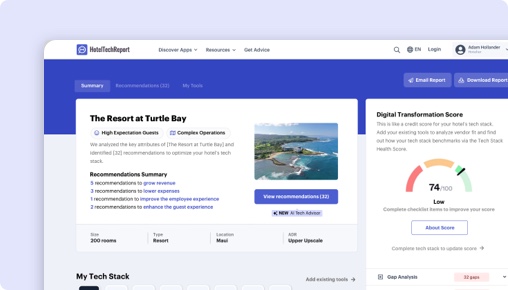
Sorry, this functionality is only available for verified hoteliers
The project dashboard is a free tool that is only available to verified hoteliers to make adopting new technology easier by streamlining their research and simplifying their communication workflow.

Avaya vs. Amadeus - HotSOS®:
Which Is Right for You?


TLDR
We analyzed 32 verified hotelier reviews, compared feature sets, pricing, and real-world case studies to break down where each platform delivers. The right choice depends on your property type and priorities:
Avaya shines in ease of use and customer support .
Amadeus shines when it comes to guest request management — especially for brand properties (3.8/5) , with exclusive features like Mobile access on any device.
How Does Avaya Compare to Amadeus - HotSOS®?
Side-by-side ratings based on 32 verified hotelier reviews on HTR.
| HTScore |
|
|
| Likelihood to Recommend |
|
|
| Ease of Use |
|
|
| Customer Support |
|
|
| Value for Money |
|
|
| Starting Price | Contact sales | Contact sales |
| Verified Reviews | 1 | 31 |
What Are the Pros and Cons of Avaya vs Amadeus - HotSOS®?
After analyzing 32 verified reviews, Avaya users most value its , while Amadeus users highlight guest request management, ease of use, internal communication. Click any theme to see what reviewers say.
|
Avaya
|
Amadeus
|
|---|---|
| Pros | |
|
+
Guest Request Management
▾
|
|
|
+
Ease of Use
▾
|
|
|
+
Internal Communication
▾
|
|
|
+
Reporting and Analytics
▾
|
|
| Cons | |
|
−
Onboarding and Training
▾
|
|
|
−
Cost
▾
|
|
|
−
Technical Issues
▾
|
|
Avaya vs Amadeus: Rankings by Hotel Segment
How each product ranks among Staff Collaboration Tools vendors for different property sizes, types, and regions — based on verified reviews from hoteliers in each segment.
By Hotel Size
| Segment |
Avaya
|
Amadeus
|
|---|---|---|
| Small (10-24 rooms) | — | #19 0 reviews |
| Mid-Size (25-74 rooms) ▾ | — | #13 6 reviews |
| Large (75-199 rooms) ▾ | — | #10 6 reviews |
| X-Large (200+ rooms) | #22 1 reviews | #9 3 reviews |
By Property Type
| Segment |
Avaya
|
Amadeus
|
|---|---|---|
| Boutique ▾ | — | #15 7 reviews |
| Luxury ▾ | #27 1 reviews | #10 12 reviews |
| Branded / Chain | — | #13 4 reviews |
| Extended Stay | — | #22 0 reviews |
By Region
| Segment |
Avaya
|
Amadeus
|
|---|---|---|
| North America ▾ | — | #11 14 reviews |
| Europe | — | #16 0 reviews |
| Asia Pacific | — | #15 0 reviews |
| Middle East | #12 1 reviews | #6 1 reviews |
The Decision
Choosing between Avaya and Amadeus HotSOS® involves evaluating which staff collaboration tool aligns best with your hotel’s operational needs. Both address internal communication, task management, and operational efficiency but diverge significantly in their scope and integration capabilities. Avaya excels in unified communications, while HotSOS offers extensive hotel-specific features. Your decision hinges on whether you prioritize a communication platform or a comprehensive hotel operations system.
Avaya’s strength lies in its broad communication functionalities, making it suitable for hotels seeking a unified contact center and staff communication system. In contrast, HotSOS is tailored for operational management, offering specialized modules for maintenance, guest requests, and multi-department coordination. Do you need a communication-focused solution or an all-in-one hotel operations platform?
Is Avaya or Amadeus HotSOS® Better for Hotels?
If your hotel needs a versatile communication system that can integrate with existing contact centers, Avaya is the more suitable choice. It’s designed to streamline voice, video, and messaging channels, making team collaboration more efficient across multiple locations. However, its limited features tailored specifically to hotel operations might fall short if you require detailed task tracking or maintenance modules.
On the other hand, HotSOS dominates in hotel-specific operations management, with 21 unique features like lost & found, real-time task tracking, and preventative maintenance. It’s ideal for hotels that value detailed workflows, cross-department coordination, and operational analytics. If your hotel prioritizes operational efficiency and guest experience management, HotSOS is clearly the better fit.
Given the review data, Amadeus HotSOS has a stronger recent review footprint, with 31 reviews in the last six months and a higher overall score (3.97/5 vs. Avaya’s 4.5/5 but only one review). This recent activity indicates a more active user community and ongoing product improvements. Which of these strengths aligns more with your current needs?
Amadeus HotSOS® vs Avaya: Which Should Your Hotel Choose?
If your hotel needs detailed operational management—such as work order automation, preventative maintenance, or multi-property oversight—HotSOS is the clear choice. Its 21 specialized features and high user satisfaction (average 5/5 in several reviews) make it highly suitable for medium to large hotels or resort properties aiming for efficiency.
If your team requires a robust communication tool that supports guest interaction, staff collaboration, and contact center operations, Avaya is preferable. Its 5/5 ease of use rating and extensive global presence make it ideal for hotels that want to enhance internal and external communication channels without the need for deep operational modules.
For hotels seeking a comprehensive, hotel-centric operations platform with scalable features, HotSOS’s broader feature set and recent review activity give it an edge. Conversely, if your focus is on communication and guest interaction, Avaya’s simplicity and technical pedigree make it a compelling choice.
Is Avaya or Amadeus HotSOS® Easier to Use?
Avaya scores a perfect 5/5 for ease of use, with a straightforward interface that staff can quickly adopt across different departments. Its onboarding process is rated 4/5, indicating a smooth transition for teams familiar with unified communications. Users say it’s “easy for everybody,” making staff onboarding faster and reducing training time.
HotSOS, while rated slightly lower at 4.37/5, still offers an intuitive interface for hotel staff. Many reviews highlight its easy training and familiar tech interface, but onboarding can be more complex due to its extensive features. Some users note initial setup challenges, especially integrating with legacy systems.
Edge: Avaya.
Which Has Better Features: Avaya or Amadeus HotSOS®?
Avaya primarily offers core communication features, with no unique modules listed beyond its broad telephony, messaging, and conferencing tools. HotSOS, however, provides 21 distinct modules like lost & found, real-time task tracking, preventative maintenance, multi-property monitoring, and in-app translation. These tailored features significantly enhance hotel operations.
HotSOS’s feature count and specialization give it a clear advantage. It supports comprehensive workflows that are crucial for operational management, while Avaya remains a communication platform with limited hotel-specific functions.
Edge: Amadeus HotSOS.
Which Has Better Customer Support: Avaya or Amadeus HotSOS®?
Avaya’s customer support is rated 5/5, with reviews praising its responsiveness and expert assistance. Users describe the support team as “helpful and quick,” leading to fewer operational disruptions and smoother onboarding.
HotSOS’s support scores 3.76/5, with some reviews indicating slow responses and inconsistent service. While many users find the platform easy to learn once trained, support responsiveness for troubleshooting issues can be a concern.
Edge: Avaya.
Which Has More Integrations: Avaya or Amadeus HotSOS®?
Avaya boasts 1 verified integration partner—innRoad—limiting its connectivity options. HotSOS, however, integrates with over 104 verified partners, including major property management systems like Opera and other hospitality-specific tools. This extensive integration network allows HotSOS to fit seamlessly into most hotel tech stacks.
If your hotel relies on multiple systems, HotSOS’s broader integration capability makes it the more adaptable choice.
Edge: Amadeus HotSOS.
Which Do Hoteliers Rate Higher: Avaya or Amadeus HotSOS®?
Avaya’s single review rates it a 4.5/5, emphasizing its technological innovation and network expansion needs. Since it has just one review, the rating is less representative of wide user sentiment but indicates a positive outlook from that user.
HotSOS, with 31 reviews and an average rating of 3.97/5, shows a consistent, active user base. Hotels in resorts and multi-department properties tend to rate it highly for operational improvements, with recent reviews praising its efficiency.
Given the more extensive and recent review data, HotSOS’s rating is more reliable.
Edge: Amadeus HotSOS.
How Much Do Avaya and Amadeus HotSOS® Cost?
Neither platform publicly discloses standard pricing, indicating customized quotes based on hotel size and needs. There are no free trials or flat-rate plans listed, which suggests pricing is likely tailored, possibly making HotSOS more costly for smaller properties due to its extensive feature set.
Budget-conscious hotels should inquire directly, but expect HotSOS to be a larger investment given its comprehensive modules.
What Type of Hotel Should Use Avaya?
- Hotels that need a unified communication solution for contact centers and staff collaboration.
- Properties seeking to enhance internal messaging, voice, and video channels.
- Hotels with existing infrastructure aiming for scalability across multiple locations.
- Teams that prioritize ease of use and rapid onboarding.
Not ideal if your hotel requires detailed operational workflows, maintenance modules, or multi-property monitoring.
Not ideal if...
- You need extensive hotel-specific features like preventative maintenance or real-time task tracking.
- Your operations depend on deep integrations with PMS systems.
- Cost is a primary concern for small or budget-limited properties.
What Type of Hotel Should Use Amadeus HotSOS®?
- Hotels aiming for comprehensive operational management, especially resorts and larger properties.
- Teams that want detailed work order, maintenance, and inspection modules.
- Properties with multiple departments needing centralized workflows.
- Hotels that value real-time operational insights and analytics.
Not ideal if...
- Your focus is primarily on internal communication rather than operational workflows.
- Your property is small and cost-sensitive, as HotSOS can be expensive.
- Your existing systems are not compatible with HotSOS’s integrations.
The Bottom Line for Hotels
Avaya offers a broad communication platform that excels in voice, video, and messaging, suitable for hotels looking to unify their staff communication channels. Its high customer support rating and ease of use make it a dependable choice for properties prioritizing internal and external communication.
HotSOS, with its 21 specialized modules and active recent reviews, is better suited for hotels that need detailed operational workflows, maintenance tracking, and multi-department coordination. Its extensive integrations and hotel-specific features make it a more comprehensive operational management solution.
If your hotel’s primary need is enhanced communication with minimal operational complexity, Avaya is the recommended choice. For properties focused on improving guest service and operational efficiency through detailed workflows, HotSOS is the superior option. Your decision should reflect whether your priority is communication or operational excellence.
Feature Comparison: Avaya vs Amadeus - HotSOS®
These are the features each vendor has configured, organized by feature group — the same data shown in the vendor dashboard. Expand a group to compare features side by side.
| Feature |
Avaya
|
Amadeus
|
|---|---|---|
|
▾
Task Management
|
|
|
| Work Prioritization | ||
| File Library Support (images, documents and videos) | ||
| Asset Tracking | ||
| Case Management | ||
| Inspection | ||
| Deep cleaning | ||
| Preventative maintenance module | ||
| Real time task tracking | ||
| Virtual logbook | ||
| Lost & found module | ||
| Late checkouts | ||
|
▾
Messaging & Collaboration
|
|
|
| Message Routing | ||
| Team goal setting (e.g. rewards sign-ups, satisfaction) | ||
| In app translation | ||
| Mobile access on any device | ||
|
▾
Escalations & Alerts
|
|
|
| Service Recovery/Escalation | ||
|
▾
Reporting
|
|
|
| Analytics dashboard | ||
| Multi-property portfolio monitoring | ||
| Print old records | ||
| Meter Reading | ||
| Compensation Tracking | ||
|
▾
Automation
|
|
|
| Automated Replies | ||
| Message Templates | ||
| Open API | ||
|
▾
Templates
|
|
|
| Message Templates |
Avaya vs Amadeus: The Bottom Line
What hoteliers love
HotSOS excels at managing guest requests by streamlining the process, allowing staff to place requests quickly and monitor their completion. This resu... HotSOS excels at managing guest requests by streamlining the process, allowing staff to place requests quickly and monitor their completion. This results in faster response times to guest needs, thereby improving guest satisfaction. However, there are some issues with entering requests manually and occasional glitches that cause delays.
Most users find HotSOS user-friendly and easy to teach to new employees. The interface supports multiple languages, which is beneficial in diverse hot... Most users find HotSOS user-friendly and easy to teach to new employees. The interface supports multiple languages, which is beneficial in diverse hotel environments. However, certain design elements and minor functions can be cumbersome and in need of improvement.
The tool greatly enhances internal communication by providing clear visibility of requests, assignments, and statuses across departments. This leads t... The tool greatly enhances internal communication by providing clear visibility of requests, assignments, and statuses across departments. This leads to better team coordination and accountability. Users appreciate the ability to communicate without phones, but some reviews highlight that miscommunication can still occur if the details are not clear or the recipient doesn't understand the request.
Where hoteliers push back
Users often find HotSOS challenging to onboard and train new staff. Many reviews note that the initial setup and programming are time-consuming and co... Users often find HotSOS challenging to onboard and train new staff. Many reviews note that the initial setup and programming are time-consuming and complicated, with some wishing for more comprehensive training resources. Nevertheless, once teams are trained, the software is perceived as easy to use.
HotSOS is generally viewed as an expensive solution, particularly for smaller properties. High consulting fees for customization and per-user costs ad... HotSOS is generally viewed as an expensive solution, particularly for smaller properties. High consulting fees for customization and per-user costs add to the financial burden, even though the features are deemed valuable.
Ranks higher for
Unique capabilities
Where the ratings diverge most
Frequently Asked Questions About Avaya vs Amadeus - HotSOS®
Can Avaya replace Amadeus - HotSOS®?
It depends on your requirements. Avaya and Amadeus - HotSOS® share many core Staff Collaboration Tools features, but each has unique capabilities. Avaya offers 1 verified integration partners, while Amadeus - HotSOS® offers 107. Review the feature comparison above to see where they differ before switching.
Which is better for small or independent hotels?
Small hotels should prioritize ease of use and fast onboarding. Avaya leads in ease of use at 5.0/5 vs 4.4/5. Look for transparent pricing and a trial or demo option. Filter reviews on each product page by property size to hear from hotels like yours.
Do Avaya or Amadeus - HotSOS® offer a free plan?
Avaya: No. Amadeus - HotSOS®: No. Neither product currently offers a free tier. Most Staff Collaboration Tools vendors offer demos or trials — request one from each to evaluate before committing.
How Does HTR Evaluate and Rank Avaya and Amadeus - HotSOS®?
The HT Score is a composite ranking that considers 4 criteria groups and over a dozen variables to help hoteliers objectively compare hotel technology products. Avaya has an HT Score of 0 and Amadeus has 23. Here is how the score is calculated.
| Criteria Group | Weight | What It Measures |
|---|---|---|
| Customer Ratings & Reviews |
|
How highly do users recommend this product? Ratings Score, Review Volume, Share of Voice, Review Depth, Review Recency, Success Stories ▾ The most heavily weighted factor. Analyzes average satisfaction ratings (likelihood to recommend, ease of use, support, ROI), total review count relative to category peers, review recency (at least 20 reviews in the trailing 6 months), and share of voice across unique hotel clients to detect selection bias. |
| Partner Ecosystem |
|
How highly do tech partners recommend this company? Partner Recommendations, Integration Quantity, Integration Quality ▾ Evaluates partner recommendations as expert votes of confidence, the number of verified integrations, and ecosystem quality — the average HT Scores of integration partners. Products with higher-quality integration ecosystems are more likely to deliver a connected tech stack. |
| Customer Centricity |
|
How customer-centric is this organization? Certified Support, Review Consistency, Profile Completeness ▾ Assesses whether the company has earned HTR Customer Support Certification, maintains consistent review collection over time (an indicator of feedback-driven culture), and keeps product profiles complete with capabilities, screenshots, pricing, and features. |
| Reach, Staying Power & Resources |
|
How extensive is this company's reach and resourcing? Geographic Reach, Staying Power, Company Resources, Trending Score ▾ Measures global presence (countries and regions served), years in business as a stability proxy, team headcount as a resource proxy, and a trending score based on trailing-twelve-month buyer inquiries, reviews, partner recommendations, and press activity. |
Customer ratings and reviews are by far the most important factor in the HT Score algorithm. HTR does not accept payment for higher rankings. All reviews are verified — only hotel industry practitioners with confirmed affiliations can submit ratings. View full HT Score methodology →
What Other Staff Collaboration Tools Comparisons Are Hoteliers Reading?
Explore more head-to-head comparisons based on verified hotelier reviews.





Contents
Get Your Free AI Analyst Report
Custom recommendations tailored to your property


Let´s lookup your hotel information
Still weighing your staff collaboration tools options?
A few popular systems from our staff collaboration tools guide — or let our AI score each one against your specific property in about two minutes.

