

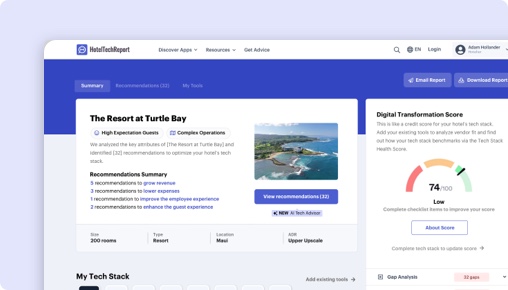
Sorry, this functionality is only available for verified hoteliers
The project dashboard is a free tool that is only available to verified hoteliers to make adopting new technology easier by streamlining their research and simplifying their communication workflow.

Amadeus – iHotelier® Central Reservations System (CRS) vs. Busy Rooms:
Which Is Right for You?

TLDR
We analyzed 58 verified hotelier reviews, compared feature sets, pricing, and real-world case studies to break down where each platform delivers. The right choice depends on your property type and priorities:
Amadeus shines in integration and usability — especially for city-center properties (4.6/5), with exclusive features like Reporting Dashboard.
How Does Amadeus – iHotelier® Central Reservations System (CRS) Compare to Busy Rooms?
Side-by-side ratings based on 58 verified hotelier reviews on HTR.
| HTScore |
|
|
| Likelihood to Recommend |
|
|
| Ease of Use |
|
|
| Customer Support |
|
|
| Value for Money |
|
|
| Starting Price | Contact sales | From $200/mo |
| Verified Reviews | 53 | 5 |
What Are the Pros and Cons of Amadeus – iHotelier® Central Reservations System (CRS) vs Busy Rooms?
After analyzing 58 verified reviews, Amadeus users most value its integration and usability, innovation and updates, analytics and reporting, while Busy Rooms users highlight . Click any theme to see what reviewers say.
|
Amadeus
|
Busy Rooms
|
|---|---|
| Pros | |
|
+
Integration and Usability
▾
|
|
|
+
Innovation and Updates
▾
|
|
|
+
Analytics and Reporting
▾
|
|
|
+
Revenue and Pricing Strategy
▾
|
|
| Cons | |
|
−
Customer Support
▾
|
|
Amadeus vs Busy Rooms: Rankings by Hotel Segment
How each product ranks among Hotel Reservations Software vendors for different property sizes, types, and regions — based on verified reviews from hoteliers in each segment.
By Hotel Size
| Segment |
Amadeus
|
Busy Rooms
|
|---|---|---|
| Small (10-24 rooms) ▾ | #8 8 reviews | #12 2 reviews |
| Mid-Size (25-74 rooms) ▾ | #6 23 reviews | #14 1 reviews |
| Large (75-199 rooms) ▾ | #3 12 reviews | #11 1 reviews |
| X-Large (200+ rooms) | #4 2 reviews | — |
By Property Type
| Segment |
Amadeus
|
Busy Rooms
|
|---|---|---|
| Boutique ▾ | #7 19 reviews | #13 2 reviews |
| Luxury ▾ | #6 18 reviews | #13 1 reviews |
| Branded / Chain ▾ | #4 16 reviews | #16 0 reviews |
| Extended Stay ▾ | #6 5 reviews | — |
By Region
| Segment |
Amadeus
|
Busy Rooms
|
|---|---|---|
| North America ▾ | #5 13 reviews | #10 1 reviews |
| Europe ▾ | #6 12 reviews | #9 2 reviews |
| Asia Pacific | #4 4 reviews | — |
| Middle East | #3 4 reviews | #8 1 reviews |
Is Amadeus – iHotelier® Central Reservations System or Busy Rooms Better for Hotels?
Amadeus iHotelier and Busy Rooms both serve as central reservations systems (CRS) for hotels but diverge in scale, market presence, and feature depth. Amadeus iHotelier fits a wide range of properties globally, including branded hotels, city center hotels, and mid-scale chains, supporting 29 countries with 107 verified integrations. Busy Rooms targets smaller portfolios focused on resorts and boutique hotels, with a footprint in 4 countries and 31 integrations verified, reflecting a more specialized but narrower reach.
Both products solve the core problem of centralizing reservation management, automating distribution across channels including OTAs, GDS, and direct bookings, and enabling revenue management. Amadeus emphasizes broad channel distribution and comprehensive analytics, while Busy Rooms highlights flexibility and brandability for resort groups and management companies.
Amadeus – iHotelier® Central Reservations System vs Busy Rooms: Which Should Your Hotel Choose?
If your property is a large branded hotel, city-center property, or a mid-scale chain operating across multiple international markets, Amadeus iHotelier’s extensive integrations (107 verified partners vs. Busy Rooms' 31) and presence in 29 countries establish it as the stronger choice. This conclusion is supported by its user base representing 12% branded hotels and 15% city center hotels, and 53 verified reviews averaging 4.4/5 overall.
If you manage a resort or boutique hotel within Europe or the Middle East, especially one requiring a flexible, brandable CRS with a smaller but highly rated system, Busy Rooms may suit better. Despite only 5 reviews and presence in 4 countries, it has a 4.9/5 overall rating and a 98% likelihood to recommend. However, the limited review volume and absence of recent reviews mean this rating is less representative of current performance compared to Amadeus.
For smaller independent hotels or niche segments like luxury resorts, Busy Rooms’ focus on customer support and tailored development may provide advantages. For properties needing advanced rate management and extensive reporting dashboards, Amadeus offers more specialized features.
Is Amadeus or Busy Rooms Easier to Use?
Amadeus holds a 4.4/5 ease of use rating with 53 reviews, while Busy Rooms reports 4.8/5 from only 5 reviews. Both score similarly on onboarding (4.1 vs. 4.5). Amadeus reviewers note an initial learning curve with comments like “a little difficult to understand the system at first” but find it user-friendly with daily use. Busy Rooms users emphasize flexibility and a “very user friendly” interface tailored to their needs, though some mention lengthy implementation.
Given the substantial difference in review count favoring Amadeus, the ease of use ratings are effectively even. Both products present manageable learning curves but require initial training. Staff adoption depends on property complexity and support during onboarding.
Edge: Even.
Which Has Better Features: Amadeus or Busy Rooms?
Amadeus offers 5 features that Busy Rooms does not: support for weekly and monthly rates, booking rules, cancellation policies, travel management company (TMC) management, and a reporting dashboard. These features enable more granular rate control, compliance with complex policies, and enhanced revenue insights—critical for hotels with diversified rate strategies and corporate bookings.
Busy Rooms shares 13 core features with Amadeus but lacks unique functionality. Its strength lies in flexible modular options and brandable interfaces rather than exclusive features.
For hotels needing advanced rate management and detailed reporting, Amadeus provides an operational advantage. For those prioritizing a flexible, modular system without those specific requirements, Busy Rooms is sufficient.
Edge: Amadeus.
Which Has Better Customer Support: Amadeus or Busy Rooms?
Amadeus achieves a 4.2/5 customer support rating from 53 reviews; Busy Rooms scores 4.8/5 from 5 reviews. Both products have onboarding ratings close enough (4.1 vs. 4.5) to call this category even.
Amadeus reviews praise professional and efficient support but flag delays and occasional lack of local training. For example, one negative review cited “account manager has no idea how the platform works,” indicating inconsistency. Busy Rooms receives accolades for responsiveness and personalized help, with one user highlighting a support executive as “a credit to your company” and essential to their success.
Given the volume difference and mixed feedback, customer support quality depends on your property’s regional location and expectations for responsiveness.
Edge: Even.
Which Has More Integrations: Amadeus or Busy Rooms?
Amadeus leads with 107 verified partners against Busy Rooms’ 31, a 245% difference. Both share 16 integrations including key PMS and marketing tools: Oracle Hospitality, Mews, Maestro PMS, and protel. Amadeus additionally integrates with specialized marketing platforms like Profitroom and RevControl, which support advanced distribution and revenue strategies.
Busy Rooms includes integrations unique to its market niche, such as Customer Alliance and Digital Hotelier, which may benefit properties focused on guest feedback and digital marketing in limited regions.
Hotels with complex distribution needs and multinational footprints will find Amadeus’s wider integration ecosystem critical. Smaller or region-specific properties may suffice with Busy Rooms’ curated partners.
Edge: Amadeus.
Which Do Hoteliers Rate Higher: Amadeus or Busy Rooms?
Amadeus has 53 total reviews averaging 4.4/5 overall; Busy Rooms has 5 reviews averaging 4.9/5. Neither product has reviews in the last 6 months, so ratings may not reflect current offerings.
Breaking down Amadeus by segment, city center hotels and boutique hotels rate it highest at 4.6/5 (19 reviews each). Luxury hotels and resorts rate it lower (4.1 and 4.0 respectively). Busy Rooms scores 4.9 to 5.0 in resorts and luxury hotels, though review counts are minimal (4 and 1 reviews respectively).
Amadeus’s broad review base offers a more representative rating. Busy Rooms’ higher rating is promising but less statistically reliable due to review volume and recency gaps.
Edge: Even.
How Much Do Amadeus and Busy Rooms Cost?
Neither Amadeus nor Busy Rooms publish pricing information or offer trials. Both platforms do not list base prices, monthly flat fees, per-room pricing, or implementation fees publicly.
Prospective buyers must engage vendor sales teams for custom quotes, which is typical for CRS software tailored to property size and complexity.
What Type of Hotel Should Use Amadeus – iHotelier® Central Reservations System?
- Hotels with diverse rate structures requiring weekly and monthly rate management.
- Properties needing sophisticated booking rules and cancellation policy controls.
- Mid-scale to large branded and city center hotels operating in multiple countries (29 supported).
- Hotels valuing deep integration with over 100 verified partners, including PMS and revenue management tools.
- Teams seeking comprehensive reporting dashboards for revenue and performance analytics.
Not ideal if:
- Your property is a small resort or boutique hotel with niche needs better served by a more flexible, brandable system.
- You require rapid onboarding and immediate simplicity without initial learning curve.
- Your hotel depends heavily on customer support responsiveness in underrepresented regions where Amadeus support has mixed reviews.
What Type of Hotel Should Use Busy Rooms?
- Resorts and boutique hotels seeking a cloud-based CRS with a brandable interface.
- Properties prioritizing flexibility in daily sales, marketing, and revenue management operations.
- Hotels in Europe and the Middle East looking for attentive customer support praised by users.
- Small to medium-sized properties not requiring advanced rate controls or detailed analytics dashboards.
Not ideal if:
- Your property demands complex pricing models like weekly/monthly rates or TMC booking management.
- You operate across many international markets requiring extensive third-party integrations.
- You need a large pool of verified integrations for global distribution and revenue optimization.
Amadeus – iHotelier® Central Reservations System vs Busy Rooms: The Bottom Line for Hotels
Amadeus iHotelier and Busy Rooms both tackle the central challenge of unifying hotel reservations and distribution, but they serve different hotel profiles. Amadeus delivers a mature, globally integrated CRS with advanced rate management and reporting suited to branded and city-center hotels with complex operations. Busy Rooms offers a high-rated, flexible, and brandable solution tailored to resorts and boutique hotels prioritizing ease of use and customer support.
Choose Amadeus if your hotel requires granular rate controls like weekly and monthly rates, cancellation policies, and TMC management, supported by a broad ecosystem with 107 integrations and presence across 29 countries. Its comprehensive reporting dashboard and scalability support complex revenue strategies.
Choose Busy Rooms if you manage a resort or boutique property valuing personalized support, flexibility, and a straightforward CRS that adapts to your brand. Its excellent user ratings and focused integrations fit smaller portfolios in select regions, despite limited review volume and fewer advanced features.
The data recommends Amadeus for hotels with larger, more complex distribution needs and Busy Rooms for smaller, guest-focused properties seeking attentive service and flexibility.
How Much Do Amadeus – iHotelier® Central Reservations System (CRS) and Busy Rooms Cost?
Hotel Reservations Software pricing is rarely straightforward. Here is what we know from each vendor's public pricing data. Always request a custom quote for your property size.
|
Amadeus
|
Busy Rooms
|
|
|---|---|---|
| Starting Price | — | From $200/mo |
Feature Comparison: Amadeus – iHotelier® Central Reservations System (CRS) vs Busy Rooms
These are the features each vendor has configured, organized by feature group — the same data shown in the vendor dashboard. Expand a group to compare features side by side.
| Feature |
Amadeus
|
Busy Rooms
|
|---|---|---|
|
▾
Content Management
|
|
|
| Content management | ||
| Guest profiles | ||
|
▾
Pricing Rules
|
|
|
| Geotargeted pricing module | ||
| Support for Weekly & Monthly Rates | ||
| Dynamic Pricing | ||
| Availability Management | ||
| Booking Rules | ||
| Cancellation Policies | ||
| TMC Management | ||
| Mobile App | ||
|
▾
Distribution
|
|
|
| Metasearch connectivity | ||
| Channel management & OTA distribution | ||
| Booking engine | ||
| TMC Management | ||
|
▾
Ecommerce
|
|
|
| Booking engine | ||
| Guest profiles | ||
| Refund Vouchers | ||
|
▾
Integrations
|
|
|
| RMS connectivity | ||
| PMS connectivity | ||
| Metasearch connectivity | ||
|
▾
Reporting
|
|
|
| Multi-property management | ||
| Reporting Dashboard | ||
| Reporting Dashboard | ||
| Mobile App | ||
|
▾
Admin
|
|
|
| Centralized user & role management | ||
| Multi-property management | ||
| Mobile App | ||
|
▾
Call Center
|
|
|
| Call center functionality |
Amadeus vs Busy Rooms: The Bottom Line
What hoteliers love
TravelClick is praised for seamless integration with various channels, GDS, and PMS systems such as Opera. However, concerns are noted regarding the c... TravelClick is praised for seamless integration with various channels, GDS, and PMS systems such as Opera. However, concerns are noted regarding the complicated OTA Sync implementation and the need for the platform to become more user-friendly. Several reviews highlight the long integration times and a few usability challenges that need improvement.
There are mixed reviews regarding the innovation and continuous updates to the platform. Some users appreciate the frequent enhancements and new featu... There are mixed reviews regarding the innovation and continuous updates to the platform. Some users appreciate the frequent enhancements and new features, while others feel that certain aspects, like iHotelier CRS, need more significant updates to remain contemporary and intuitive.
The analytics and reporting tools within TravelClick are highly valued by hoteliers for their ability to track performance and make informed decisions... The analytics and reporting tools within TravelClick are highly valued by hoteliers for their ability to track performance and make informed decisions. Users highlight the detailed business intelligence reports and market intelligence capabilities as critical components for strategy development.
Where hoteliers push back
The customer support of TravelClick is generally appreciated for being helpful, professional, and efficient. Several reviews note the responsiveness a... The customer support of TravelClick is generally appreciated for being helpful, professional, and efficient. Several reviews note the responsiveness and helpfulness of the support team, though there are mentions of delayed replies and insufficient training. The need for local support in various regions and more training options is also highlighted.
Ranks higher for
Unique capabilities
Frequently Asked Questions About Amadeus – iHotelier® Central Reservations System (CRS) vs Busy Rooms
Can Amadeus – iHotelier® Central Reservations System (CRS) replace Busy Rooms?
It depends on your requirements. Amadeus – iHotelier® Central Reservations System (CRS) and Busy Rooms share many core Hotel Reservations Software features, but each has unique capabilities. Amadeus – iHotelier® Central Reservations System (CRS) offers 107 verified integration partners, while Busy Rooms offers 31. Review the feature comparison above to see where they differ before switching.
Which is better for small or independent hotels?
Small hotels should prioritize ease of use and fast onboarding. Busy Rooms leads in ease of use at 4.8/5 vs 4.4/5. Look for transparent pricing and a trial or demo option. Filter reviews on each product page by property size to hear from hotels like yours.
Do Amadeus – iHotelier® Central Reservations System (CRS) or Busy Rooms offer a free plan?
Amadeus – iHotelier® Central Reservations System (CRS): No. Busy Rooms: No. Neither product currently offers a free tier. Most Hotel Reservations Software vendors offer demos or trials — request one from each to evaluate before committing.
How Does HTR Evaluate and Rank Amadeus – iHotelier® Central Reservations System (CRS) and Busy Rooms?
The HT Score is a composite ranking that considers 4 criteria groups and over a dozen variables to help hoteliers objectively compare hotel technology products. Amadeus has an HT Score of 73 and Busy Rooms has 0. Here is how the score is calculated.
| Criteria Group | Weight | What It Measures |
|---|---|---|
| Customer Ratings & Reviews |
|
How highly do users recommend this product? Ratings Score, Review Volume, Share of Voice, Review Depth, Review Recency, Success Stories ▾ The most heavily weighted factor. Analyzes average satisfaction ratings (likelihood to recommend, ease of use, support, ROI), total review count relative to category peers, review recency (at least 20 reviews in the trailing 6 months), and share of voice across unique hotel clients to detect selection bias. |
| Partner Ecosystem |
|
How highly do tech partners recommend this company? Partner Recommendations, Integration Quantity, Integration Quality ▾ Evaluates partner recommendations as expert votes of confidence, the number of verified integrations, and ecosystem quality — the average HT Scores of integration partners. Products with higher-quality integration ecosystems are more likely to deliver a connected tech stack. |
| Customer Centricity |
|
How customer-centric is this organization? Certified Support, Review Consistency, Profile Completeness ▾ Assesses whether the company has earned HTR Customer Support Certification, maintains consistent review collection over time (an indicator of feedback-driven culture), and keeps product profiles complete with capabilities, screenshots, pricing, and features. |
| Reach, Staying Power & Resources |
|
How extensive is this company's reach and resourcing? Geographic Reach, Staying Power, Company Resources, Trending Score ▾ Measures global presence (countries and regions served), years in business as a stability proxy, team headcount as a resource proxy, and a trending score based on trailing-twelve-month buyer inquiries, reviews, partner recommendations, and press activity. |
Customer ratings and reviews are by far the most important factor in the HT Score algorithm. HTR does not accept payment for higher rankings. All reviews are verified — only hotel industry practitioners with confirmed affiliations can submit ratings. View full HT Score methodology →
What Other Hotel Reservations Software Comparisons Are Hoteliers Reading?
Explore more head-to-head comparisons based on verified hotelier reviews.




Contents
Get Your Free AI Analyst Report
Custom recommendations tailored to your property


Let´s lookup your hotel information
Still weighing your hotel reservations software options?
A few popular systems from our hotel reservations software guide — or let our AI score each one against your specific property in about two minutes.


