

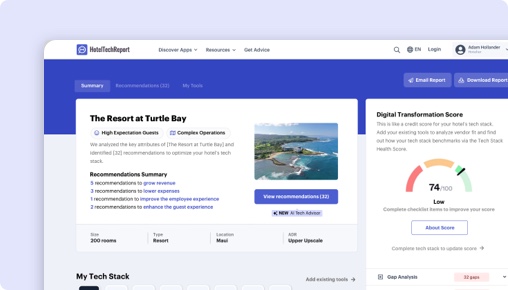
Sorry, this functionality is only available for verified hoteliers
The project dashboard is a free tool that is only available to verified hoteliers to make adopting new technology easier by streamlining their research and simplifying their communication workflow.

Akia Team Chat vs. D-EDGE Dmbook:
Which Is Right for You?


TLDR
We analyzed 36 verified hotelier reviews, compared feature sets, pricing, and real-world case studies to break down where each platform delivers. The right choice depends on your property type and priorities:
Akia shines in ROI and onboarding — especially for brand properties (5.0/5) , with exclusive features like Mobile Friendly and Guest History.
D-Edge shines — especially for brand properties (4.5/5) .
How Does Akia Team Chat Compare to D-EDGE Dmbook?
Side-by-side ratings based on 36 verified hotelier reviews on HTR.
| HTScore |
|
|
| Likelihood to Recommend |
|
|
| Ease of Use |
|
|
| Customer Support |
|
|
| Value for Money |
|
|
| Starting Price | From $500/mo | From $100/mo |
| Verified Reviews | 26 | 10 |
What Are the Pros and Cons of Akia Team Chat vs D-EDGE Dmbook?
After analyzing 36 verified reviews, Akia users most value its mobile accessibility for staff, guest communication and concern tracking, ai suggestions and learning, while D-Edge users highlight . Click any theme to see what reviewers say.
|
Akia
|
D-Edge
|
|---|---|
| Pros | |
|
+
Mobile accessibility for staff
▾
|
|
|
+
Guest communication and concern tracking
▾
|
|
|
+
AI suggestions and learning
▾
|
|
|
+
Cross-department communication
▾
|
|
| Cons | |
|
−
Mailbox organization and clutter
▾
|
|
|
−
AI on/off flexibility
▾
|
|
Akia vs D-Edge: Rankings by Hotel Segment
How each product ranks among Staff Collaboration Tools vendors for different property sizes, types, and regions — based on verified reviews from hoteliers in each segment.
By Hotel Size
| Segment |
Akia
|
D-Edge
|
|---|---|---|
| Small (10-24 rooms) ▾ | #4 9 reviews | #13 2 reviews |
| Mid-Size (25-74 rooms) ▾ | #8 10 reviews | #20 4 reviews |
| Large (75-199 rooms) | #21 1 reviews | #15 3 reviews |
| X-Large (200+ rooms) | #20 1 reviews | — |
By Property Type
| Segment |
Akia
|
D-Edge
|
|---|---|---|
| Boutique ▾ | #10 8 reviews | #21 4 reviews |
| Luxury ▾ | #16 6 reviews | #21 3 reviews |
| Branded / Chain | #11 3 reviews | #18 4 reviews |
| Extended Stay | #9 4 reviews | #14 3 reviews |
By Region
| Segment |
Akia
|
D-Edge
|
|---|---|---|
| North America ▾ | #6 23 reviews | #18 2 reviews |
| Europe ▾ | — | #9 5 reviews |
| Asia Pacific | — | #6 2 reviews |
The Decision
Choosing the right staff collaboration tool for your hotel hinges on understanding how each product addresses your internal communication needs. Akia Team Chat by Akia and D-Edge Dmbook by D-Edge both aim to streamline communication, but they diverge in features, user experience, and overall hotel fit. Akia excels in user ratings and recent reviews, making it the more reliable choice for up-to-date insights. Which of these tools will better serve your hotel’s operational flow?
Is Akia or D-Edge Better for Hotels?
Both Akia and D-Edge serve to improve internal communication, but Akia’s broader feature set and higher review scores suggest a more comprehensive solution. Akia offers 35 unique features, including photo sharing, chatbot booking, and real-time translation, whereas D-Edge provides a more streamlined approach with 0 additional features. While D-Edge’s primary strength lies in its simple, task-focused system, Akia’s versatility makes it more suitable for hotels needing detailed communication tools.
Review quantity further sets Akia apart, with 22 recent reviews compared to D-Edge’s 10, and its overall rating (4.95/5) surpasses D-Edge’s 4.67/5. The latest reviews reinforce Akia’s high user satisfaction, citing ease of use, excellent support, and notable ROI, while D-Edge’s reviews highlight its simple, effective handover capabilities but note less recent feedback. This suggests Akia’s continuous improvements and active user base make it a more dependable choice.
Are you prioritizing a highly-rated, feature-rich platform, or is a straightforward handover tool sufficient? The decision rests on your hotel’s complexity and communication needs.
Akia vs D-Edge: Which Should Your Hotel Choose?
If your hotel needs a highly flexible, feature-rich communication platform with advanced automation and multi-property monitoring, go with Akia. Its 35 specialized features, including chatbots, SMS messaging, and guest surveys, cater to hotels seeking deep operational integration.
On the other hand, if your hotel requires a simple, reliable handover and internal communication tool, especially for smaller or less complex operations, D-Edge’s straightforward approach might suffice. Its core strengths lie in reducing miscommunication, decreasing email volume, and providing real-time alerts within a familiar, easy-to-use interface.
If your team needs rapid, detailed communication capabilities with ongoing support, Akia’s extensive features and recent reviews favor it. Conversely, for a basic, task-oriented handover system, D-Edge’s simplicity and lower cost could be appealing.
Is Akia or D-Edge Easier to Use?
Akia’s ease of use is rated at 4.89/5, with recent reviews praising its intuitive interface, mobile app, and user-friendly onboarding. Users mention that Akia’s platform simplifies communication across departments and is quick to adopt, with some highlighting its responsive support team.
D-Edge follows closely at 4.65/5, with reviews describing its interface as simple, intuitive, and effective for internal communication. However, some users note that mobile optimization can be improved and that its fewer features make it easier to navigate for basic needs.
Edge: Akia.
Which Has Better Features: Akia or D-Edge?
Akia’s 35 features include photo sharing, chatbot booking, WhatsApp and Facebook Messenger integration, automated responses, guest history, message routing, real-time translations, task tracking, and more. These enable a highly customizable communication environment for hotels, especially those with complex operations.
D-Edge offers no additional features beyond its core communication functions but excels in straightforward handover and task management. Its primary advantage is simplicity, not breadth, making it less suitable for hotels seeking advanced automation or multi-channel messaging.
Edge: Akia.
Which Has Better Customer Support: Akia or D-Edge?
Akia’s support team enjoys a 4.82/5 rating, with recent reviews emphasizing responsiveness, professionalism, and quick issue resolution. Clients appreciate the proactive onboarding and ongoing assistance, which help maximize Akia’s extensive feature set.
D-Edge’s support scores 4.65/5, with reviewers praising its responsiveness and ease of access. However, some mention that support could be more proactive or faster, especially when integrating with other systems.
Edge: Akia.
Which Has More Integrations: Akia or D-Edge?
D-Edge’s 115 verified integrations include major property management and booking platforms like Stayntouch, SiteMinder, Oracle Hospitality, Mews, and Cloudbeds. Many of these integrations are critical for larger, tech-forward hotels seeking seamless operational workflows.
Akia, with 32 verified partners, covers key integrations such as Facebook Messenger, SMS, and booking systems like OpenHotel and WebRezPro. While fewer, Akia’s integrations are well-suited for contactless communication and guest engagement.
Edge: D-Edge.
Which Do Hoteliers Rate Higher: Akia or D-Edge?
Akia’s 22 recent reviews yield an impressive overall rating of 4.95/5, with users praising its ease of use, support, and ROI. Hotels of various segments, especially boutique hotels, rate Akia higher for its feature richness and responsiveness.
D-Edge’s 10 reviews give a solid 4.67/5, with property types like independent hotels and standard properties appreciating its simplicity and effectiveness. However, the less recent reviews suggest it may not be evolving as quickly as Akia.
Edge: Akia.
How Much Do Akia and D-Edge Cost?
Akia does not publish specific pricing details, implying a bespoke quote based on hotel size and needs. Its value is reflected in high user satisfaction and substantial ROI, making it a premium choice.
D-Edge charges a flat rate of $100 per month, offering a straightforward, predictable expense. Since Akia’s pricing isn’t public, consider your budget and the scale of your operations when comparing value.
What Type of Hotel Should Use Akia?
- Hotels that need a feature-packed communication platform with automation capabilities.
- Teams that operate across multiple properties and require centralized monitoring.
- Hotels prioritizing guest engagement through surveys, messaging, and contactless check-in.
- Properties aiming to improve internal workflows and staff communication.
- Hotels with tech-savvy staff comfortable with extensive features.
Not ideal if your hotel relies on basic communication needs or prefers a simple, low-cost solution.
What Type of Hotel Should Use D-Edge?
- Hotels that want a straightforward, easy-to-use internal communication tool.
- Properties with limited tech needs and minimal automation requirements.
- Hotels seeking to reduce miscommunication and streamline handovers.
- Smaller hotels or those new to staff collaboration tools.
- Hotels interested in a cost-effective, reliable communication system.
Not ideal if your hotel requires advanced automation, integrations, or multi-channel messaging.
The Bottom Line for Hotels
In summary, Akia offers a highly rated, feature-rich platform with extensive integration options, making it ideal for hotels seeking operational depth and guest engagement tools. Its recent reviews and high satisfaction scores demonstrate consistent value delivery.
D-Edge provides a simple, cost-effective solution focused on internal handovers and straightforward communication. Its broad integrations suit larger, tech-enabled hotels but lack the depth of Akia’s feature set.
If your hotel values comprehensive communication capabilities and ongoing support, Akia is the clear choice. For basic internal coordination with lower complexity and budget considerations, D-Edge remains a solid option.
Feature Comparison: Akia Team Chat vs D-EDGE Dmbook
These are the features each vendor has configured, organized by feature group — the same data shown in the vendor dashboard. Expand a group to compare features side by side.
| Feature |
Akia
|
D-Edge
|
|---|---|---|
|
▾
Task Management
|
|
|
| Work Prioritization | ||
| File Library Support (images, documents and videos) | ||
| Asset Tracking | ||
| Case Management | ||
| Inspection | ||
| Deep cleaning | ||
| Preventative maintenance module | ||
| Real time task tracking | ||
| Virtual logbook | ||
| Lost & found module | ||
| Late checkouts | ||
|
▾
Messaging & Collaboration
|
|
|
| Message Routing | ||
| Team goal setting (e.g. rewards sign-ups, satisfaction) | ||
| In app translation | ||
| Mobile access on any device | ||
|
▾
Escalations & Alerts
|
|
|
| Service Recovery/Escalation | ||
|
▾
Reporting
|
|
|
| Analytics dashboard | ||
| Multi-property portfolio monitoring | ||
| Print old records | ||
| Meter Reading | ||
| Compensation Tracking | ||
|
▾
Automation
|
|
|
| Automated Replies | ||
| Message Templates | ||
| Open API | ||
|
▾
Templates
|
|
|
| Message Templates |
Real-World Results: Akia vs D-Edge by Business Goal
We analyzed 1 verified case studies to compare what hotels actually achieve with each platform across four key business objectives.
Dylan Hotel NYC
Small
"Automation emphasizes the guests experience at their fingertips. Akia closes the gap of missed opportunities by acting as a liaison to our guest satisfaction efforts. We have been..."
 D-Edge
No published case study for this goal yet.
Akia vs D-Edge: The Bottom Line
What hoteliers love
Reviewers value being able to use Above on cellular phones, which lets staff handle guest concerns throughout the day while moving around the property... Reviewers value being able to use Above on cellular phones, which lets staff handle guest concerns throughout the day while moving around the property. The mobile workflow is seen as a practical advantage for frontline hotel operations.
Users say Above is especially useful for tracking guest messages, concerns, and follow-up tasks in one place. This helps staff stay on top of service... Users say Above is especially useful for tracking guest messages, concerns, and follow-up tasks in one place. This helps staff stay on top of service issues during the stay and respond faster to protect guest satisfaction.
Users mention that Above's AI remembers patterns and suggests actions, which speeds up work without replacing staff. The AI is viewed as helping teams... Users mention that Above's AI remembers patterns and suggests actions, which speeds up work without replacing staff. The AI is viewed as helping teams communicate more effectively and work faster across the organization.
Where hoteliers push back
One reviewer says the mailbox can feel more cluttered than necessary, which can make it harder to manage communications efficiently. This is a potenti... One reviewer says the mailbox can feel more cluttered than necessary, which can make it harder to manage communications efficiently. This is a potential friction point for teams handling high message volume.
Users specifically want more nuanced control than a simple AI on/off choice. This indicates concern that the current setup may be too binary for hotel... Users specifically want more nuanced control than a simple AI on/off choice. This indicates concern that the current setup may be too binary for hotels that want to balance automation with human judgment.
Ranks higher for
Unique capabilities
Ranks higher for
Where the ratings diverge most
Frequently Asked Questions About Akia Team Chat vs D-EDGE Dmbook
Can Akia Team Chat replace D-EDGE Dmbook?
It depends on your requirements. Akia Team Chat and D-EDGE Dmbook share many core Staff Collaboration Tools features, but each has unique capabilities. Akia Team Chat offers 32 verified integration partners, while D-EDGE Dmbook offers 117. Review the feature comparison above to see where they differ before switching.
Which is better for small or independent hotels?
Small hotels should prioritize ease of use and fast onboarding. Akia Team Chat leads in ease of use at 4.9/5 vs 4.6/5. Look for transparent pricing and a trial or demo option. Filter reviews on each product page by property size to hear from hotels like yours.
Do Akia Team Chat or D-EDGE Dmbook offer a free plan?
Akia Team Chat: No. D-EDGE Dmbook: No. Neither product currently offers a free tier. Most Staff Collaboration Tools vendors offer demos or trials — request one from each to evaluate before committing.
How Does HTR Evaluate and Rank Akia Team Chat and D-EDGE Dmbook?
The HT Score is a composite ranking that considers 4 criteria groups and over a dozen variables to help hoteliers objectively compare hotel technology products. Akia has an HT Score of 73 and D-Edge has 0. Here is how the score is calculated.
| Criteria Group | Weight | What It Measures |
|---|---|---|
| Customer Ratings & Reviews |
|
How highly do users recommend this product? Ratings Score, Review Volume, Share of Voice, Review Depth, Review Recency, Success Stories ▾ The most heavily weighted factor. Analyzes average satisfaction ratings (likelihood to recommend, ease of use, support, ROI), total review count relative to category peers, review recency (at least 20 reviews in the trailing 6 months), and share of voice across unique hotel clients to detect selection bias. |
| Partner Ecosystem |
|
How highly do tech partners recommend this company? Partner Recommendations, Integration Quantity, Integration Quality ▾ Evaluates partner recommendations as expert votes of confidence, the number of verified integrations, and ecosystem quality — the average HT Scores of integration partners. Products with higher-quality integration ecosystems are more likely to deliver a connected tech stack. |
| Customer Centricity |
|
How customer-centric is this organization? Certified Support, Review Consistency, Profile Completeness ▾ Assesses whether the company has earned HTR Customer Support Certification, maintains consistent review collection over time (an indicator of feedback-driven culture), and keeps product profiles complete with capabilities, screenshots, pricing, and features. |
| Reach, Staying Power & Resources |
|
How extensive is this company's reach and resourcing? Geographic Reach, Staying Power, Company Resources, Trending Score ▾ Measures global presence (countries and regions served), years in business as a stability proxy, team headcount as a resource proxy, and a trending score based on trailing-twelve-month buyer inquiries, reviews, partner recommendations, and press activity. |
Customer ratings and reviews are by far the most important factor in the HT Score algorithm. HTR does not accept payment for higher rankings. All reviews are verified — only hotel industry practitioners with confirmed affiliations can submit ratings. View full HT Score methodology →
What Other Staff Collaboration Tools Comparisons Are Hoteliers Reading?
Explore more head-to-head comparisons based on verified hotelier reviews.

Contents
Get Your Free AI Analyst Report
Custom recommendations tailored to your property


