

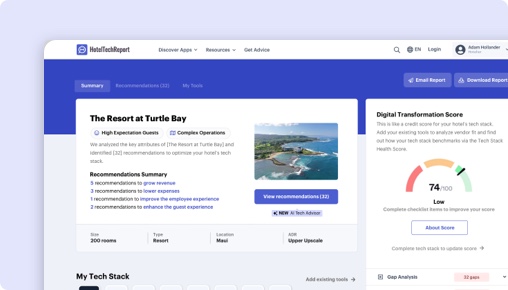
Sorry, this functionality is only available for verified hoteliers
The project dashboard is a free tool that is only available to verified hoteliers to make adopting new technology easier by streamlining their research and simplifying their communication workflow.

Duve App vs. Guest Services by SmartStay:
Which Is Right for You?


TLDR
We analyzed 814 verified hotelier reviews, compared feature sets, pricing, and real-world case studies to break down where each platform delivers. The right choice depends on your property type and priorities:
Duve shines in guest communication and unified messaging hub — especially for bed & breakfast properties (4.8/5), with exclusive features like Mobile Friendly and SMS text messaging.
Liverton stands out with exclusive features like Hotel Website Check-in Portal and Lobby Kiosk.
How Does Duve App Compare to Guest Services by SmartStay?
Side-by-side ratings based on 814 verified hotelier reviews on HTR.
| HTScore |
|
|
| Likelihood to Recommend |
|
|
| Ease of Use |
|
|
| Customer Support |
|
|
| Value for Money |
|
|
| Starting Price | From $900/mo | From $500/mo |
| Verified Reviews | 807 | 7 |
What Are the Pros and Cons of Duve App vs Guest Services by SmartStay?
After analyzing 814 verified reviews, Duve users most value its guest communication and unified messaging hub, operational efficiency and reduced front-desk workload, guest app content and personalization, while Liverton users highlight . Click any theme to see what reviewers say.
|
Duve
|
Liverton
|
|---|---|
| Pros | |
|
+
Guest communication and unified messaging hub
▾
|
|
|
+
Operational efficiency and reduced front-desk workload
▾
|
|
|
+
Guest app content and personalization
▾
|
|
|
+
Upselling and ancillary revenue
▾
|
|
| Cons | |
|
−
Customization, workflows, and configuration flexibility
▾
|
|
|
−
Mobile access and app usability for staff/guests
▾
|
|
|
−
PMS and third-party integrations
▾
|
|
Duve vs Liverton: Rankings by Hotel Segment
How each product ranks among Hotel Guest Apps vendors for different property sizes, types, and regions — based on verified reviews from hoteliers in each segment.
By Hotel Size
| Segment |
Duve
|
Liverton
|
|---|---|---|
| Small (10-24 rooms) ▾ | #1 139 reviews | — |
| Mid-Size (25-74 rooms) ▾ | #1 229 reviews | #25 3 reviews |
| Large (75-199 rooms) ▾ | #1 195 reviews | #16 3 reviews |
| X-Large (200+ rooms) ▾ | #1 66 reviews | #14 1 reviews |
By Property Type
| Segment |
Duve
|
Liverton
|
|---|---|---|
| Boutique ▾ | #1 256 reviews | #28 2 reviews |
| Luxury ▾ | #1 305 reviews | #22 3 reviews |
| Branded / Chain ▾ | #1 208 reviews | #20 2 reviews |
| Extended Stay ▾ | #1 94 reviews | — |
By Region
| Segment |
Duve
|
Liverton
|
|---|---|---|
| North America ▾ | #2 56 reviews | #21 0 reviews |
| Europe ▾ | #1 262 reviews | — |
| Asia Pacific ▾ | #1 29 reviews | — |
| Middle East ▾ | #1 258 reviews | — |
Is Duve App by Duve or Guest Services by SmartStay by Liverton Better for Hotels?
Duve App and Guest Services by SmartStay by Liverton both address the hotel guest app category but serve distinctly different hotel needs. Duve App excels as a comprehensive, branded guest experience platform with advanced upselling, guest messaging, and contactless check-in features suited for a broad range of property sizes and types globally. Liverton focuses heavily on kiosk and self-service check-in/out combined with door lock integration and in-room F&B ordering, targeting hotels prioritizing streamlined front desk automation and mobile key issuance.
Both products reduce front desk workload by automating guest communication and check-in processes. Duve centralizes guest messaging across multiple channels and drives ancillary revenue through upselling. Liverton emphasizes self-service options and seamless payment and mobile key issuance integrated with PMS and POS systems. Hotels seeking a full guest engagement ecosystem will find Duve’s feature-rich platform advantageous, while those aiming for kiosk-based guest autonomy and in-room service integration will prefer Liverton.
Duve App vs Guest Services by SmartStay by Liverton: Which Should Your Hotel Choose?
If your hotel operates in Europe, North America, or Asia-Pacific with diverse guest demographics and needs, Duve App is the choice supported by 766 reviews averaging 4.7/5 overall. Independent hotels, luxury and branded chains, and vacation rentals benefit from Duve’s broad capabilities including multi-channel messaging, automated upselling, and branded guest apps. This is backed by multiple case studies showing up to 1120% ROI from upselling and check-in rates exceeding 70%.
If your property prioritizes self-service check-in kiosks, fast room selection, and direct mobile key issuance with integrated F&B ordering, Liverton suits medium to large hotels with a tech-forward guest base, despite its limited review data (7 reviews, 4.6/5). Liverton’s strength lies in its kiosk and door lock integrations and streamlined payment authorization, fitting hotels focused on operational automation at the front desk and in-room services. Data for small or budget hotels is limited for Liverton, so caution is advised.
Is Duve App by Duve or Guest Services by SmartStay by Liverton Easier to Use?
Duve App and Liverton have comparable ease of use and onboarding ratings, with Duve scoring 4.7/5 ease of use and 4.6/5 onboarding from 766 reviews, and Liverton scoring 4.6/5 ease of use and 4.5/5 onboarding from 7 reviews. Duve reviewers highlight the user-friendly interface and straightforward setup that enables rapid deployment. Some mention a steep learning curve due to feature richness, but overall staff adoption is positive, facilitated by centralized guest communication and automation that reduces training overhead.
Liverton users report a clean, tidy interface and appreciate kiosk check-in options that guests find novel and fast. However, some reviewers note initial technical issues during trials and desire more guest navigation flexibility within the kiosk workflow. Given the volume and recency of Duve’s reviews versus Liverton’s limited data, Duve’s ease of use claims carry more operational weight.
Edge: Even.
Which Has Better Features: Duve App by Duve or Guest Services by SmartStay by Liverton?
Duve App offers 23 unique features including WhatsApp integration, automated guest messaging, mobile check-in/out, room service ordering, payments, AI-assisted messaging, and a fully branded web-app. These features change hotel operations by centralizing guest communication, enabling upselling through automated pre-arrival messages, and reducing front desk manual tasks. For example, Duve’s automated replies and message routing allow staff to manage guest inquiries efficiently across channels like SMS and WhatsApp, improving response times and guest satisfaction.
Liverton provides 20 distinct features such as hotel website check-in portal, lobby kiosks, self-service check-in/out, device-agnostic operation, door lock integration, ID verification, and pre-arrival upselling with room selection. This suite automates guest check-in and payment authorization while issuing mobile keys and QR codes, streamlining front desk workflows and speeding guest arrival. In-room QR-based food and beverage ordering, integrated with POS and PMS, enables instant chargeback to rooms, enhancing guest convenience and operational accuracy.
Duve’s feature set prioritizes unified guest communication and revenue generation via upsells, while Liverton focuses on kiosk-driven automation and in-room service integration. Both bring capabilities not found in the other: Liverton’s kiosk and door lock features are absent in Duve, and Duve’s advanced messaging and multi-channel upsell automation are missing from Liverton. Duve’s 23 unique hotel-relevant features exceed Liverton’s 20.
Edge: Duve App by Duve.
Which Has Better Customer Support: Duve App by Duve or Guest Services by SmartStay by Liverton?
Both products score similarly on customer support and onboarding, with Duve at 4.6/5 and 4.6/5 respectively across 766 reviews, and Liverton at 4.3/5 and 4.5/5 from 7 reviews. Duve reviewers frequently commend quick and effective problem resolution and ongoing support availability, though a minority note occasional difficulty reaching support or delays in responses. Liverton users praise the Liverton team for swift communication and seamless problem solving even during full hotel operations, reflecting a high-touch support experience.
Given Duve’s extensive review base and consistent positive feedback contrasted with Liverton’s limited but favorable responses, both products have competent support, but Duve’s larger user base provides more evidence of sustained customer service quality.
Edge: Even.
Which Has More Integrations: Duve App by Duve or Guest Services by SmartStay by Liverton?
Duve App integrates with 72 verified partners including major PMS providers like Oracle Hospitality, Mews, Cloudbeds, and specialized systems such as RoomRaccoon and eviivo. These integrations enable seamless PMS data synchronization, third-party upselling tools, door lock systems, and AI services, expanding operational flexibility for hotels. Duve’s open API supports further customization and system extension, critical for properties with complex tech stacks.
Liverton connects with 8 verified partners, sharing integrations with RMS, Oracle Hospitality, and Shiji Group, focusing on PMS, POS, and door lock systems essential for kiosk check-in and mobile key issuance workflows. Liverton’s integrations support its self-service and payment authorization processes but lack the breadth of Duve’s marketplace.
Duve’s 72 integrations represent more than eight times Liverton’s 8, offering broader compatibility and extensibility across hotel operations.
Edge: Duve App by Duve.
Which Do Hoteliers Rate Higher: Duve App by Duve or Guest Services by SmartStay by Liverton?
Duve App’s rating stands at 4.7/5 from 766 reviews with 183 in the last six months, maintaining a strong recent score of 4.6/5. Liverton has 4.6/5 from 7 reviews but no recent reviews in the last six months. Duve’s large, current review volume offers a statistically robust measure of performance and satisfaction.
Segment ratings for Duve range from 4.7/5 to 4.9/5 across luxury hotels (338 reviews, 4.8/5), boutique hotels (279 reviews, 4.7/5), resorts (279 reviews, 4.8/5), and city center hotels (263 reviews, 4.8/5). Liverton’s limited segment data shows highest ratings in city center hotels (6 reviews, 4.8/5) and boutique hotels (2 reviews, 5/5), but sample size is too small for broad conclusions.
Duve’s sustained high ratings across diverse hotel segments and recent activity outweigh Liverton’s smaller, less current data set.
Edge: Even.
How Much Do Duve App by Duve and Guest Services by SmartStay by Liverton Cost?
Duve App’s base price is $900 with no freemium, no monthly flat fee, no per-room fee, and no implementation fee publicly disclosed. Liverton’s base price is $500, also without freemium, monthly flat, or per-room fees, and no implementation fee. Neither offers public trial periods.
Liverton’s lower base price may appeal to budget-conscious buyers, but lack of published detailed pricing and absence of trials for both products limit transparent cost comparison. Hotels should request detailed quotes and consider total cost of ownership including setup, customization, and integration efforts.
What Type of Hotel Should Use Duve App by Duve?
- Hotels that require a fully branded, AI-powered guest app supporting multilingual communication and automated messaging across WhatsApp, SMS, and email.
- Teams needing integrated upselling tools that generate significant ancillary revenue, proven by documented ROIs up to 1120%.
- Properties prioritizing contactless check-in and check-out to reduce front desk workload and improve guest convenience.
- Hotels operating across multiple regions (63 countries) with varied guest profiles, benefiting from Duve’s advanced customization and translation features.
- Large chains and boutique hotels seeking centralized guest communication and data insights through analytics dashboards.
Not ideal if:
- Your operation needs kiosk-based self-service check-in or robust in-room QR ordering integrated with POS systems; Duve lacks kiosk and POS ordering features.
- Your team requires a simpler, less feature-dense platform with minimal setup complexity.
- You operate a small property with limited need for extensive integrations or upselling automation.
What Type of Hotel Should Use Guest Services by SmartStay by Liverton?
- Hotels focusing on self-service check-in/out kiosks and lobby-based guest autonomy to reduce front desk interactions.
- Properties that want guests to select rooms during digital check-in and leverage door lock integration for mobile key issuance via Apple/Google Wallet or QR codes.
- Hotels seeking seamless in-room food and beverage ordering using QR menus integrated with POS and PMS for immediate room chargebacks.
- Properties prioritizing streamlined payment capture, deposit collection, and authorization workflows as part of check-in.
- Medium-to-large hotels with tech-savvy guests familiar with kiosk interfaces and mobile key technology.
Not ideal if:
- Your property needs a branded guest app with messaging, upselling, or multi-channel guest communication.
- You require a broad ecosystem of third-party integrations or flexible guest interaction workflows beyond kiosk and mobile key use.
- You desire extensive guest messaging automation and AI-powered features.
- Your property operates largely outside the two countries Liverton currently supports.
Duve App by Duve vs Guest Services by SmartStay by Liverton: The Bottom Line for Hotels
The core difference between Duve App and Liverton lies in their operational focus: Duve is a feature-rich, fully branded guest app emphasizing guest communication, upselling, and contactless check-in that suits a broad international hotel market. Liverton concentrates on kiosk-based self-service, mobile key integration, and in-room F&B ordering, aimed at hotels seeking to automate front desk and service delivery with minimal guest-staff interaction.
Choose Duve if your hotel values a centralized guest messaging hub with proven upselling ROI, AI-assisted multilingual communication, and a scalable platform integrating with a wide range of systems. Duve’s extensive verified integrations and global footprint support diverse properties from luxury to budget, with strong recent user satisfaction.
Choose Liverton if your property prioritizes kiosk and self-service check-in/out with seamless mobile key issuance, along with in-room QR ordering tied directly to POS and PMS systems. Liverton fits hotels looking to reduce front desk load through guest autonomy and integrated payment workflows, though with limited market presence and fewer verified integrations.
The decisive factor is your hotel’s operational model: Duve fits hotels aiming for comprehensive digital guest engagement and revenue generation; Liverton suits those focused on self-service kiosks and keyless room access.
Feature Comparison: Duve App vs Guest Services by SmartStay
These are the features each vendor has configured, organized by feature group — the same data shown in the vendor dashboard. Expand a group to compare features side by side.
| Feature |
Duve
|
Liverton
|
|---|---|---|
|
▾
Communication & Messaging
|
|
|
| Automatic Translations (Multi-Lingual) | ||
| Request Management | ||
| Room Service Ordering | ||
| Guest Messaging | ||
| App download | ||
| Web-app | ||
|
▾
Content Management
|
|
|
| Hotel Directory | ||
| Guest Profiles | ||
| Local Recommendations | ||
| Web-app | ||
|
▾
Upselling
|
|
|
| Payments | ||
| Room Service Ordering | ||
|
▾
Request Management
|
|
|
| Request Management | ||
| Room Service Ordering | ||
| Mobile Checkout | ||
| Mobile Checkin |
Real-World Results: Duve vs Liverton by Business Goal
We analyzed 8 verified case studies to compare what hotels actually achieve with each platform across four key business objectives.
סטאי תל אביב - The Setai, Tel Aviv
Large
"Duve was a game changer for our customer service. I knew the platform would help us connect with guests but I was amazed at how cleverly simple it all is, even guests who are not v..."
 Liverton
No published case study for this goal yet.
Brown Hotels
Large
"While scaling up and growing in terms of more hotel rooms and more hotels in different countries we found it difficult to communicate with our guests in a very personal way. Duve f..."
 Liverton
No published case study for this goal yet.
Duve vs Liverton: The Bottom Line
What hoteliers love
Reviewers consistently say Duve centralizes guest communication across WhatsApp, SMS, email, OTA channels, and in-app chat, making it easier to manage... Reviewers consistently say Duve centralizes guest communication across WhatsApp, SMS, email, OTA channels, and in-app chat, making it easier to manage conversations in one place. This reduces missed messages, speeds up responses, and helps teams keep guest interactions organized across the full stay.
Reviewers say Duve reduces repetitive admin work by centralizing requests, automating communication, and letting staff handle more guest needs without... Reviewers say Duve reduces repetitive admin work by centralizing requests, automating communication, and letting staff handle more guest needs without constant phone calls or manual follow-up. Many mention better collaboration across departments and faster service delivery, especially in high-volume or understaffed operations.
Users value the branded guest app as a digital directory for hotel services, menus, activities, recommendations, and offers. They also emphasize perso... Users value the branded guest app as a digital directory for hotel services, menus, activities, recommendations, and offers. They also emphasize personalization—different workflows, layouts, translations, and branded content that make the experience feel tailored to the property and guest type.
Where hoteliers push back
A frequent request is for more control over workflows, layouts, templates, messaging rules, and property-specific settings. While many appreciate Duve... A frequent request is for more control over workflows, layouts, templates, messaging rules, and property-specific settings. While many appreciate Duve’s flexibility, reviewers often say certain features are still too rigid or require too much setup to match different hotel operations.
Some reviewers want a native mobile app or easier phone-based access for both staff and guests, saying it would make live communication and task handl... Some reviewers want a native mobile app or easier phone-based access for both staff and guests, saying it would make live communication and task handling more convenient. They also mention occasional usability friction such as login steps, message visibility, or interface complexity on the go.
Ranks higher for
Unique capabilities
Unique capabilities
Frequently Asked Questions About Duve App vs Guest Services by SmartStay
Can Duve App replace Guest Services by SmartStay?
It depends on your requirements. Duve App and Guest Services by SmartStay share many core Hotel Guest Apps features, but each has unique capabilities. Duve App offers 72 verified integration partners, while Guest Services by SmartStay offers 8. Review the feature comparison above to see where they differ before switching.
Which is better for small or independent hotels?
Small hotels should prioritize ease of use and fast onboarding. Duve App leads in ease of use at 4.7/5 vs 4.6/5. Look for transparent pricing and a trial or demo option. Filter reviews on each product page by property size to hear from hotels like yours.
Do Duve App or Guest Services by SmartStay offer a free plan?
Duve App: No. Guest Services by SmartStay: No. Neither product currently offers a free tier. Most Hotel Guest Apps vendors offer demos or trials — request one from each to evaluate before committing.
How Does HTR Evaluate and Rank Duve App and Guest Services by SmartStay?
The HT Score is a composite ranking that considers 4 criteria groups and over a dozen variables to help hoteliers objectively compare hotel technology products. Duve has an HT Score of 100 and Liverton has 0. Here is how the score is calculated.
| Criteria Group | Weight | What It Measures |
|---|---|---|
| Customer Ratings & Reviews |
|
How highly do users recommend this product? Ratings Score, Review Volume, Share of Voice, Review Depth, Review Recency, Success Stories ▾ The most heavily weighted factor. Analyzes average satisfaction ratings (likelihood to recommend, ease of use, support, ROI), total review count relative to category peers, review recency (at least 20 reviews in the trailing 6 months), and share of voice across unique hotel clients to detect selection bias. |
| Partner Ecosystem |
|
How highly do tech partners recommend this company? Partner Recommendations, Integration Quantity, Integration Quality ▾ Evaluates partner recommendations as expert votes of confidence, the number of verified integrations, and ecosystem quality — the average HT Scores of integration partners. Products with higher-quality integration ecosystems are more likely to deliver a connected tech stack. |
| Customer Centricity |
|
How customer-centric is this organization? Certified Support, Review Consistency, Profile Completeness ▾ Assesses whether the company has earned HTR Customer Support Certification, maintains consistent review collection over time (an indicator of feedback-driven culture), and keeps product profiles complete with capabilities, screenshots, pricing, and features. |
| Reach, Staying Power & Resources |
|
How extensive is this company's reach and resourcing? Geographic Reach, Staying Power, Company Resources, Trending Score ▾ Measures global presence (countries and regions served), years in business as a stability proxy, team headcount as a resource proxy, and a trending score based on trailing-twelve-month buyer inquiries, reviews, partner recommendations, and press activity. |
Customer ratings and reviews are by far the most important factor in the HT Score algorithm. HTR does not accept payment for higher rankings. All reviews are verified — only hotel industry practitioners with confirmed affiliations can submit ratings. View full HT Score methodology →
What Other Hotel Guest Apps Comparisons Are Hoteliers Reading?
Explore more head-to-head comparisons based on verified hotelier reviews.





Contents
Get Your Free AI Analyst Report
Custom recommendations tailored to your property


Let´s lookup your hotel information
Still weighing your hotel guest apps options?
A few popular systems from our hotel guest apps guide — or let our AI score each one against your specific property in about two minutes.


