

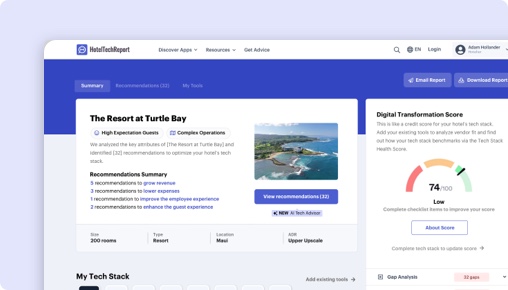
Sorry, this functionality is only available for verified hoteliers
The project dashboard is a free tool that is only available to verified hoteliers to make adopting new technology easier by streamlining their research and simplifying their communication workflow.

Duve Upselling vs. Oracle OPERA Guest Engagement and Merchandising:
Which Is Right for You?

TLDR
We analyzed 545 verified hotelier reviews, compared feature sets, pricing, and real-world case studies to break down where each platform delivers. The right choice depends on your property type and priorities:
Duve shines in guest messaging and communication hub — especially for hostel properties (4.8/5), with exclusive features like Mobile Friendly and SMS text messaging.
Oracle Hospitality shines in integrated rate management tool — especially for branded chain properties (4.8/5), with exclusive features like Check-in upselling.
How Does Duve Upselling Compare to Oracle OPERA Guest Engagement and Merchandising?
Side-by-side ratings based on 545 verified hotelier reviews on HTR.
| HTScore |
|
|
| Likelihood to Recommend |
|
|
| Ease of Use |
|
|
| Customer Support |
|
|
| Value for Money |
|
|
| Starting Price | From $900/mo | From $100/mo |
| Verified Reviews | 450 | 95 |
What Are the Pros and Cons of Duve Upselling vs Oracle OPERA Guest Engagement and Merchandising?
After analyzing 545 verified reviews, Duve users most value its guest messaging and communication hub, upselling and ancillary revenue generation, operational efficiency and time savings, while Oracle Hospitality users highlight integrated rate management tool, cloud-based features, integration with third-party systems. Click any theme to see what reviewers say.
|
Duve
|
Oracle Hospitality
|
|---|---|
| Pros | |
|
+
Guest messaging and communication hub
▾
|
+
Integrated Rate Management Tool
▾
|
|
+
Upselling and ancillary revenue generation
▾
|
+
Cloud-Based Features
▾
|
|
+
Operational efficiency and time savings
▾
|
+
Integration with Third-Party Systems
▾
|
|
+
Guest app and branded guest journey
▾
|
|
| Cons | |
|
−
Customization and branding flexibility
▾
|
−
Complexity and Learning Curve
▾
|
|
−
Support, onboarding, and training
▾
|
−
Cost Concerns
▾
|
|
−
PMS/integration sync and operational data flow
▾
|
|
Duve vs Oracle Hospitality: Rankings by Hotel Segment
How each product ranks among Upselling Software vendors for different property sizes, types, and regions — based on verified reviews from hoteliers in each segment.
By Hotel Size
| Segment |
Duve
|
Oracle Hospitality
|
|---|---|---|
| Small (10-24 rooms) ▾ | #2 76 reviews | #14 3 reviews |
| Mid-Size (25-74 rooms) ▾ | #3 145 reviews | #6 31 reviews |
| Large (75-199 rooms) ▾ | #3 91 reviews | #5 43 reviews |
| X-Large (200+ rooms) ▾ | #3 42 reviews | #7 11 reviews |
By Property Type
| Segment |
Duve
|
Oracle Hospitality
|
|---|---|---|
| Boutique ▾ | #3 144 reviews | #6 42 reviews |
| Luxury ▾ | #3 160 reviews | #6 57 reviews |
| Branded / Chain ▾ | #3 107 reviews | #6 53 reviews |
| Extended Stay ▾ | #2 49 reviews | #8 8 reviews |
By Region
| Segment |
Duve
|
Oracle Hospitality
|
|---|---|---|
| North America ▾ | #3 40 reviews | #6 29 reviews |
| Europe ▾ | #2 160 reviews | #13 17 reviews |
| Asia Pacific ▾ | #5 18 reviews | #3 36 reviews |
| Middle East ▾ | #1 115 reviews | #6 6 reviews |
Is Duve Upselling by Duve or Oracle OPERA Guest Engagement and Merchandising by Oracle Hospitality Better for Hotels?
Duve Upselling and Oracle OPERA Guest Engagement both target the hotel upselling space but diverge sharply in scope and operational approach. Duve offers a comprehensive, guest-facing platform emphasizing personalized upsells, guest communication, and digital check-in, widely adopted by small to large independent hotels and vacation rentals. Oracle OPERA focuses on AI-driven, real-time upselling integrated deeply with its OPERA PMS, favored by larger branded and luxury hotels with existing Oracle infrastructure.
Both platforms address the challenge of increasing ancillary revenue through automated, personalized upsells, reducing front desk workload, and enhancing guest satisfaction. Duve integrates multiple communication channels and payment options to empower guests to self-serve upsells digitally. Oracle OPERA leverages machine learning to trigger upsells from booking to check-in, embedding upselling tightly in property operations. The choice depends primarily on property size, existing PMS, and desired level of guest interaction.
Duve Upselling vs Oracle OPERA Guest Engagement and Merchandising: Which Should Your Hotel Choose?
If you manage a small to midsize independent hotel, boutique property, or vacation rental, Duve’s 449 reviews with a 4.6 rating and deployment in 52 countries strongly recommend it. Its guest app, multi-channel messaging (SMS, WhatsApp, email), automated pre-arrival check-in, and extensive integrations (72 partners) suit properties aiming for direct guest engagement and operational automation. Its pricing starting at $900 without per-room fees supports medium-sized operations well.
If you run a large branded hotel or luxury property already using OPERA PMS, Oracle’s 95 reviews averaging 4.7 and 390 integrations make it a natural fit. Its AI-powered upselling from Nor1 PRIME and deep PMS integration streamline upsells at scale. Oracle’s $100 base price likely scales differently with licensing costs, which may be prohibitive for smaller hotels. The lack of recent reviews and zero last-six-month activity suggest Oracle’s upselling module is stable but not rapidly evolving.
For segments like luxury hotels, Oracle Hospitality leads with 36% user base versus Duve’s 9%, while Duve dominates boutique hotels, vacation rentals, and budget hotels with more review volume. Since Oracle has no recent reviews and Duve’s last six months rating is stable at 4.6 across 130 reviews, Duve’s current product experience is better documented for fast-changing guest communication needs.
Is Duve Upselling or Oracle OPERA Guest Engagement and Merchandising Easier to Use?
Both products rate identically for ease of use at 4.7/5 and onboarding with Duve at 4.6 and Oracle at 4.7. Reviewers praise Duve’s intuitive guest app and communication hub that front desk staff find straightforward, streamlining workflows with automated messaging and pre-arrival processes. Oracle’s users commend its smooth software interface and cloud-based access, though some mention a steep learning curve due to feature complexity, particularly challenging for smaller hotels with limited training resources.
Duve reviewers note occasional setup complexity but emphasize user-friendly daily operations once configured. Oracle’s complexity impacts smaller properties more, as some users wish for easier PMS integration and simpler upsell workflows. The even ratings reflect these trade-offs: Duve is easier for guest-facing tasks; Oracle is robust but requires more training.
Edge: Even.
Which Has Better Features: Duve Upselling or Oracle OPERA Guest Engagement and Merchandising?
Duve offers 31 unique features beyond 12 shared ones, whereas Oracle has only one unique feature: check-in upselling. Duve’s mobile-friendly guest app, WhatsApp integration, automated replies, SMS messaging, multi-lingual automatic translations, payments, mobile check-in/checkout, room service ordering, and staff task routing create a full digital guest experience platform. These features directly reduce front desk workload by shifting tasks like ID uploads, payments, and room service orders to guests’ devices, improving operational efficiency and guest satisfaction.
Oracle’s single unique feature, check-in upselling, fits seamlessly into OPERA PMS workflows, allowing staff to offer upgrades during check-in. However, it lacks the broad guest self-service and multi-channel communication tools Duve provides. Duve’s extensive analytics dashboard and offer performance reporting give managers actionable insights to tailor upsell campaigns, a capability Oracle’s reviews do not emphasize.
Edge: Duve Upselling.
Which Has Better Customer Support: Duve Upselling or Oracle OPERA Guest Engagement and Merchandising?
Duve and Oracle both score 4.6/5 on customer support with similar onboarding ratings (Duve 4.6, Oracle 4.7). Duve reviewers frequently praise their account managers like Gal and highlight prompt issue resolution, though some report difficulties reaching support during rare outages. Oracle users appreciate efficient problem-solving and clear communication from the support team, especially for upsell platform issues.
Overall, support experiences are positive but not flawless on either side. Both vendors maintain consistent onboarding quality, and neither dominates support ratings sufficiently to draw an edge.
Edge: Even.
Which Has More Integrations: Duve Upselling or Oracle OPERA Guest Engagement and Merchandising?
Oracle Hospitality has 390 verified partners, more than five times Duve’s 72, sharing 33 common integrations including PMS providers like WebRezPro and SiteMinder. Oracle’s vast partner ecosystem includes specialized revenue management, POS, and analytics systems such as Criton, Omnibees, and Profitroom, important for large branded hotels needing comprehensive operational connectivity.
Duve’s integrations favor PMS providers popular in independent and boutique segments, like RoomRaccoon, eviivo, and Little Hotelier, alongside payment processors and messaging platforms. These integrations support Duve’s guest-centric workflows and marketplace services.
For hotels relying on a broad array of third-party systems, Oracle’s integration depth is a clear advantage. For properties prioritizing guest app and communication integrations, Duve covers essential channels well but with fewer partners overall.
Edge: Oracle OPERA Guest Engagement.
Which Do Hoteliers Rate Higher: Duve Upselling or Oracle OPERA Guest Engagement and Merchandising?
Duve has a slightly lower overall rating (4.6/5) than Oracle (4.7/5), but Duve’s rating is based on 449 reviews including 130 in the last six months, while Oracle’s 95 reviews have zero recent activity. Duve’s stable recent rating confirms current product quality, whereas Oracle’s older reviews may not reflect recent changes.
Segment ratings show Duve excels in boutique hotels (4.7/5 across 163 reviews), budget hotels (4.8/5), and vacation rentals (4.7/5), with strong scores in city center and branded hotels. Oracle scores higher in luxury hotels (4.7/5 across 57 reviews) and branded hotels (4.8/5), aligning with its user base.
Recent review volume and recency indicate Duve’s product is more actively reviewed and supported currently, important for operators needing ongoing updates and community feedback.
Edge: Even.
How Much Do Duve Upselling and Oracle OPERA Guest Engagement and Merchandising Cost?
Duve’s published base price is $900 with no freemium, monthly flat fee, per-room pricing, or implementation fees disclosed. Oracle’s base price is $100 with similar lack of detailed pricing transparency. Neither vendor publishes a per-room or usage-based fee publicly.
Given Duve’s feature set and client testimonials emphasizing no hidden fees, its pricing suits medium properties that want an all-in-one guest engagement platform. Oracle’s lower base price likely comes with additional licensing or customization costs typical of large PMS solutions, which may increase total cost significantly for smaller hotels.
Without detailed pricing, operators should request full proposals to understand total costs, but Duve’s transparent base fee and flat structure provide clearer upfront budgeting.
What Type of Hotel Should Use Duve Upselling by Duve?
- Hotels that want a guest-facing app integrating messaging, digital check-in, and upselling into one platform with 449 verified reviews backing its effectiveness.
- Properties seeking personalized, profile-driven upsells such as spa packages or transportation services supported by extensive customization.
- Boutique, vacation rental, and independent hotels that benefit from multi-channel communication including WhatsApp and SMS integration.
- Teams aiming to reduce front desk workload by automating pre-arrival communication and payments via guest devices.
- Hotels requiring flexibility with 72 integrations including popular PMS and payment providers.
Not ideal if:
- You need a check-in upselling feature embedded directly in a PMS without guest self-service.
- Your property is a large branded or luxury chain relying on extensive third-party system integrations.
- You require a strictly cloud-based AI upselling system with real-time machine learning focused on booking-to-check-in.
What Type of Hotel Should Use Oracle OPERA Guest Engagement and Merchandising by Oracle Hospitality?
- Large branded hotels and luxury properties already using OPERA PMS and seeking seamless upsell automation embedded in property management workflows.
- Hotels prioritizing AI-driven, real-time machine learning upsells from booking through check-in with Nor1 PRIME technology.
- Properties that need deep integration with a wide ecosystem of 390 partners including revenue management and analytics platforms.
- Teams that prefer a performance-based revenue model minimizing upfront risk and have resources for extensive staff training.
- Hotels in markets where cloud-based access and frequent updates to upselling tools are critical.
Not ideal if:
- You operate a small to midsize independent property with limited training resources and need rapid guest communication tools.
- You require a guest app offering multi-channel messaging, mobile check-in/out, and payments integrated in one platform.
- Your hotel prioritizes frequent product updates and active user community feedback.
Duve Upselling vs Oracle OPERA Guest Engagement and Merchandising: The Bottom Line for Hotels
Duve Upselling and Oracle OPERA Guest Engagement differ fundamentally in approach and target property types. Duve provides a broad guest engagement platform combining upselling, messaging, and digital check-in into a single user-friendly app, ideal for independent, boutique, and vacation rental properties. Oracle OPERA offers a tightly integrated, AI-powered upselling solution embedded in its PMS, preferred by larger branded and luxury hotels.
Choose Duve if you want comprehensive guest self-service, multi-channel upselling, and communication that reduces front desk workload, supported by 449 recent reviews and 130 in the last six months. Duve’s features like WhatsApp messaging, mobile checkout, and performance analytics enable personalized guest experiences and flexible operations.
Choose Oracle OPERA if your hotel is a large branded or luxury property running Oracle PMS and you need a real-time AI upselling engine that connects deeply with numerous third-party systems. Oracle’s 390 integrations and cloud-based platform support complex workflows and performance-based pricing models, favored by hotels with robust training resources and operational scale.
The decision hinges on property size, existing PMS, and operational preference for direct guest engagement versus embedded AI upselling. Duve’s current active development and user base make it more suitable for properties emphasizing guest communication and ancillary revenue growth via guest apps. Oracle OPERA excels where PMS integration and AI-driven upsell automation dominate.
How Much Do Duve Upselling and Oracle OPERA Guest Engagement and Merchandising Cost?
Upselling Software pricing is rarely straightforward. Here is what we know from each vendor's public pricing data. Always request a custom quote for your property size.
|
Duve
|
Oracle Hospitality
|
|
|---|---|---|
| Starting Price | From $900/mo | From $100/mo |
Feature Comparison: Duve Upselling vs Oracle OPERA Guest Engagement and Merchandising
These are the features each vendor has configured, organized by feature group — the same data shown in the vendor dashboard. Expand a group to compare features side by side.
| Feature |
Duve
|
Oracle Hospitality
|
|---|---|---|
|
▾
Offer Delivery
|
|
|
| Offer Orchestration (Booking → Pre-Arrival → Arrival → In-Stay → Post-Stay) | ||
| Multi-Channel Delivery (Email, SMS, WhatsApp, Chat) | ||
| Guest Segmentation & Targeting | ||
| Digital Acceptance & Payment Capture | ||
| Check-In & On-Property Upsell Support | ||
| Post-Stay & Future Stay Offers | ||
|
▾
Offers & Merchandising
|
|
|
| Offer Templates Library | ||
| Dynamic Upgrade Pricing | ||
| Room Upgrade Merchandising | ||
| Ancillary Product Merchandising | ||
| Gift Vouchers & Prepaid Experiences | ||
| Segmentation | ||
|
▾
Operations & Fulfillment
|
|
|
| Type 2 SOC 2 Certified (Data Security) | ||
| Automated Fulfillment Task Routing | ||
| Multi-Channel Delivery (Email, SMS, WhatsApp, Chat) | ||
| Gift Vouchers & Prepaid Experiences | ||
| Inventory & Eligibility Controls | ||
| Reservation & Folio Update Workflow | ||
| Staff & Department Fulfillment Visibility | ||
| Exception, Refund & Override Handling | ||
|
▾
Performance & Control
|
|
|
| Segmentation | ||
| Type 2 SOC 2 Certified (Data Security) | ||
| Offer Suppression & Approval Controls | ||
| Performance Reporting & Offer Analytics | ||
| Multi-Property/Chain Dashboard | ||
| Offer Experimentation & A/B Testing | ||
| Offer Performance Analytics |
Real-World Results: Duve vs Oracle Hospitality by Business Goal
We analyzed 9 verified case studies to compare what hotels actually achieve with each platform across four key business objectives.
סטאי תל אביב - The Setai, Tel Aviv
Large
"Duve was a game changer for our customer service. I knew the platform would help us connect with guests but I was amazed at how cleverly simple it all is, even guests who are not v..."
 Fairmont Tremblant
Small
"With success hinging on so many unknown variables in an altered marketplace, Nor1 provides me with a sense of control. In the times that we’re in, that’s priceless."
 Brown Hotels
Large
"While scaling up and growing in terms of more hotel rooms and more hotels in different countries we found it difficult to communicate with our guests in a very personal way. Duve f..."
 Oracle Hospitality
No published case study for this goal yet.
Duve vs Oracle Hospitality: The Bottom Line
What hoteliers love
Users repeatedly say Duve centralizes guest communication across channels like SMS, WhatsApp, email, and in-app chat, making it easier to answer quest... Users repeatedly say Duve centralizes guest communication across channels like SMS, WhatsApp, email, and in-app chat, making it easier to answer questions quickly and keep guests informed before and during the stay. Many note that this reduces repetitive front-office work and creates a faster, more consistent guest experience.
The most common value cited is Duve’s ability to drive additional revenue through room upgrades, late check-out, early check-in, packages, and other e... The most common value cited is Duve’s ability to drive additional revenue through room upgrades, late check-out, early check-in, packages, and other extras. Reviewers say the platform makes offers easy to manage and helps hotels monetize unsold inventory while supporting TRevPAR and overall profitability.
Reviewers commonly describe Duve as a tool that reduces manual work for front desk and guest service teams by centralizing tasks and automating routin... Reviewers commonly describe Duve as a tool that reduces manual work for front desk and guest service teams by centralizing tasks and automating routine communication. This efficiency is seen as especially valuable for busy hotels, allowing staff to focus more on service and less on repetitive admin.
Where hoteliers push back
Users often want more control over the look, layout, and configuration of the guest app and related workflows. While Duve is seen as flexible, reviewe... Users often want more control over the look, layout, and configuration of the guest app and related workflows. While Duve is seen as flexible, reviewers say larger groups especially need better tools for category management, branding, and property-specific customization.
Support quality is mixed: some reviewers praise fast help and strong implementation assistance, while others say response times, hotel-specific expert... Support quality is mixed: some reviewers praise fast help and strong implementation assistance, while others say response times, hotel-specific expertise, or follow-up can be lacking. Several also want better training resources for new staff so teams can use the platform consistently and manage changes more confidently.
Ranks higher for
Unique capabilities
What hoteliers love
Users commend OPERA for its integrated rate management which simplifies daily operations, enabling a focus on upselling and cross-selling. This tool h... Users commend OPERA for its integrated rate management which simplifies daily operations, enabling a focus on upselling and cross-selling. This tool helps staff optimize revenue potential with clear, streamlined processes despite some finding it cumbersome to navigate.
The cloud-based nature of OPERA is praised for reducing dependency on local servers, improving remote access, and ensuring seamless updates. These fea... The cloud-based nature of OPERA is praised for reducing dependency on local servers, improving remote access, and ensuring seamless updates. These features offer a significant advantage in unifying operations and maintaining effective upselling strategies.
OPERA is acknowledged for its strong integration capabilities with numerous third-party systems including POS and analytics. This extensive integratio... OPERA is acknowledged for its strong integration capabilities with numerous third-party systems including POS and analytics. This extensive integration helps unify hotel operations and data for meaningful upselling opportunities and streamlined guest experiences.
Where hoteliers push back
Some users report that OPERA's multitude of features results in a steep learning curve and complexity in onboarding. This impacts smaller hotels more... Some users report that OPERA's multitude of features results in a steep learning curve and complexity in onboarding. This impacts smaller hotels more significantly as their resources for training might be limited, raising cost and efficiency concerns.
The high costs associated with OPERA, including licensing, implementation, and customization, create barriers for smaller or independent hotels. While... The high costs associated with OPERA, including licensing, implementation, and customization, create barriers for smaller or independent hotels. While its capabilities are robust, these costs can outweigh its benefits for hotels operating on tight budgets.
Ranks higher for
Unique capabilities
Frequently Asked Questions About Duve Upselling vs Oracle OPERA Guest Engagement and Merchandising
Can Duve Upselling replace Oracle OPERA Guest Engagement and Merchandising?
It depends on your requirements. Duve Upselling and Oracle OPERA Guest Engagement and Merchandising share many core Upselling Software features, but each has unique capabilities. Duve Upselling offers 72 verified integration partners, while Oracle OPERA Guest Engagement and Merchandising offers 390. Review the feature comparison above to see where they differ before switching.
Which is better for small or independent hotels?
Small hotels should prioritize ease of use and fast onboarding. Duve Upselling leads in ease of use at 4.7/5 vs 4.7/5. Look for transparent pricing and a trial or demo option. Filter reviews on each product page by property size to hear from hotels like yours.
Do Duve Upselling or Oracle OPERA Guest Engagement and Merchandising offer a free plan?
Duve Upselling: No. Oracle OPERA Guest Engagement and Merchandising: No. Neither product currently offers a free tier. Most Upselling Software vendors offer demos or trials — request one from each to evaluate before committing.
How Does HTR Evaluate and Rank Duve Upselling and Oracle OPERA Guest Engagement and Merchandising?
The HT Score is a composite ranking that considers 4 criteria groups and over a dozen variables to help hoteliers objectively compare hotel technology products. Duve has an HT Score of 98 and Oracle Hospitality has 80. Here is how the score is calculated.
| Criteria Group | Weight | What It Measures |
|---|---|---|
| Customer Ratings & Reviews |
|
How highly do users recommend this product? Ratings Score, Review Volume, Share of Voice, Review Depth, Review Recency, Success Stories ▾ The most heavily weighted factor. Analyzes average satisfaction ratings (likelihood to recommend, ease of use, support, ROI), total review count relative to category peers, review recency (at least 20 reviews in the trailing 6 months), and share of voice across unique hotel clients to detect selection bias. |
| Partner Ecosystem |
|
How highly do tech partners recommend this company? Partner Recommendations, Integration Quantity, Integration Quality ▾ Evaluates partner recommendations as expert votes of confidence, the number of verified integrations, and ecosystem quality — the average HT Scores of integration partners. Products with higher-quality integration ecosystems are more likely to deliver a connected tech stack. |
| Customer Centricity |
|
How customer-centric is this organization? Certified Support, Review Consistency, Profile Completeness ▾ Assesses whether the company has earned HTR Customer Support Certification, maintains consistent review collection over time (an indicator of feedback-driven culture), and keeps product profiles complete with capabilities, screenshots, pricing, and features. |
| Reach, Staying Power & Resources |
|
How extensive is this company's reach and resourcing? Geographic Reach, Staying Power, Company Resources, Trending Score ▾ Measures global presence (countries and regions served), years in business as a stability proxy, team headcount as a resource proxy, and a trending score based on trailing-twelve-month buyer inquiries, reviews, partner recommendations, and press activity. |
Customer ratings and reviews are by far the most important factor in the HT Score algorithm. HTR does not accept payment for higher rankings. All reviews are verified — only hotel industry practitioners with confirmed affiliations can submit ratings. View full HT Score methodology →
What Other Upselling Software Comparisons Are Hoteliers Reading?
Explore more head-to-head comparisons based on verified hotelier reviews.



Get Your Free AI Analyst Report
Custom recommendations tailored to your property


Let´s lookup your hotel information
Still weighing your upselling software options?
A few popular systems from our upselling software guide — or let our AI score each one against your specific property in about two minutes.


