

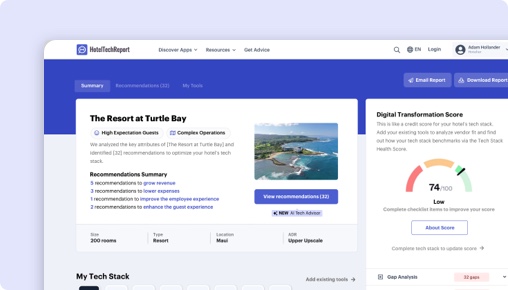
Sorry, this functionality is only available for verified hoteliers
The project dashboard is a free tool that is only available to verified hoteliers to make adopting new technology easier by streamlining their research and simplifying their communication workflow.

freetobook vs. Rentlio:
Which Is Right for You?


TLDR
We analyzed 137 verified hotelier reviews, compared feature sets, pricing, and real-world case studies to break down where each platform delivers. The right choice depends on your property type and priorities:
freetobook shines in ease of use and customer support , with exclusive features like Guest Messaging and Ancillary revenue tracking.
Rentlio shines , with exclusive features like On premise and Mobile App.
How Does freetobook Compare to Rentlio?
Side-by-side ratings based on 137 verified hotelier reviews on HTR.
| HTScore |
|
|
| Likelihood to Recommend |
|
|
| Ease of Use |
|
|
| Customer Support |
|
|
| Value for Money |
|
|
| Starting Price | From $200/mo | From $1,500/mo |
| Verified Reviews | 137 | 0 |
What Are the Pros and Cons of freetobook vs Rentlio?
After analyzing 137 verified reviews, freetobook users most value its ease of use, pricing/value for money, guest experience enhancements, while Rentlio users highlight . Click any theme to see what reviewers say.
|
freetobook
|
Rentlio
|
|---|---|
| Pros | |
|
+
Ease of Use
▾
|
|
|
+
Pricing/Value for Money
▾
|
|
|
+
Guest Experience Enhancements
▾
|
|
|
+
Channel Management
▾
|
|
| Cons | |
|
−
Customization
▾
|
|
|
−
Self-Catering Focus
▾
|
|
|
−
Handling of Single vs. Double Occupancy Rates
▾
|
|
freetobook vs Rentlio: Rankings by Hotel Segment
How each product ranks among Property Management Systems vendors for different property sizes, types, and regions — based on verified reviews from hoteliers in each segment.
By Hotel Size
| Segment |
freetobook
|
Rentlio
|
|---|---|---|
| Small (10-24 rooms) ▾ | #28 26 reviews | — |
| Mid-Size (25-74 rooms) | #53 2 reviews | — |
| X-Large (200+ rooms) | #25 1 reviews | — |
By Property Type
| Segment |
freetobook
|
Rentlio
|
|---|---|---|
| Boutique ▾ | #23 24 reviews | — |
| Luxury ▾ | #26 20 reviews | — |
| Branded / Chain ▾ | #31 6 reviews | — |
| Extended Stay ▾ | #26 5 reviews | — |
By Region
| Segment |
freetobook
|
Rentlio
|
|---|---|---|
| North America ▾ | #28 6 reviews | — |
| Europe ▾ | #8 94 reviews | — |
| Asia Pacific | #22 2 reviews | — |
| Middle East | #14 2 reviews | — |
The Decision
Choosing between freetobook and Rentlio hinges on your hotel’s specific needs, operational scale, and budget. Both platforms aim to streamline property management, but their approach and feature depth differ significantly. While Rentlio positions itself as a holistic hotel management solution, freetobook offers a more focused, user-friendly experience tailored mainly to small independents and B&Bs. Which system aligns better with your hotel’s growth plans and operational style?
Is freetobook or Rentlio Better for Hotels?
freetobook excels in ease of use, boasting a 4.91/5 rating and over 129 reviews, with recent feedback reinforcing its popularity among small and independent properties. Its simple interface and integrated channel management make daily operations more manageable, especially for teams with limited technical expertise. Rentlio, by contrast, has no ratings or reviews yet, offering no current user feedback to validate its effectiveness or usability.
freetobook’s recent reviews highlight its intuitive design and dedicated support, making onboarding smoother for staff unfamiliar with PMS systems. Rentlio’s lack of user ratings leaves its usability unverified, which is risky when evaluating a system that promises to unify multiple operational facets. Given the recent review activity and higher rating, freetobook clearly has the more proven track record for hotel managers seeking an accessible, reliable PMS.
Do you prioritize proven user satisfaction and support, or are you willing to risk newer, unreviewed solutions like Rentlio?
freetobook vs Rentlio: Which Should Your Hotel Choose?
If your hotel needs a straightforward, highly-rated property management system focused on reservation and channel management, go with freetobook. Its strengths lie in usability, excellent customer support, and features tailored for small to medium-sized properties—particularly B&Bs, inns, and budget hotels. Rentlio might suit larger hotels or those seeking an all-in-one platform that covers a broader range of operational tasks, but without user reviews or a proven market presence, caution is advised.
For hotels prioritizing ease of onboarding, quick staff adoption, and a strong reputation backed by recent reviews, freetobook is the clear choice. Conversely, if your hotel values extensive on-premise options, multi-lingual support, and advanced group or task management features, Rentlio’s feature set could appeal, though it currently lacks user validation.
In summary: Small, independent hotels and B&Bs focused on booking efficiency and support should favor freetobook. Larger, multi-property operations looking for integrated management tools might consider Rentlio—but only if they’re comfortable with its unverified market presence.
Is freetobook or Rentlio Easier to Use?
freetobook’s UI scores a remarkable 4.91 out of 5 based on user reviews, emphasizing its user-friendliness and minimal learning curve. Its onboarding process is rated at 4.9/5, with many users mentioning how quickly staff can get up to speed, even with minimal technical background. Support quality is also high, with a 4.91/5 rating and comments praising personalized, responsive assistance.
Rentlio, however, has no publicly available ratings or reviews on ease of use, onboarding, or support, leaving its user experience unverified. This absence suggests either a nascent market presence or limited user engagement. Without tangible feedback, it’s impossible to gauge whether Rentlio’s interface is as accessible as freetobook’s.
Edge: freetobook.
Which Has Better Features: freetobook or Rentlio?
freetobook offers 25 shared features with Rentlio, but it also has 13 features exclusive to its platform, including automated space optimization, digital registration, guest messaging, and employee shift planning. Its feature set is tailored toward small properties, with tools designed to automate reservations, enhance guest communications, and track ancillary revenue.
Rentlio’s unique features—like tax configuration, automated night audits, multi-lingual support, and task management—indicate a broader scope suitable for larger or multi-property operations. It offers 11 features exclusively, but with fewer verified partners (11 vs. 4 for freetobook), its reach and proven integrations are limited.
Given the feature counts and user validation, freetobook’s more comprehensive and tested feature suite provides better value for small and mid-sized hotels seeking core PMS functions with added automation.
Edge: freetobook.
Which Has Better Customer Support: freetobook or Rentlio?
freetobook’s customer support scores 4.91/5 based on recent reviews, with hoteliers praising its quick, knowledgeable, and personalized assistance. Users frequently mention how support helps them optimize their operations and resolve issues swiftly, which is critical for small teams.
Rentlio shows no available support ratings or reviews, making it impossible to assess its responsiveness or quality. Its lack of publicly shared customer feedback suggests that if support is a priority, freetobook currently offers a more reliable and proven experience.
Edge: freetobook.
Which Has More Integrations: freetobook or Rentlio?
freetobook integrates with 4 verified partners, including essential tools like Stripe and RoomPriceGenie. Its integrations cover booking channels and revenue management, providing enough connectivity for small properties to automate payments and pricing.
Rentlio, with 11 verified partners, offers a broader range of integrations, including tools for housekeeping, guest communication, and revenue management like PriceLabs, CheKin, and Hotellab. The larger number of partnerships indicates a more extensive ecosystem, beneficial for properties needing diverse operational tools.
Edge: Rentlio.
Which Do Hoteliers Rate Higher: freetobook or Rentlio?
freetobook’s reviews are recent and plentiful, with 27 in the last six months and an impressive 99% likelihood to recommend. Its users, mainly small B&Bs and inns, rate it highly for ease of use, support, and value, frequently emphasizing its simplicity and affordability.
Rentlio has no publicly available reviews or ratings, making it impossible to assess user sentiment or satisfaction. Without recent feedback, we cannot confidently say how hoteliers perceive Rentlio’s performance or support quality.
Edge: freetobook.
How Much Do freetobook and Rentlio Cost?
freetobook’s pricing is straightforward—$200 per month with no implementation or hidden fees. It does not offer a freemium model or tiered pricing, but its affordability and included features make it attractive for small operators.
Rentlio’s base price is $1,500 upfront, with no mention of monthly or per-room charges. Its higher cost and lack of detailed pricing options suggest it targets larger or multi-property hotels with bigger budgets, but the absence of flexible plans might deter small independents.
What Type of Hotel Should Use freetobook?
- Hotels that are small to medium-sized, especially B&Bs, inns, and budget hotels.
- Teams seeking an easy-to-learn system with strong booking and channel management.
- Properties prioritizing guest messaging, reputation tools, and automation.
- Hotels with limited or no in-house IT support.
- Hotels looking for proven, recent positive reviews and support.
Not ideal if you need extensive multi-lingual support, advanced group management, or on-premise deployment.
What Type of Hotel Should Use Rentlio?
- Larger hotels or chains that want an integrated management platform.
- Teams needing multi-lingual capabilities and on-premise deployment.
- Properties focused on automation, task management, and detailed operational control.
- Hotels seeking extensive partner integrations for revenue management and housekeeping.
- Hotels comfortable with a less proven, unreviewed system in exchange for broader features.
Not ideal if your hotel is small, relies heavily on support and ease of use, or cannot invest in a higher upfront cost without recent user validation.
Rentlio vs freetobook: The Bottom Line for Hotels
The core difference lies in market presence and proven user satisfaction. freetobook’s high ratings, recent reviews, and extensive support make it the safer choice for small and independent hotels seeking reliability and ease of use.
Choose freetobook if your priority is a user-friendly platform with strong support, recent positive feedback, and good value for money. Rentlio may appeal to larger or multi-property operators looking for a broader feature set and more integrations, but its current lack of verified reviews makes it a riskier option.
In conclusion, for most small hotels and B&Bs, freetobook’s established reputation and recent positive feedback make it the recommended choice. Larger operations should explore Rentlio’s offerings carefully, but proceed only if their extensive features align with your operational needs and budget.
How Much Do freetobook and Rentlio Cost?
Property Management Systems pricing is rarely straightforward. Here is what we know from each vendor's public pricing data. Always request a custom quote for your property size.
|
freetobook
|
Rentlio
|
|
|---|---|---|
| Starting Price | From $200/mo | From $1,500/mo |
Feature Comparison: freetobook vs Rentlio
These are the features each vendor has configured, organized by feature group — the same data shown in the vendor dashboard. Expand a group to compare features side by side.
| Feature |
freetobook
|
Rentlio
|
|---|---|---|
|
▾
Accounting & Finance
|
|
|
| Direct billing | ||
| RevPaR & ADR Reports | ||
| Multi-currency | ||
| Transactional Emails (booking, folios, etc) | ||
| Automated night audit | ||
|
▾
Marketing & Ecommerce
|
|
|
| Guest Communication (SMS Messaging) | ||
| Native Email Marketing | ||
| Guest profiles | ||
| Guest CRM | ||
| Gift Vouchers | ||
| Channel Manager | ||
| Booking Engine | ||
| Transactional Emails (booking, folios, etc) | ||
|
▾
Administration & Configuration
|
|
|
| Centralized user & role management | ||
| Multi-lingual | ||
| Cloud based | ||
| On premise | ||
|
▾
Customer Management
|
|
|
| Guest Communication (SMS Messaging) | ||
| Guest profiles | ||
| Centralized Messaging | ||
| Transactional Emails (booking, folios, etc) | ||
|
▾
Front Office
|
|
|
| Mobile Device Notes & Tasks (Voice-to-Text) | ||
| Mobile App | ||
| Automated night audit | ||
| Calendar view | ||
| Multi-lingual | ||
| Task Management | ||
| Automated reminders | ||
| Guest profiles | ||
| Tablet/Kiosk Check-in | ||
| Payment Requests | ||
| Centralized Messaging | ||
| Automated Space Optimization | ||
|
▾
Groups Management
|
|
|
| Group functionality | ||
| Automated Space Optimization | ||
|
▾
Guest Experience
|
|
|
| Integrated ID & Passport Scanner | ||
| Digital Registration | ||
| Guest App | ||
| Online Check-in | ||
| Online Checkout | ||
| Guest Messaging | ||
| Transactional Emails (booking, folios, etc) | ||
| ID Scanning & Registration Pre-fill | ||
| Lobby Kiosk | ||
|
▾
Housekeeping
|
|
|
| Housekeeping module | ||
| Housekeeping Mobile App | ||
| Real-Time Status Updates | ||
| Automated Assignments | ||
| Real Time Reporting | ||
| Shift Planning | ||
| Employee Messaging | ||
| Online Checkout | ||
|
▾
Payments
|
|
|
| Integrated Payment Terminal & Card Reader | ||
| Direct billing | ||
| Multi-currency | ||
| Payment processing | ||
| Payment Requests | ||
|
▾
Reservations Management
|
|
|
| RevPaR & ADR Reports | ||
| Gift Vouchers | ||
| Channel Manager | ||
| Integrated CRS | ||
| Drag-n-Drop Tapechart | ||
| Rate Management | ||
| Automated Space Optimization | ||
| Rules Based Room Assignments | ||
| Transactional Emails (booking, folios, etc) | ||
|
▾
Revenue Management
|
|
|
| RevPaR & ADR Reports | ||
| Custom rates | ||
| Ancillary revenue tracking | ||
| Revenue management module | ||
| Base Pricing | ||
|
▾
Taxes & Compliance
|
|
|
| PCI Compliant | ||
| GDPR Compliant | ||
| SOC2 Complaint | ||
| Tax Configuration | ||
|
▾
Support & Training
|
|
|
| Online 24/7 support | ||
|
▾
Food & Beverage
|
|
|
| EPoS | ||
|
▾
Spa
|
|
|
| Spa & Wellness Module |
freetobook vs Rentlio: The Bottom Line
What hoteliers love
The software’s user-friendly nature is a major highlight, enabling even less tech-savvy users to manage their properties efficiently. This simplicity... The software’s user-friendly nature is a major highlight, enabling even less tech-savvy users to manage their properties efficiently. This simplicity allows property owners and managers to easily navigate the system, reducing the time required for administrative tasks and thereby increasing focus on improving guest services.
Freetobook is perceived as excellent value for money, offering advanced features at competitive pricing. Users recognize its affordability in comparis... Freetobook is perceived as excellent value for money, offering advanced features at competitive pricing. Users recognize its affordability in comparison to other systems, which is particularly attractive to small accommodation businesses looking to maintain professional operations without significant outlays.
Freetobook enables hotels to enhance the guest experience through features like the GuestAppy system, which provides personalized booking confirmation... Freetobook enables hotels to enhance the guest experience through features like the GuestAppy system, which provides personalized booking confirmations and tailored options. Users note these additions positively impact guest satisfaction and help in delivering a more professional service.
Where hoteliers push back
Although generally praised for its flexibility, some users feel there's room for improvement regarding customization options, particularly for invoice... Although generally praised for its flexibility, some users feel there's room for improvement regarding customization options, particularly for invoices and booking summaries. Enhanced options would allow users to better tailor the system to specific operational needs, improving overall satisfaction.
The system is primarily designed for hotels, and some reviewers have indicated a need for more self-catering features, suggesting potential for expans... The system is primarily designed for hotels, and some reviewers have indicated a need for more self-catering features, suggesting potential for expansion in this area. Addressing this could make Freetobook more attractive to a wider variety of accommodation providers.
Unique capabilities
Unique capabilities
Where the ratings diverge most
Frequently Asked Questions About freetobook vs Rentlio
Can freetobook replace Rentlio?
It depends on your requirements. freetobook and Rentlio share many core Property Management Systems features, but each has unique capabilities. freetobook offers 4 verified integration partners, while Rentlio offers 11. Review the feature comparison above to see where they differ before switching.
Which is better for small or independent hotels?
Small hotels should prioritize ease of use and fast onboarding. freetobook leads in ease of use at 4.9/5 vs 0.0/5. Look for transparent pricing and a trial or demo option. Filter reviews on each product page by property size to hear from hotels like yours.
Do freetobook or Rentlio offer a free plan?
freetobook: No. Rentlio: No. Neither product currently offers a free tier. Most Property Management Systems vendors offer demos or trials — request one from each to evaluate before committing.
How Does HTR Evaluate and Rank freetobook and Rentlio?
The HT Score is a composite ranking that considers 4 criteria groups and over a dozen variables to help hoteliers objectively compare hotel technology products. freetobook has an HT Score of 86 and Rentlio has 0. Here is how the score is calculated.
| Criteria Group | Weight | What It Measures |
|---|---|---|
| Customer Ratings & Reviews |
|
How highly do users recommend this product? Ratings Score, Review Volume, Share of Voice, Review Depth, Review Recency, Success Stories ▾ The most heavily weighted factor. Analyzes average satisfaction ratings (likelihood to recommend, ease of use, support, ROI), total review count relative to category peers, review recency (at least 20 reviews in the trailing 6 months), and share of voice across unique hotel clients to detect selection bias. |
| Partner Ecosystem |
|
How highly do tech partners recommend this company? Partner Recommendations, Integration Quantity, Integration Quality ▾ Evaluates partner recommendations as expert votes of confidence, the number of verified integrations, and ecosystem quality — the average HT Scores of integration partners. Products with higher-quality integration ecosystems are more likely to deliver a connected tech stack. |
| Customer Centricity |
|
How customer-centric is this organization? Certified Support, Review Consistency, Profile Completeness ▾ Assesses whether the company has earned HTR Customer Support Certification, maintains consistent review collection over time (an indicator of feedback-driven culture), and keeps product profiles complete with capabilities, screenshots, pricing, and features. |
| Reach, Staying Power & Resources |
|
How extensive is this company's reach and resourcing? Geographic Reach, Staying Power, Company Resources, Trending Score ▾ Measures global presence (countries and regions served), years in business as a stability proxy, team headcount as a resource proxy, and a trending score based on trailing-twelve-month buyer inquiries, reviews, partner recommendations, and press activity. |
Customer ratings and reviews are by far the most important factor in the HT Score algorithm. HTR does not accept payment for higher rankings. All reviews are verified — only hotel industry practitioners with confirmed affiliations can submit ratings. View full HT Score methodology →
What Other Property Management Systems Comparisons Are Hoteliers Reading?
Explore more head-to-head comparisons based on verified hotelier reviews.





Contents
Get Your Free AI Analyst Report
Custom recommendations tailored to your property


Let´s lookup your hotel information
Still weighing your property management systems options?
A few popular systems from our property management systems guide — or let our AI score each one against your specific property in about two minutes.


