

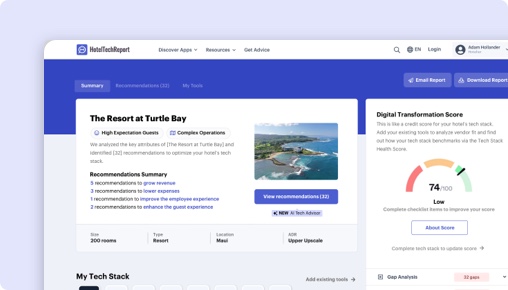
Sorry, this functionality is only available for verified hoteliers
The project dashboard is a free tool that is only available to verified hoteliers to make adopting new technology easier by streamlining their research and simplifying their communication workflow.

Unified Inbox by Bookboost vs. Duve - Communication Hub:
Which Is Right for You?

TLDR
We analyzed 1,041 verified hotelier reviews, compared feature sets, pricing, and real-world case studies to break down where each platform delivers. The right choice depends on your property type and priorities:
Bookboost shines in guest messaging speed and responsiveness — especially for resort properties (5.0/5), with exclusive features like Guest History and SMS text messaging.
Duve shines in guest messaging / centralized communication — especially for motel properties (5.0/5), with exclusive features like Mobile Checkin and Guest Profiles.
How Does Unified Inbox by Bookboost Compare to Duve - Communication Hub?
Side-by-side ratings based on 1,041 verified hotelier reviews on HTR.
| HTScore |
|
|
| Likelihood to Recommend |
|
|
| Ease of Use |
|
|
| Customer Support |
|
|
| Value for Money |
|
|
| Starting Price | From $400/mo | From $900/mo |
| Verified Reviews | 196 | 845 |
What Are the Pros and Cons of Unified Inbox by Bookboost vs Duve - Communication Hub?
After analyzing 1,041 verified reviews, Bookboost users most value its guest messaging speed and responsiveness, automation, templates, and bots, centralized multichannel inbox, while Duve users highlight guest messaging / centralized communication, guest app / digital guest journey personalization, upselling / ancillary revenue. Click any theme to see what reviewers say.
|
Bookboost
|
Duve
|
|---|---|
| Pros | |
|
+
Guest messaging speed and responsiveness
▾
|
+
Guest messaging / centralized communication
▾
|
|
+
Automation, templates, and bots
▾
|
+
Guest app / digital guest journey personalization
▾
|
|
+
Centralized multichannel inbox
▾
|
+
Upselling / ancillary revenue
▾
|
|
+
Guest journey personalization
▾
|
+
Support / account management / implementation help
▾
|
| Cons | |
|
−
Search, stability, and notification issues
▾
|
−
Usability / onboarding / configuration complexity
▾
|
|
−
Team assignment and multi-property workflow
▾
|
−
PMS / system integrations and synchronization
▾
|
|
−
AI replies / AI agent / translation
▾
|
|
Bookboost vs Duve: Rankings by Hotel Segment
How each product ranks among Guest Messaging Software vendors for different property sizes, types, and regions — based on verified reviews from hoteliers in each segment.
By Hotel Size
| Segment |
Bookboost
|
Duve
|
|---|---|---|
| Small (10-24 rooms) ▾ | #8 33 reviews | #1 168 reviews |
| Mid-Size (25-74 rooms) ▾ | #6 97 reviews | #2 264 reviews |
| Large (75-199 rooms) ▾ | #9 21 reviews | #2 201 reviews |
| X-Large (200+ rooms) ▾ | #3 35 reviews | #2 76 reviews |
By Property Type
| Segment |
Bookboost
|
Duve
|
|---|---|---|
| Boutique ▾ | #5 112 reviews | #2 303 reviews |
| Luxury ▾ | #3 96 reviews | #2 344 reviews |
| Branded / Chain ▾ | #4 85 reviews | #2 244 reviews |
| Extended Stay ▾ | #4 26 reviews | #2 104 reviews |
By Region
| Segment |
Bookboost
|
Duve
|
|---|---|---|
| North America ▾ | #28 1 reviews | #6 65 reviews |
| Europe ▾ | #3 171 reviews | #1 308 reviews |
| Asia Pacific ▾ | #5 15 reviews | #2 25 reviews |
| Middle East ▾ | — | #1 286 reviews |
Is Unified Inbox by Bookboost or Duve - Communication Hub Better for Hotels?
Unified Inbox by Bookboost and Duve - Communication Hub both address guest messaging challenges by consolidating multiple communication channels into a single platform, reducing front-desk workload and improving guest engagement. Bookboost excels in unifying WhatsApp, email, SMS, OTAs, and social into guest-centric threads powered by an AI agent that drafts replies and escalates complex cases. Duve offers a broader guest experience suite, integrating communication with digital check-in, upselling, and task management supported by generative AI agents.
Bookboost fits hotels that prioritize a unified inbox with deep CRM and marketing campaign capabilities, especially multi-property operators seeking actionable guest profiles and automation. Duve suits properties aiming for comprehensive digital guest journeys, including contactless check-in, multi-channel messaging, and revenue-driving upselling features. Both products improve operational efficiency by centralizing guest communication and automating repetitive tasks but diverge in feature focus and integration scope.
Unified Inbox by Bookboost vs Duve - Communication Hub: Which Should Your Hotel Choose?
If your hotel is a city center or boutique property that values message centralization and marketing automation, choose Bookboost. It has 196 reviews with a 4.8/5 rating overall, and strong segment ratings including 4.8/5 for City Center Hotels (87 reviews) and Boutique Hotels (112 reviews). Reviewers note its multi-channel inbox reduces missed messages and enhances guest personalization through detailed guest histories and campaign context.
If you operate a large branded hotel, resort, or luxury property requiring seamless digital check-in, upselling, and operational task management, Duve fits better. Duve has 845 total reviews at 4.7/5, with 180 recent reviews averaging 4.5/5, reflecting current performance. It holds strong ratings in Branded Hotels (4.8/5, 280 reviews), Luxury Hotels (4.8/5, 379 reviews), and Resorts (4.8/5, 297 reviews). Its multi-functional guest app and AI-driven upsell tools suit properties focused on revenue and guest journey digitization.
Data for small vacation rentals and extended stay segments is thinner for Bookboost and Duve but trends suggest Duve’s broader feature set favors larger, tech-forward properties, while Bookboost appeals to teams seeking CRM-driven guest communication. Note Bookboost’s recent review volume dropped 77%, potentially signaling less current feedback on ongoing product evolution.
Is Unified Inbox by Bookboost or Duve - Communication Hub Easier to Use?
Both products share identical Ease of Use scores at 4.7/5 with similar Onboarding ratings (Bookboost 4.7/5, Duve 4.6/5). Bookboost reviewers frequently praise the intuitive interface and easy management of multi-channel conversations, highlighting reduced training time and quick adoption by staff. Duve users commend the accessible guest app design and the simplicity of setting up customer journeys, though some mention complexity in configuring workflows or multi-property setups.
Front desk teams benefit from Bookboost’s unified inbox that minimizes switching between platforms, while Duve’s integrated check-in and messaging streamlines tasks but may require more initial configuration effort. Both products demonstrate strong usability but differ in complexity based on the scope of features adopted.
Edge: Even.
Which Has Better Features: Unified Inbox by Bookboost or Duve - Communication Hub?
Bookboost offers 24 exclusive features focusing on guest communication and marketing automation, including secured data protection, guest history, SMS messaging, an open API, Facebook Messenger integration, a ticketing system, analytics dashboards, team KPIs, and behavioral marketing campaigns. These features enable hotels to personalize guest journeys, automate messaging with AI, and manage multi-property workflows efficiently.
Duve provides 29 unique features emphasizing digital guest journey management and operational integration: PMS integration, mobile check-in/out, local recommendations, payments, automatic translations, segmentation, multi-channel message delivery (email, SMS, WhatsApp, chat), upselling orchestration, door lock integration, ID verification, room upgrade merchandising, and recurring tasks. These features support contactless operations, upsell revenue, and comprehensive guest self-service.
Bookboost’s strength lies in CRM-driven messaging and marketing campaign automation, impacting guest retention and communication efficiency. Duve excels in operational digitalization with robust check-in flows and ancillary revenue tools. The difference reflects Bookboost’s marketing focus versus Duve’s all-in-one guest experience platform.
Edge: Duve.
Which Has Better Customer Support: Unified Inbox by Bookboost or Duve - Communication Hub?
Bookboost leads slightly in customer support with a 4.8/5 rating versus Duve’s 4.6/5, while onboarding scores are close (4.7/5 Bookboost, 4.6/5 Duve). Bookboost reviewers consistently emphasize rapid, proactive support and a responsive team that helps with onboarding and feature requests. Duve’s support is praised for professionalism and responsiveness but has a notable subset of reviews citing slow responses and difficulties with integration support.
Both vendors receive strong marks for support quality, but Bookboost’s smaller user base and personalized assistance appear to translate into higher satisfaction. Duve’s larger scale brings variability in support experiences, particularly around technical and integration challenges.
Edge: Even.
Which Has More Integrations: Unified Inbox by Bookboost or Duve - Communication Hub?
Duve has twice as many verified partners as Bookboost: 72 versus 36, with 17 shared integrations including RoomRaccoon, HOTELTIME, apaleo, Sirvoy, SiteMinder, Oracle Hospitality, Mews, and Little Hotelier. Bookboost uniquely integrates with hotelkit, Preno, SnapShot, Oaky, Maestro PMS, and Straiv. Duve offers additional connections to Priority Software, eviivo, WebRezPro, Guesty, Stayntouch, Simple Booking, and others.
Duve’s broader integration ecosystem supports PMS data synchronization, door lock control, payment processing, and guest app features, better suiting larger properties requiring extensive system connectivity. Bookboost’s integrations focus on communication, analytics, and marketing tools, fitting hotels emphasizing guest messaging and campaign management.
Edge: Duve.
Which Do Hoteliers Rate Higher: Unified Inbox by Bookboost or Duve - Communication Hub?
Both products hold nearly equal overall ratings (Bookboost 4.8/5, Duve 4.7/5), with Duve having substantially more reviews (845 total, 180 in last 6 months) versus Bookboost (196 total, 5 recent). However, Bookboost’s recent review volume has dropped 77% from prior periods, limiting insight into current user sentiment. Duve’s last 6 months rating of 4.5/5 is slightly below its overall 4.7/5, indicating some recent challenges but still strong satisfaction.
Segment-specific ratings favor Bookboost in City Center Hotels (4.8/5, 87 reviews), Hostels (4.8/5, 54 reviews), Resorts (5/5, 39 reviews), and Boutique Hotels (4.8/5, 112 reviews). Duve dominates in Luxury Hotels (4.8/5, 379 reviews), Branded Hotels (4.8/5, 280 reviews), Resorts (4.8/5, 297 reviews), and Bed & Breakfasts (4.8/5, 197 reviews).
Review volume and recency favor Duve as the more tested option in the current market, while Bookboost’s high ratings mostly reflect past performance.
Edge: Even.
How Much Do Unified Inbox by Bookboost and Duve - Communication Hub Cost?
Bookboost charges a base price of $400 with no published implementation fees, per-room, or flat monthly pricing. Duve’s base price is $900, also without additional published fees or trial offers. Neither product offers freemium or trial options.
Both products require direct vendor contact for detailed pricing based on property size and feature requirements. Duve’s higher base price reflects its broader feature set and market positioning for larger properties, while Bookboost offers a more modest entry point for communication-centric use cases.
What Type of Hotel Should Use Unified Inbox by Bookboost?
-
Hotels that operate multiple properties and need a centralized inbox combining WhatsApp, SMS, email, and OTA messages into guest-specific threads to improve response times and service consistency. (Supported by multi-property case studies and feature set)
-
Teams that prioritize marketing automation and guest journey personalization with behavioral marketing campaigns and prediction tools to drive loyalty and upsells. (Based on exclusive features including guest profiling, prediction & forecasting, and campaign management)
-
Properties with front desk teams seeking to reduce manual messaging and streamline escalation workflows through AI-assisted ticketing and chatbot automation. (Review highlights of AI drafting replies and ticket resolution)
-
Hotels looking for integrations with specialized tools like FLEXIPASS digital keys and advanced analytics dashboards for operational insights. (Unique integrations and analytics dashboard)
-
Not ideal if your primary need is a fully integrated digital guest journey with mobile check-in/out or embedded payment features, as these are limited or absent.
-
Not ideal if your property requires extensive PMS integration and real-time synchronization beyond messaging channels.
-
Not a fit for hotels that want extensive upselling orchestration and in-app guest service ordering features.
What Type of Hotel Should Use Duve - Communication Hub?
-
Large branded hotel chains and luxury resorts requiring a unified platform for guest messaging, contactless check-in/out, and integrated upselling across multiple channels. (Supported by segment ratings and case studies from branded hotels and large portfolios)
-
Properties aiming to digitize the guest journey end-to-end with mobile check-in, room selection, payments, and door lock integration enhancing operational efficiency.
-
Hotels seeking AI-driven 24/7 guest communication with generative AI agents capable of personalized recommendations, sentiment analysis, and automated replies to scale service.
-
Teams wanting robust multi-channel messaging including WhatsApp, SMS, email, and in-app chat with scheduled messaging and broadcast capabilities for targeted guest groups.
-
Not ideal if budget constraints limit investment, as Duve’s base price is more than double Bookboost’s and some users cite pricing as a concern.
-
Not recommended for smaller properties or those with limited technical resources due to initial setup complexity and occasional integration delays.
-
Not optimal if your main focus is deeply personalized marketing campaigns and CRM-driven guest segmentation without the need for comprehensive guest journey digitalization.
Unified Inbox by Bookboost vs Duve - Communication Hub: The Bottom Line for Hotels
Unified Inbox by Bookboost and Duve Communication Hub both solve the core problem of fragmented guest messaging by unifying communication channels and automating responses. Bookboost centers on delivering a powerful, AI-driven guest communication platform with strong marketing automation tailored for multi-property and CRM-focused operations. Duve provides a broader digital guest journey suite integrating messaging, contactless check-in, upselling, and task management to elevate operational efficiency and revenue.
Choose Bookboost if your property prioritizes multi-channel message centralization, detailed guest profiling, and marketing campaign automation with a moderate pricing entry point. Its 24 unique features such as behavioral marketing campaigns and ticketing systems support operational teams managing multiple properties. Hotels in segments like City Center, Boutique, and Hostels have rated it highly, though recent review activity has dropped sharply, so verify current support responsiveness.
Opt for Duve if your hotel requires comprehensive guest digitalization, including PMS connectivity, mobile check-in/out, multi-channel messaging, and AI-powered upselling orchestration. Its 29 exclusive features support revenue generation and guest self-service for large branded hotels and luxury resorts. Duve’s extensive integration network and high review volume (845 total, 180 recent) provide confidence in current product maturity despite some reports of integration challenges and higher costs.
The decision hinges on whether your hotel seeks a communication- and marketing-centric platform (Bookboost) or an all-in-one guest experience and operational system (Duve). Both deliver strong usability and support, but Duve’s broader scope and integration depth suit larger, tech-diverse portfolios, while Bookboost’s focused approach benefits properties emphasizing guest messaging efficiency and marketing automation.
How Much Do Unified Inbox by Bookboost and Duve - Communication Hub Cost?
Guest Messaging Software pricing is rarely straightforward. Here is what we know from each vendor's public pricing data. Always request a custom quote for your property size.
|
Bookboost
|
Duve
|
|
|---|---|---|
| Starting Price | From $400/mo | From $900/mo |
Feature Comparison: Unified Inbox by Bookboost vs Duve - Communication Hub
These are the features each vendor has configured, organized by feature group — the same data shown in the vendor dashboard. Expand a group to compare features side by side.
| Feature |
Bookboost
|
Duve
|
|---|---|---|
|
▾
Unified Inbox
|
|
|
| Team Messaging | ||
| Broadcast Messaging | ||
| Desktop App (non-web based) | ||
| Photo Sharing | ||
| Mobile App | ||
| Mobile Friendly | ||
| Live Translations | ||
| Website Livechat | ||
|
▾
Multi-Channel
|
|
|
| Whatsapp Integration | ||
| Facebook Messenger Integration | ||
| SMS text messaging | ||
| Website Livechat | ||
|
▾
Automation
|
|
|
| Message Routing | ||
| Automated Replies | ||
| Chatbot Booking Agent | ||
| Broadcast Messaging | ||
| Upsell Fulfillment Tracking | ||
| Open API | ||
| Automated Workflows | ||
|
▾
Upselling & Ancillaries
|
|
|
| Upsell Marketplace | ||
| Offer Campaigns | ||
| Upsell Fulfillment Tracking | ||
| Purchase Links | ||
| Charge to Folio | ||
| Room Upgrades Campaigns | ||
| Upselling Campaigns | ||
|
▾
Task & Request Management
|
|
|
| Ticketing System | ||
| Tasks & Checklists | ||
| Inspections | ||
| Recurring Tasks | ||
| Upsell Fulfillment Tracking | ||
|
▾
Surveys & Feedback
|
|
|
| Messaging Guest Surveys | ||
| TripAdvisor Review Partner | ||
| Guest Reviews Campaigns | ||
|
▾
Reporting & Analytics
|
|
|
| Analytics dashboard | ||
| Guest History | ||
| Upsell Fulfillment Tracking | ||
| Team KPIs Dashboard | ||
| Custom Goal Setting | ||
|
▾
Compliance & Privacy
|
|
|
| Automated Opt-In/Consent Collection | ||
| Secured Data Protection | ||
| Open API | ||
|
▾
Digital Registration & Check-in
|
|
|
| Document & Passport Scanning | ||
| Credit Card Authorization | ||
| Mobile Keys | ||
| Custom Fields | ||
|
▾
Pre-Stay
|
|
|
| Chatbot Booking Agent | ||
| Booking Recovery Campaigns | ||
| Behavioral Marketing Campaigns | ||
| Email to Chatbot Automation | ||
| Smooth Handover to Human Agents | ||
| Click to Call | ||
| Lead Qualification | ||
| OTA Price Comparison | ||
| Interface Personalization | ||
|
▾
In-Stay & Post Stay
|
|
|
| Digital Check-in | ||
| Room Upgrades Campaigns | ||
| Upselling Campaigns | ||
| Automated Workflows | ||
| Custom Routing and Escalations | ||
| Pre-programmed Guest Notifications | ||
| Guest Reviews Campaigns | ||
| Retention Campaigns | ||
|
▾
Back-Office
|
|
|
| Unified Omnichannel Inbox | ||
| Status Tabs in Inbox Navigation | ||
| Assigning Agents | ||
| Canned Responses | ||
| User Profile Customizations | ||
| Multi Property Management | ||
| Customizable Working Hours | ||
| Unlimited Users | ||
|
▾
Artificial Intelligence
|
|
|
| Chatbot Booking Agent | ||
| Sentiment Analysis | ||
| Self-Learning NLP | ||
| Syntax & Semantic Analysis | ||
| Behavioral Analysis | ||
| Customer Profiling | ||
| Prediction & Forecasting |
Real-World Results: Bookboost vs Duve by Business Goal
We analyzed 16 verified case studies to compare what hotels actually achieve with each platform across four key business objectives.
Northern Lights Village
Small
"Bookboost is an efficient and reliable tool, which aggregates all our messaging channels into one intuitive interface. The integration with our PMS allows us to have all relevant i..."
 סטאי תל אביב - The Setai, Tel Aviv
Large
"Duve was a game changer for our customer service. I knew the platform would help us connect with guests but I was amazed at how cleverly simple it all is, even guests who are not v..."
 LINDEMANN HOTELS®
Small
"Whether it’s on the website, after the booking has been made or during and after a stay, Bookboost enables us to have control over all incoming and outgoing communication which mak..."
 Brown Hotels
Large
"While scaling up and growing in terms of more hotel rooms and more hotels in different countries we found it difficult to communicate with our guests in a very personal way. Duve f..."
Bookboost vs Duve: The Bottom Line
What hoteliers love
Many reviews highlight how Bookboost speeds up guest response times and makes communication feel immediate. Hotels say this helps them resolve request... Many reviews highlight how Bookboost speeds up guest response times and makes communication feel immediate. Hotels say this helps them resolve requests faster, improve guest satisfaction, and reduce the effort compared with phone calls or back-and-forth email.
Users value templates, bots, and automated messaging for handling repetitive guest requests and speeding up replies. Several reviewers want stronger A... Users value templates, bots, and automated messaging for handling repetitive guest requests and speeding up replies. Several reviewers want stronger AI-generated responses, better automatic phrases, and more control over timing and triggers to make automation feel more personal and effective.
Users most often praise Bookboost for bringing guest communication into one inbox, combining emails, chats, WhatsApp, and OTA messages. This helps hot... Users most often praise Bookboost for bringing guest communication into one inbox, combining emails, chats, WhatsApp, and OTA messages. This helps hotel teams manage requests faster, avoid missed messages, and keep operations organized across properties and departments.
Where hoteliers push back
A meaningful set of reviews points to usability problems such as weak search, lag, missed messages, noisy notifications, and occasional instability. T... A meaningful set of reviews points to usability problems such as weak search, lag, missed messages, noisy notifications, and occasional instability. These issues matter because hotels depend on the product to catch every guest request quickly and keep inbox handling reliable.
Reviewers often mention the value of assigning conversations to the right person or team and managing multiple properties from one place. This is espe... Reviewers often mention the value of assigning conversations to the right person or team and managing multiple properties from one place. This is especially useful for larger hotel groups, though some note issues with inbox routing, team visibility, and messages being assigned when staff are off.
Ranks higher for
Unique capabilities
What hoteliers love
Reviewers most often say Duve centralizes guest communication in one hub, making it easier to handle questions, requests, and follow-ups across the st... Reviewers most often say Duve centralizes guest communication in one hub, making it easier to handle questions, requests, and follow-ups across the stay. Hotels value the speed and convenience of replying through multiple channels like WhatsApp, SMS, email, and in-app chat without juggling separate tools.
The guest app is valued as a branded, self-service touchpoint where guests can view hotel services, order items, and manage parts of their stay from o... The guest app is valued as a branded, self-service touchpoint where guests can view hotel services, order items, and manage parts of their stay from one place. Reviewers also want more flexibility in branding, layouts, category management, and content organization, especially for multi-property groups.
Upselling is one of Duve's biggest commercial use cases, with many hotels saying it helps convert room upgrades, late checkout, amenities, and service... Upselling is one of Duve's biggest commercial use cases, with many hotels saying it helps convert room upgrades, late checkout, amenities, and service offers into extra revenue. Reviewers like that Duve surfaces these offers before arrival and during the stay, making upsell more natural and less labor-intensive for staff.
Where hoteliers push back
While many reviewers find Duve easy to use, others say setup and ongoing configuration can be confusing, especially for new users or multi-property te... While many reviewers find Duve easy to use, others say setup and ongoing configuration can be confusing, especially for new users or multi-property teams. The most common friction points are unclear workflows, too many settings, and a need for better guidance when customizing the system for hotel-specific operations.
Integration with PMS and other hotel systems is a major theme: when it works, it removes manual entry and keeps guest details flowing into operations.... Integration with PMS and other hotel systems is a major theme: when it works, it removes manual entry and keeps guest details flowing into operations. But many reviewers report sync delays, compatibility issues, limited editability from PMS data, or difficulty connecting to systems like Opera, Mews, Cloudbeds, Protel, and other tools.
Ranks higher for
Unique capabilities
Frequently Asked Questions About Unified Inbox by Bookboost vs Duve - Communication Hub
Can Unified Inbox by Bookboost replace Duve - Communication Hub?
It depends on your requirements. Unified Inbox by Bookboost and Duve - Communication Hub share many core Guest Messaging Software features, but each has unique capabilities. Unified Inbox by Bookboost offers 36 verified integration partners, while Duve - Communication Hub offers 72. Review the feature comparison above to see where they differ before switching.
Which is better for small or independent hotels?
Small hotels should prioritize ease of use and fast onboarding. Unified Inbox by Bookboost leads in ease of use at 4.7/5 vs 4.7/5. Look for transparent pricing and a trial or demo option. Filter reviews on each product page by property size to hear from hotels like yours.
Do Unified Inbox by Bookboost or Duve - Communication Hub offer a free plan?
Unified Inbox by Bookboost: No. Duve - Communication Hub: No. Neither product currently offers a free tier. Most Guest Messaging Software vendors offer demos or trials — request one from each to evaluate before committing.
How Does HTR Evaluate and Rank Unified Inbox by Bookboost and Duve - Communication Hub?
The HT Score is a composite ranking that considers 4 criteria groups and over a dozen variables to help hoteliers objectively compare hotel technology products. Bookboost has an HT Score of 91 and Duve has 98. Here is how the score is calculated.
| Criteria Group | Weight | What It Measures |
|---|---|---|
| Customer Ratings & Reviews |
|
How highly do users recommend this product? Ratings Score, Review Volume, Share of Voice, Review Depth, Review Recency, Success Stories ▾ The most heavily weighted factor. Analyzes average satisfaction ratings (likelihood to recommend, ease of use, support, ROI), total review count relative to category peers, review recency (at least 20 reviews in the trailing 6 months), and share of voice across unique hotel clients to detect selection bias. |
| Partner Ecosystem |
|
How highly do tech partners recommend this company? Partner Recommendations, Integration Quantity, Integration Quality ▾ Evaluates partner recommendations as expert votes of confidence, the number of verified integrations, and ecosystem quality — the average HT Scores of integration partners. Products with higher-quality integration ecosystems are more likely to deliver a connected tech stack. |
| Customer Centricity |
|
How customer-centric is this organization? Certified Support, Review Consistency, Profile Completeness ▾ Assesses whether the company has earned HTR Customer Support Certification, maintains consistent review collection over time (an indicator of feedback-driven culture), and keeps product profiles complete with capabilities, screenshots, pricing, and features. |
| Reach, Staying Power & Resources |
|
How extensive is this company's reach and resourcing? Geographic Reach, Staying Power, Company Resources, Trending Score ▾ Measures global presence (countries and regions served), years in business as a stability proxy, team headcount as a resource proxy, and a trending score based on trailing-twelve-month buyer inquiries, reviews, partner recommendations, and press activity. |
Customer ratings and reviews are by far the most important factor in the HT Score algorithm. HTR does not accept payment for higher rankings. All reviews are verified — only hotel industry practitioners with confirmed affiliations can submit ratings. View full HT Score methodology →
What Other Guest Messaging Software Comparisons Are Hoteliers Reading?
Explore more head-to-head comparisons based on verified hotelier reviews.






Contents
Get Your Free AI Analyst Report
Custom recommendations tailored to your property


Let´s lookup your hotel information
Still weighing your guest messaging software options?
A few popular systems from our guest messaging software guide — or let our AI score each one against your specific property in about two minutes.


