

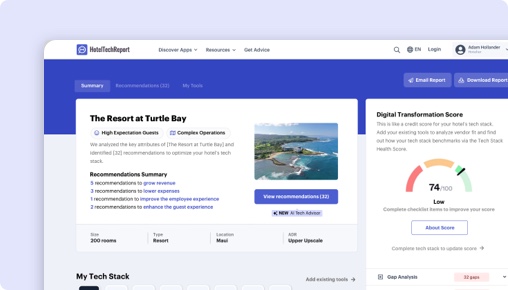
Sorry, this functionality is only available for verified hoteliers
The project dashboard is a free tool that is only available to verified hoteliers to make adopting new technology easier by streamlining their research and simplifying their communication workflow.

Unified Inbox by Bookboost vs. Duve - Communication Hub:
Which Is Right for You?

TLDR
We analyzed 898 verified hotelier reviews, compared feature sets, pricing, and real-world case studies to break down where each platform delivers. The right choice depends on your property type and priorities:
Bookboost shines when it comes to ease of use — especially for brand properties (5.0/5) , with exclusive features like Guest History and SMS text messaging.
Duve shines when it comes to guest communication and two-way messaging — especially for brand properties (0.0/5) , with exclusive features like Messaging Guest Surveys and Mobile Checkin.
How Does Unified Inbox by Bookboost Compare to Duve - Communication Hub?
Side-by-side ratings based on 898 verified hotelier reviews on HTR.
| HTScore |
|
|
| Likelihood to Recommend |
|
|
| Ease of Use |
|
|
| Customer Support |
|
|
| Value for Money |
|
|
| Starting Price | From $400/mo | From $900/mo |
| Verified Reviews | 192 | 706 |
What Are the Pros and Cons of Unified Inbox by Bookboost vs Duve - Communication Hub?
After analyzing 898 verified reviews, Bookboost users most value its ease of use, guest experience, ai-assisted responses, while Duve users highlight guest communication and two-way messaging, operational efficiency and front desk workload reduction, support responsiveness and implementation help. Click any theme to see what reviewers say.
|
Bookboost
|
Duve
|
|---|---|
| Pros | |
|
+
Ease of Use
▾
|
+
Guest communication and two-way messaging
▾
|
|
+
Guest Experience
▾
|
+
Operational efficiency and front desk workload reduction
▾
|
|
+
AI-Assisted Responses
▾
|
+
Support responsiveness and implementation help
▾
|
|
+
Multi-Channel Integration
▾
|
+
Guest App customization and white-label experience
▾
|
| Cons | |
|
−
AI-Assisted Responses
▾
|
−
PMS and third-party integrations
▾
|
|
−
Automated Communication
▾
|
−
Automation and scheduled messaging
▾
|
|
−
Search Functionality
▾
|
|
Bookboost vs Duve: Rankings by Hotel Segment
How each product ranks among Guest Messaging Software vendors for different property sizes, types, and regions — based on verified reviews from hoteliers in each segment.
By Hotel Size
| Segment |
Bookboost
|
Duve
|
|---|---|---|
| Small (10-24 rooms) ▾ | #7 31 reviews | #1 161 reviews |
| Mid-Size (25-74 rooms) ▾ | #6 96 reviews | #2 257 reviews |
| Large (75-199 rooms) ▾ | #9 18 reviews | #2 138 reviews |
| X-Large (200+ rooms) ▾ | #3 37 reviews | #2 68 reviews |
By Property Type
| Segment |
Bookboost
|
Duve
|
|---|---|---|
| Boutique ▾ | #4 105 reviews | #2 268 reviews |
| Luxury ▾ | #3 88 reviews | #2 310 reviews |
| Branded / Chain ▾ | #4 84 reviews | #2 221 reviews |
| Extended Stay ▾ | #3 23 reviews | #2 97 reviews |
By Region
| Segment |
Bookboost
|
Duve
|
|---|---|---|
| North America ▾ | #24 1 reviews | #6 63 reviews |
| Europe ▾ | #2 167 reviews | #1 260 reviews |
| Asia Pacific ▾ | #5 15 reviews | #4 19 reviews |
| Middle East ▾ | — | #1 274 reviews |
The Decision
Choosing between Bookboost and Duve for guest messaging hinges on your hotel's specific needs and priorities. Both platforms aim to streamline communication, enhance guest experiences, and boost revenue, but they differ significantly in features, user base, and overall approach. If your goal is a highly-rated, recent, and well-supported platform with a broad feature set, Duve’s superior review count and recent user feedback make it the more compelling choice.
Are you ready to dive into the nuances that set these two guest messaging solutions apart?
Is Bookboost or Duve Better for Hotels?
Both Bookboost and Duve aim to centralize guest communication and automate workflows, but their core strengths diverge. Bookboost’s Unified Inbox simplifies multi-channel messaging with a focus on operational efficiency, leveraging features like guest history, chatbots, and analytics. Duve, however, offers a broader range of communication channels, including WhatsApp, SMS, and email, with deep automation, AI-powered agents, and extensive integrations.
While Bookboost’s platform excels in providing detailed guest profiles and targeted marketing campaigns, Duve’s strength lies in its multi-channel flexibility and AI-driven automation. Given Duve’s larger review base and more recent feedback, it appears to be better suited for hotels seeking a versatile, innovative guest engagement tool.
Do you want a platform that emphasizes marketing and guest relationship management, or one that leans into operational automation across multiple channels?
Duve vs Bookboost: Which Should Your Hotel Choose?
If your hotel needs a multi-channel communication hub with advanced AI capabilities, go with Duve. Its extensive integrations, AI agents, and broad feature set—including WhatsApp, SMS, and guest profiling—make it ideal for large or tech-savvy properties aiming for personalized, contactless guest experiences.
If your hotel prioritizes simplicity, ease of use, and a focus on operational messaging without extensive automation, Bookboost’s straightforward platform with a well-rated dashboard and positive reviews may suffice. However, for properties looking to scale automation, gather detailed guest insights, and leverage AI, Duve’s larger review count (559 recent reviews versus 162 for Bookboost) signals a more proven, contemporary solution.
Which approach aligns best with your property’s digital maturity and growth ambitions?
Is Bookboost or Duve Easier to Use?
Bookboost earns a higher ease-of-use rating (4.73/5 versus Duve's 4.69/5) and is highly praised for its intuitive dashboard and straightforward onboarding process, making staff adoption smoother. Users highlight its simplicity in managing multi-channel messaging and the proactive support team that helps during setup.
Duve, while also rated highly (4.69/5), has been noted to have some UX challenges, especially as features expand. Reviewers mention that Duve’s interface can be complex initially, but its comprehensive automation and multi-channel management compensate for this.
Edge: Bookboost.
Which Has Better Features: Bookboost or Duve?
Bookboost offers 20 features exclusive to its platform, including guest history, Facebook Messenger integration, analytics dashboards, chatbot booking, and behavioral analysis—facilitating targeted marketing and operational insights. Duve, on the other hand, boasts 31 unique features like a mobile app, PMS integration, digital check-in, room service, multilingual support, upsell marketplace, and device-agnostic functionality.
While Duve’s feature count and automation options, such as AI agents and inbound messaging, surpass Bookboost, the latter's core features are focused on multi-channel messaging and guest profiling. Overall, Duve’s broader and more advanced feature set makes it more suitable for hotels seeking a comprehensive digital guest experience.
Edge: Duve.
Which Has Better Customer Support: Bookboost or Duve?
Bookboost’s support is rated at 4.8/5, with reviews emphasizing their proactive, helpful, and responsive service during onboarding and ongoing use. Users frequently mention that the Bookboost team is quick to assist, making implementation smoother despite some complexity.
Duve’s support scores 4.59/5, with reviews citing occasional delays and dissatisfaction with support responsiveness. Some customers express frustration with support response times and the need for better issue resolution, especially during initial setup.
Edge: Bookboost.
Which Has More Integrations: Bookboost or Duve?
Duve’s platform integrates with 65 verified partners, offering extensive connectivity with PMS, CRM, door lock systems, and other third-party tools. Shared integrations include major players like Mews, SiteMinder, and Oracle Hospitality, with many unique options such as SaltoKS locks and custom integrations.
Bookboost, with 35 verified partners, also connects to key systems like RoomRaccoon, hotelkit, and Maestro PMS, but its integration ecosystem is smaller. For properties with complex or extensive tech stacks, Duve’s broader integrations give it a clear advantage.
Edge: Duve.
Which Do Hoteliers Rate Higher: Bookboost or Duve?
Duve’s user reviews across 559 recent feedback highlight a consistently high rating, with an overall score of 97.5/100, compared to Bookboost’s 87.8/100 from 162 reviews. Hotels across various segments, especially larger or more tech-enabled properties, rate Duve higher for features, support, and overall satisfaction.
Bookboost’s reviews, though very positive (4.98/5), are fewer and tend to come from boutique and smaller hotels, with less recent data. Given Duve’s larger, more recent review base and higher scores, it’s the better-rated choice on current performance.
Edge: Duve.
How Much Do Bookboost and Duve Cost?
Bookboost offers a straightforward monthly fee of $400, with no free tier or trial, providing transparent pricing for small to mid-sized hotels. Duve’s base price is $900 per month, also without a trial, reflecting its larger feature set and broader automation capabilities.
While Duve costs more upfront, its extensive features and integrations can justify the investment for properties seeking comprehensive automation and guest engagement tools. Smaller hotels or those with limited budgets might prefer Bookboost’s more affordable, simpler pricing.
What Type of Hotel Should Use Bookboost?
- Hotels that prioritize simplicity in guest messaging, with a focus on operational communication and basic automation.
- Properties looking for an easy-to-use platform with proven support and quick onboarding.
- Hotels with smaller or boutique portfolios that value straightforward communication tools.
- Hotels that want to integrate SMS and email with minimal complexity.
- Teams looking for a cost-effective, reliable messaging solution.
Not ideal if you require extensive automation, AI-driven guest interactions, or multi-channel integration beyond messaging.
What Type of Hotel Should Use Duve?
- Hotels aiming for a fully integrated guest experience with contactless check-in, upselling, and personalized communication.
- Larger properties or chains that benefit from extensive PMS and third-party system integrations.
- Hotels looking to automate guest interactions with AI agents and inbound messaging.
- Properties that want multi-channel communication including WhatsApp, SMS, email, and guest apps.
- Hotels seeking to increase operational efficiency and revenue through targeted upselling and automation.
- Tech-forward brands that value customization and scalable solutions.
Not ideal if you’re a small property or prefer a simple, low-cost messaging system without extensive automation.
Duve vs Bookboost: The Bottom Line for Hotels
Duve’s extensive feature set, higher review count, and recent positive feedback underscore its position as a more comprehensive, scalable guest engagement platform. Its ability to connect with multiple systems, automate processes, and provide personalized communication makes it ideal for mid-sized to large properties aiming to elevate their digital guest journey.
Bookboost excels in delivering a reliable, easy-to-use messaging platform focused on operational communication and basic guest interaction. Its affordability, strong support, and simplicity are better suited for smaller hotels or properties just beginning to digitize guest communications.
Choose Duve if you want a versatile, future-proof platform that grows with your property. Opt for Bookboost if your priority is straightforward messaging with minimal setup and cost.
This detailed comparison should help you make an informed decision aligned with your hotel’s digital strategy and guest engagement goals.
How Much Do Unified Inbox by Bookboost and Duve - Communication Hub Cost?
Guest Messaging Software pricing is rarely straightforward. Here is what we know from each vendor's public pricing data. Always request a custom quote for your property size.
|
Bookboost
|
Duve
|
|
|---|---|---|
| Starting Price | From $400/mo | From $900/mo |
Feature Comparison: Unified Inbox by Bookboost vs Duve - Communication Hub
These are the features each vendor has configured, organized by feature group — the same data shown in the vendor dashboard. Expand a group to compare features side by side.
| Feature |
Bookboost
|
Duve
|
|---|---|---|
|
▾
Unified Inbox
|
|
|
| Team Messaging | ||
| Broadcast Messaging | ||
| Desktop App (non-web based) | ||
| Photo Sharing | ||
| Mobile App | ||
| Mobile Friendly | ||
| Live Translations | ||
| Website Livechat | ||
|
▾
Multi-Channel
|
|
|
| Whatsapp Integration | ||
| Facebook Messenger Integration | ||
| SMS text messaging | ||
| Website Livechat | ||
|
▾
Automation
|
|
|
| Message Routing | ||
| Automated Replies | ||
| Chatbot Booking Agent | ||
| Broadcast Messaging | ||
| Upsell Fulfillment Tracking | ||
| Open API | ||
| Automated Workflows | ||
|
▾
Upselling & Ancillaries
|
|
|
| Upsell Marketplace | ||
| Offer Campaigns | ||
| Upsell Fulfillment Tracking | ||
| Purchase Links | ||
| Charge to Folio | ||
| Room Upgrades Campaigns | ||
| Upselling Campaigns | ||
|
▾
Task & Request Management
|
|
|
| Ticketing System | ||
| Tasks & Checklists | ||
| Inspections | ||
| Recurring Tasks | ||
| Upsell Fulfillment Tracking | ||
|
▾
Surveys & Feedback
|
|
|
| Messaging Guest Surveys | ||
| TripAdvisor Review Partner | ||
| Guest Reviews Campaigns | ||
|
▾
Reporting & Analytics
|
|
|
| Analytics dashboard | ||
| Guest History | ||
| Upsell Fulfillment Tracking | ||
| Team KPIs Dashboard | ||
| Custom Goal Setting | ||
|
▾
Compliance & Privacy
|
|
|
| Automated Opt-In/Consent Collection | ||
| Secured Data Protection | ||
| Open API | ||
|
▾
Digital Registration & Check-in
|
|
|
| Document & Passport Scanning | ||
| Credit Card Authorization | ||
| Mobile Keys | ||
| Custom Fields | ||
|
▾
Pre-Stay
|
|
|
| Chatbot Booking Agent | ||
| Booking Recovery Campaigns | ||
| Behavioral Marketing Campaigns | ||
| Email to Chatbot Automation | ||
| Smooth Handover to Human Agents | ||
| Click to Call | ||
| Lead Qualification | ||
| OTA Price Comparison | ||
| Interface Personalization | ||
|
▾
In-Stay & Post Stay
|
|
|
| Digital Check-in | ||
| Room Upgrades Campaigns | ||
| Upselling Campaigns | ||
| Automated Workflows | ||
| Custom Routing and Escalations | ||
| Pre-programmed Guest Notifications | ||
| Guest Reviews Campaigns | ||
| Retention Campaigns | ||
|
▾
Back-Office
|
|
|
| Unified Omnichannel Inbox | ||
| Status Tabs in Inbox Navigation | ||
| Assigning Agents | ||
| Canned Responses | ||
| User Profile Customizations | ||
| Multi Property Management | ||
| Customizable Working Hours | ||
| Unlimited Users | ||
|
▾
Artificial Intelligence
|
|
|
| Chatbot Booking Agent | ||
| Sentiment Analysis | ||
| Self-Learning NLP | ||
| Syntax & Semantic Analysis | ||
| Behavioral Analysis | ||
| Customer Profiling | ||
| Prediction & Forecasting |
Real-World Results: Bookboost vs Duve by Business Goal
We analyzed 16 verified case studies to compare what hotels actually achieve with each platform across four key business objectives.
Northern Lights Village
Small
"Bookboost is an efficient and reliable tool, which aggregates all our messaging channels into one intuitive interface. The integration with our PMS allows us to have all relevant i..."
 סטאי תל אביב - The Setai, Tel Aviv
Large
סטאי תל אביב - The Setai, Tel Aviv
Large
"Duve was a game changer for our customer service. I knew the platform would help us connect with guests but I was amazed at how cleverly simple it all is, even guests who are not v..."
 LINDEMANN HOTELS®
Small
LINDEMANN HOTELS®
Small
"Whether it’s on the website, after the booking has been made or during and after a stay, Bookboost enables us to have control over all incoming and outgoing communication which mak..."
 Brown Hotels
Large
Brown Hotels
Large
"While scaling up and growing in terms of more hotel rooms and more hotels in different countries we found it difficult to communicate with our guests in a very personal way. Duve f..."
Bookboost vs Duve: The Bottom Line
What hoteliers love
Users repeatedly praised Bookboost for its simplicity, user-friendly interface, and streamlined functionality, which helps reduce time spent on commun... Users repeatedly praised Bookboost for its simplicity, user-friendly interface, and streamlined functionality, which helps reduce time spent on communication tasks and enhances staff efficiency.
The platform significantly improves guest interactions by offering fast responses and personalized communication, leading to higher guest satisfaction... The platform significantly improves guest interactions by offering fast responses and personalized communication, leading to higher guest satisfaction and potentially increased loyalty.
Multiple reviewers suggested the addition of AI-generated replies, which could speed up response times and maintain consistency in guest communication... Multiple reviewers suggested the addition of AI-generated replies, which could speed up response times and maintain consistency in guest communication without compromising personalization.
Where hoteliers push back
Multiple reviewers suggested the addition of AI-generated replies, which could speed up response times and maintain consistency in guest communication... Multiple reviewers suggested the addition of AI-generated replies, which could speed up response times and maintain consistency in guest communication without compromising personalization.
Features like automated messaging for confirmations and reminders were well-received, contributing to operational efficiency by reducing manual worklo... Features like automated messaging for confirmations and reminders were well-received, contributing to operational efficiency by reducing manual workloads.
Ranks higher for
Unique capabilities
What hoteliers love
Users most often praise Duve for making it easy to communicate with guests before, during, and after the stay through a centralized messaging hub. The... Users most often praise Duve for making it easy to communicate with guests before, during, and after the stay through a centralized messaging hub. They say it reduces manual follow-up, speeds response times, and helps staff answer questions more efficiently across the guest journey.
A consistent message is that Duve saves time by centralizing requests, automating routine communication, and reducing front desk congestion. Hotels sa... A consistent message is that Duve saves time by centralizing requests, automating routine communication, and reducing front desk congestion. Hotels say it helps staff focus on higher-value service, though a few users still want better prioritization, status visibility, and operational controls.
Some users praise Duve’s onboarding and support team as responsive, helpful, and willing to customize the platform to hotel needs. Others report slow... Some users praise Duve’s onboarding and support team as responsive, helpful, and willing to customize the platform to hotel needs. Others report slow or vague responses during troubleshooting, especially for integration and billing issues, which can create friction during implementation and change management.
Where hoteliers push back
Integration with PMS and other hotel systems is a recurring operational theme, with users appreciating when Duve syncs guest data and workflows well.... Integration with PMS and other hotel systems is a recurring operational theme, with users appreciating when Duve syncs guest data and workflows well. At the same time, several reviews note frustrating sync delays, limited editability of imported content, and more effort than expected during migrations or when connecting to other platforms.
Reviewers frequently mention automation, personalized templates, and scheduled messages as time-saving features that keep guest communication consiste... Reviewers frequently mention automation, personalized templates, and scheduled messages as time-saving features that keep guest communication consistent. They also want better controls around targeting, timing, delivery tracking, and message status so automated outreach is more reliable and measurable.
Ranks higher for
Unique capabilities
Frequently Asked Questions About Unified Inbox by Bookboost vs Duve - Communication Hub
Can Unified Inbox by Bookboost replace Duve - Communication Hub?
It depends on your requirements. Unified Inbox by Bookboost and Duve - Communication Hub share many core Guest Messaging Software features, but each has unique capabilities. Unified Inbox by Bookboost offers 36 verified integration partners, while Duve - Communication Hub offers 70. Review the feature comparison above to see where they differ before switching.
Which is better for small or independent hotels?
Small hotels should prioritize ease of use and fast onboarding. Unified Inbox by Bookboost leads in ease of use at 4.7/5 vs 4.7/5. Look for transparent pricing and a trial or demo option. Filter reviews on each product page by property size to hear from hotels like yours.
Do Unified Inbox by Bookboost or Duve - Communication Hub offer a free plan?
Unified Inbox by Bookboost: No. Duve - Communication Hub: No. Neither product currently offers a free tier. Most Guest Messaging Software vendors offer demos or trials — request one from each to evaluate before committing.
How Does HTR Evaluate and Rank Unified Inbox by Bookboost and Duve - Communication Hub?
The HT Score is a composite ranking that considers 4 criteria groups and over a dozen variables to help hoteliers objectively compare hotel technology products. Bookboost has an HT Score of 86 and Duve has 98. Here is how the score is calculated.
| Criteria Group | Weight | What It Measures |
|---|---|---|
| Customer Ratings & Reviews |
|
How highly do users recommend this product? Ratings Score, Review Volume, Share of Voice, Review Depth, Review Recency, Success Stories ▾ The most heavily weighted factor. Analyzes average satisfaction ratings (likelihood to recommend, ease of use, support, ROI), total review count relative to category peers, review recency (at least 20 reviews in the trailing 6 months), and share of voice across unique hotel clients to detect selection bias. |
| Partner Ecosystem |
|
How highly do tech partners recommend this company? Partner Recommendations, Integration Quantity, Integration Quality ▾ Evaluates partner recommendations as expert votes of confidence, the number of verified integrations, and ecosystem quality — the average HT Scores of integration partners. Products with higher-quality integration ecosystems are more likely to deliver a connected tech stack. |
| Customer Centricity |
|
How customer-centric is this organization? Certified Support, Review Consistency, Profile Completeness ▾ Assesses whether the company has earned HTR Customer Support Certification, maintains consistent review collection over time (an indicator of feedback-driven culture), and keeps product profiles complete with capabilities, screenshots, pricing, and features. |
| Reach, Staying Power & Resources |
|
How extensive is this company's reach and resourcing? Geographic Reach, Staying Power, Company Resources, Trending Score ▾ Measures global presence (countries and regions served), years in business as a stability proxy, team headcount as a resource proxy, and a trending score based on trailing-twelve-month buyer inquiries, reviews, partner recommendations, and press activity. |
Customer ratings and reviews are by far the most important factor in the HT Score algorithm. HTR does not accept payment for higher rankings. All reviews are verified — only hotel industry practitioners with confirmed affiliations can submit ratings. View full HT Score methodology →
What Other Guest Messaging Software Comparisons Are Hoteliers Reading?
Explore more head-to-head comparisons based on verified hotelier reviews.






Contents
Get Your Free AI Analyst Report
Custom recommendations tailored to your property


Let´s lookup your hotel information
Still weighing your guest messaging software options?
A few popular systems from our guest messaging software guide — or let our AI score each one against your specific property in about two minutes.


