

Sorry, this functionality is only available for verified hoteliers
The project dashboard is a free tool that is only available to verified hoteliers to make adopting new technology easier by streamlining their research and simplifying their communication workflow.

10 Best Guest In-Room Tablets for Hotels

By Jordan Hollander
Last updated on July 24, 2026

Jordan Hollander
CEO @ Hotel Tech Report
Jordan is the co-founder of HotelTechReport, the hotel industry's app store where millions of professionals discover tech tools to transform their businesses. He was previously on the Global Partnerships team at Starwood Hotels & Resorts. Prior to his work with SPG, Jordan was Director of Business Development at MWT Hospitality and an equity analyst at Wells Capital Management. Jordan received his MBA from Northwestern’s Kellogg School of Management where he was a Zell Global Entrepreneurship Scholar and a Pritzker Group Venture Fellow.
-
517
articles contributed
Our reviewers evaluate software independently. Learn how we stay transparent, read our review methodology, and tell us about any tools we missed.
This list is based on research we’ve conducted since 2017, analyzing dozens of guest In-Room Tablets Solutions using verified hotelier reviews, product deep dives, and our proprietary HTScore.
Guest room tablets sit at the intersection of guest experience, operational efficiency, and ancillary revenue. When implemented correctly, they reduce front desk workload, accelerate service delivery, drive measurable upsell revenue, and create a modern in-room experience that strengthens pricing power and brand perception.
Leading platforms go far beyond digital directories. They act as operational infrastructure — connecting PMS, POS, service optimization, and CRM systems into a unified engagement layer that routes requests in real time, posts revenue automatically, and tracks performance across departments. In high-volume environments, that connectivity directly impacts accountability and margin.
To help you save time and reduce risk, we surveyed 6,965 hoteliers across 131 countries and combined those insights with verified hotelier reviews and hands-on product demos. At Hotel Tech Report, we evaluate workflow depth, integration strength, hardware models, and segment fit — not just feature lists — so you can understand how each platform performs in real-world operations.
Key Questions This Guide Answers
Does the platform post F&B and upsell revenue to the PMS in real time, or require manual reconciliation?
How deeply does it integrate with POS and service optimization systems — true automation or basic API sync?
What is the total cost of ownership when factoring in hardware, replacements, licensing, and support?
Will your guest demographic actually engage with a physical in-room device?
Can the platform scale across multiple properties with centralized control and reporting?
Does it reduce operational friction — or create parallel workflows staff must manage?
If you’re evaluating guest room tablet software, this guide is your roadmap to selecting a platform that doesn’t just look good in a demo — but actually works inside your operation.
- 1.
- 2.
- 3.
- 4.
- 5.
- 6.
- 7.
- 8.
- 9.
- 10.
Over 2M+ Leading Hotel Professionals Trust Our Advice




Get Your Custom In-Room Hotel Tablets Analyst Report
- Ranked recommendations for your property
- Real operator reviews & pricing data
- Tailored to your size, market & integrations
Trusted by thousands of hoteliers worldwide
Takes 2 min · No credit card needed
LAST UPDATED
APPS TESTED



CONTRIBUTING EXPERTS


How to Choose the Right Guest In-Room Tablets Solutions
This list is already tailored to your property’s size, type, and operating model. Want to refine it further? Use the filters to narrow your shortlist by region, integration requirements, hardware model, and other operational criteria to identify the platforms that best align with your specific guest experience strategy.
Best Guest In-Room Tablets Solutions by Property Type
These rankings are driven by performance data — not vendor claims. By analyzing verified hotelier reviews, integration depth, and real-world usage signals across each property segment, we identify the platforms that consistently deliver results in specific operating environments. The outcome: clearer, segment-aware recommendations based on what’s actually working for hotels most similar to yours.
Q3 2026 In-Room Hotel Tablets Survey Rankings
Based on HTR's Q3 2026 quarterly In-Room Hotel Tablets survey insights, these are the products that are currently most recommended by each size of hotel.
Q3 2026 In-Room Hotel Tablets Survey Rankings
Based on HTR's Q3 2026 quarterly In-Room Hotel Tablets survey insights, these are the products that are currently most recommended by each size of hotel.
| Best for | Hoteliers | Recommended | |
|---|---|---|---|
Best In-Room Hotel Tablets for Small Hotels (up to 49 rooms)
Small
up to 49 rooms
|
234 Hoteliers |
4 products recommended
SuitePad
, Volo
, Crave Interactive
and 1 others
|
|
|
|
|||
Best In-Room Hotel Tablets for Mid-sized Hotels (50-99 rooms)
Mid-sized
50-99 rooms
|
173 Hoteliers |
4 products recommended
SuitePad
, Crave Interactive
, Volo
and 1 others
|
|
|
|
|||
Best In-Room Hotel Tablets for Large Hotels (100-499 rooms)
Large
100-499 rooms
|
382 Hoteliers |
2 products recommended
|
|
|
|
|||
Best In-Room Hotel Tablets for Small Hotels (up to 49 rooms)
Best In-Room Hotel Tablets for Mid-sized Hotels (50-99 rooms)
Best In-Room Hotel Tablets for Large Hotels (100-499 rooms)
Create Free Account
Join 1.5M+ hoteliers making data-driven decisions



By proceeding you agree to our Terms of Service and Privacy Policy
What you'll get




Best In-Room Hotel Tablets Reviews
Guest In-Room Tablets Solutions Features & Comparison


 100 HT Score
88 HT Score
87 HT Score
31 HT Score
70 HT Score
32 HT Score
100 HT Score
88 HT Score
87 HT Score
31 HT Score
70 HT Score
32 HT Score
Discover popular comparisons
How We Evaluate Guest In-Room Tablets Solutions
In-room tablets have evolved from simple digital compendiums into fully integrated guest experience hubs. Today’s leading platforms connect directly with core hotel systems, drive ancillary revenue, streamline service workflows, and centralize guest communication.
But not all solutions are built the same. Some prioritize content presentation, others emphasize upselling performance or deep operational integration.
This guide breaks down how we define, evaluate, and compare vendors in this category so you can confidently select the right partner for your property.
Guest room tablets serve as a centralized in-room control and communication hub that allows guests to interact directly with hotel services, amenities, and information through a dedicated device placed in the room.
Rather than relying on printed directories or requiring guests to download mobile apps, tablets provide an always-available interface that simplifies service requests, streamlines communication, and surfaces revenue opportunities throughout the stay.
Capability | Description | Operational Value |
|---|---|---|
Digital Guest Directory | Replaces printed compendiums with dynamic hotel information such as amenities, hours, policies, and local recommendations | Keeps property information updated without reprinting materials and improves guest access to information |
Room Service & F&B Ordering | Allows guests to browse menus and place orders directly from the tablet | Reduces front desk and phone orders while increasing F&B order volume |
Housekeeping & Maintenance Requests | Guests can request cleaning, amenities, or maintenance directly from the device | Requests can be automatically routed to the appropriate department, improving response times |
Spa, Dining & Activity Bookings | Enables guests to book on-property amenities such as spa treatments, restaurant reservations, or activities | Drives incremental revenue from hotel outlets and services |
Concierge Communication | Provides a messaging interface to contact hotel staff for assistance or recommendations | Reduces call volume and centralizes guest communication |
In-Room Controls (where integrated) | Allows guests to control lighting, temperature, curtains, or entertainment systems | Enhances guest comfort while integrating room automation systems |
Unlike mobile-only guest apps, in-room tablets are physically present in the room, ensuring consistent accessibility regardless of guest device preferences.
Operationally, these platforms function as a central engagement layer within the hotel’s technology stack. When integrated with systems like the PMS, POS, housekeeping platforms, and service optimization tools, they automate service workflows, enable seamless revenue posting to guest folios, and provide visibility into guest engagement and service performance.
Choosing the right in-room tablet platform isn’t about who has the longest feature list—it’s about how well the system performs inside real hotel operations.
Most vendors promise similar capabilities: digital directories, room service ordering, and guest service requests. But the real differences emerge in integration depth, workflow automation, device management, and revenue attribution. A tablet platform that simply displays information behaves very differently from one that routes requests automatically, posts charges to folios in real time, and generates measurable ancillary revenue.
Our evaluation framework prioritizes the capabilities that have the greatest impact on hotel performance—operational efficiency, service responsiveness, guest engagement, and revenue generation. The scorecard below outlines the key attributes we analyze when comparing vendors.
Evaluation Scorecard
Capability | Importance | What to Ask Vendors | What Good Looks Like | Red Flags / Weak Implementations |
|---|---|---|---|---|
PMS Integration | ★★★★★ | Is folio posting real-time? Which PMSs are native integrations vs middleware? What guest data syncs? | Real-time two-way integration syncing guest profiles and automatically posting charges to folios | Batch exports, CSV uploads, or manual reconciliation |
POS Integration | ★★★★★ | Do orders flow directly into the POS/kitchen? Are menus synced automatically? | Orders route directly to POS with modifiers, prices, and availability synced | Staff must re-enter orders or maintain menus in multiple systems |
Service Request Routing | ★★★★★ | How are housekeeping or maintenance requests routed internally? Is SLA tracking supported? | Requests automatically route to departments with status tracking and escalation | Requests are sent via email or generic notification feeds |
Upselling & Revenue Tools | ★★★★☆ | Can offers be triggered dynamically based on stay phase or guest type? Is revenue tracked? | Dynamic offers (late checkout, upgrades, amenities) with conversion and revenue tracking | Static promotions with no analytics |
Hardware & Device Management | ★★★★☆ | How are devices monitored, updated, and replaced? Is remote device management included? | Central dashboard with device health monitoring, remote updates, and kiosk controls | Manual device maintenance room-by-room |
Content & Menu Management | ★★★★☆ | How easily can teams update menus, offers, or content? Is a CMS included? | Simple CMS allowing instant updates across all devices | Vendor must make content changes or updates require development work |
Security & Privacy Controls | ★★★★☆ | How are sessions reset at checkout? What data is stored on the device? | Automatic session reset with encryption and role-based permissions | Guest data persists on the device or requires manual resets |
Reporting & Analytics | ★★★☆☆ | What dashboards exist for engagement, service requests, and revenue? | Clear dashboards for request volume, response times, and revenue attribution | Only basic usage counts or limited reporting |
Multilingual Guest Interface | ★★★☆☆ | How many languages are supported? Can language match guest nationality? | Language automatically adjusts based on PMS profile or device settings | Limited language support or manual switching |
Smart Room / IoT Integration | ★☆☆☆☆ | Can the tablet control lighting, temperature, or curtains? | Tablet acts as centralized control hub for smart-room devices | Limited or unreliable integrations |
Dealbreaker Questions
Before going too deep into product demos, there are a few questions that can quickly reveal whether a platform will scale operationally. If the answers to these are unclear—or “no”—the solution may create more work than it eliminates.
Does the system post charges directly to the PMS folio in real time?
If charges require manual reconciliation or exports, accounting and front desk workflows become messy.Are service requests routed automatically to departments or just emailed?
Email-based routing often leads to missed requests and slower response times.Is there centralized device monitoring and remote management?
Without remote monitoring, managing dozens or hundreds of tablets becomes an IT burden.Can offers and menus be updated instantly by hotel staff?
If content updates require vendor support, information quickly becomes outdated.
These questions can eliminate many weak solutions early in the evaluation process.
When these elements work together effectively, the tablet becomes more than a digital directory—it becomes a central engagement layer connecting guests to hotel services, staff workflows, and revenue opportunities throughout the stay.
1. Large Hotels & Resorts
In large-scale environments, guest communication, upselling, and service routing must operate flawlessly across multiple departments. With high guest volume and multiple revenue centers — spa, F&B, retail, activities — in-room tablets can become a centralized command center for both revenue and operations.
At this level, the platform must integrate deeply, scale reliably, and provide measurable ROI across departments.
Defining Characteristics:
Multiple revenue centers (spa, F&B, golf, activities, events)
High guest volume with diverse demographics
Complex service workflows across departments
Formal procurement involving IT, finance, and operations
Strong focus on revenue optimization and brand consistency
Common Needs & Preferences:
Enterprise-grade integrations across systems
Centralized control across outlets and properties
Advanced reporting and revenue attribution
Strong automation for service routing
High reliability and multilingual capabilities
Key Features and Needs
Feature Title | Description | Why It’s Critical |
|---|---|---|
Multi-Outlet Service Routing | Automatically routes requests to spa, F&B, housekeeping, engineering | Prevents bottlenecks and ensures accountability across departments |
PMS & POS Deep Integration | Real-time folio posting and order synchronization | Eliminates manual entry and enables seamless revenue capture |
Advanced Upsell Engine | Dynamic offers based on guest profile or stay phase | Drives measurable ancillary revenue at scale |
Enterprise Analytics Dashboard | Revenue attribution, service KPIs, and engagement tracking | Enables data-driven decisions across multiple revenue centers |
Remote Fleet Management | Centralized device monitoring and updates across properties | Essential for large portfolios with hundreds of devices |
2. Boutique & Independent Hotels
Boutique properties focus heavily on curated experiences and brand storytelling. In-room tablets should enhance personalization — not feel transactional or corporate.
Ease of use, strong design flexibility, and intuitive service request handling are often more important than enterprise-scale reporting.
Defining Characteristics:
Experience-driven brand positioning
Lean teams with limited IT support
High emphasis on aesthetics and personalization
Focus on direct bookings and guest loyalty
Desire to differentiate through service
Common Needs & Preferences:
Design-forward UI that reflects brand identity
Easy content management
Guest messaging and personalization tools
Upsell features that feel curated, not pushy
Simple onboarding and strong vendor support
Key Features and Needs
Feature Title | Description | Why It’s Critical |
|---|---|---|
Visual Customization | Branding flexibility, themes, imagery control | Ensures the tablet reflects the hotel’s design-forward identity |
Integrated Guest Messaging | Direct communication between guest and front desk | Enables high-touch service without adding staff overhead |
Curated Upsell Modules | Custom packages and experience-driven offers | Aligns revenue generation with experiential positioning |
Content Management System | Easy updates to menus, events, and property info | Allows lean teams to stay agile without IT dependence |
Simple Workflow Automation | Pre-set routing and request templates | Keeps operations smooth without complex setup |
3. Small Hotels & B&Bs
For smaller properties, simplicity and ROI clarity matter most. Tablets must be easy to deploy, affordable, and straightforward to manage.
The goal is often operational efficiency first — with light upselling as a bonus.
Defining Characteristics:
Owner/operator involvement in daily operations
Limited budget and IT support
Smaller staff teams handling multiple roles
High reliance on direct and repeat guests
Sensitivity to hardware and licensing costs
Common Needs & Preferences:
Plug-and-play setup
Transparent pricing
Core service request functionality
Basic upselling without complexity
Minimal training requirements
Key Features and Needs
Feature Title | Description | Why It’s Critical |
|---|---|---|
Plug-and-Play Deployment | Pre-configured device setup and simple onboarding | Reduces setup time and technical barriers |
Core Service Request Module | Housekeeping, maintenance, front desk messaging | Covers essential operational needs without overbuilding |
Basic Revenue Tracking | Simple upsell and order reporting | Helps justify ROI without complex analytics |
Affordable Licensing Model | Transparent per-room or per-device pricing | Keeps costs predictable for budget-sensitive operators |
Remote Support Access | Vendor-managed updates and troubleshooting | Critical for properties without internal IT |
4. Budget Hotels, Motels & Limited-Service Properties
In high-turnover, low-margin environments, technology must increase efficiency without increasing cost. Tablets should reduce front desk load, automate routine service requests, and streamline communication.
Revenue features are secondary to cost control and operational speed.
Defining Characteristics:
High guest turnover and short stays
Lean staffing models
Heavy OTA reliance
Focus on cost control and operational efficiency
Minimal tolerance for downtime
Common Needs & Preferences:
Fast deployment and low hardware costs
Automation of common service requests
Reduced front desk workload
Stable OTA-related integrations
Simple interface for diverse guest demographics
Key Features and Needs
Feature Title | Description | Why It’s Critical |
|---|---|---|
Self-Service Requests | Automated housekeeping and maintenance routing | Reduces front desk interruptions |
Lightweight Interface | Simple navigation with limited complexity | Ensures fast adoption and minimal guest confusion |
PMS Sync for Folio Posting | Automatic charge posting to guest accounts | Prevents manual reconciliation |
Durable Hardware Options | Devices built for high usage environments | Reduces replacement frequency and maintenance costs |
Cost-Controlled Pricing | Scalable pricing aligned with occupancy | Maintains margin stability in low-ADR models |
If you’ve ever tried comparing in-room tablet platforms side-by-side and felt like every demo looked impressive but somehow unclear, you’re not alone. On the surface, they all promise digital directories, service requests, and upselling tools. But once you start digging into integrations, hardware models, revenue attribution, and workflow automation, the differences become significant.
And those differences matter a lot more than most hoteliers realize.
Here’s why evaluating vendors in this space is more complicated than it first appears:
1. Not All Platforms Are Built for the Same Operational Model
A tablet solution built for a 500-room resort with multiple outlets operates very differently from one designed for a 30-room boutique hotel.
Some platforms are engineered around enterprise service routing and multi-department analytics. Others prioritize design flexibility and curated guest engagement. Comparing them without considering your property type is like comparing a luxury concierge desk to a self-service kiosk. Both serve guests — but in very different ways.
2. “Fully Integrated” Can Mean Almost Anything
Most vendors claim deep integrations with PMS, POS, housekeeping, and ticketing systems. But what does that actually mean?
Is revenue posted in real time to the folio, or manually reconciled later?
Are service requests automatically routed to the correct department, or sent via email?
Does guest data dynamically trigger upsell offers, or are promotions static?
Integration depth dramatically affects operational efficiency — yet the nuance is rarely obvious from marketing materials.
3. Hardware Models Vary Widely
Some providers bundle proprietary hardware with device management tools. Others operate as software-only solutions compatible with third-party tablets.
That affects:
Upfront capital costs
Replacement cycles
Maintenance logistics
Remote device control
Scalability across properties
Without understanding the total cost of ownership, pricing comparisons can be misleading.
4. Revenue Claims Aren’t Always Transparent
Many vendors position tablets as revenue drivers. And they can be. But the structure of upsell placement, reporting capabilities, and conversion tracking varies significantly.
Some platforms provide detailed revenue attribution and performance dashboards. Others offer basic order tracking without true ROI visibility.
If incremental revenue is part of your investment thesis, you need clarity beyond feature lists.
5. Demos Don’t Reflect Operational Stress
In a demo, placing a room service order looks seamless. But what happens during peak check-in when 40 guests submit requests simultaneously?
Does the system scale?
Are departments notified instantly?
Is there visibility into SLA tracking?
Real-world friction rarely shows up in controlled demo environments.
6. Guest Demographics Influence Adoption
A luxury resort catering to international travelers may see strong engagement with multilingual tablets and curated experiences.
A limited-service hotel with short stays may find usage focused primarily on service requests.
Technology success in this category is closely tied to guest profile, length of stay, and service model — not just feature depth.
The Bottom Line
Comparing vendors in this category is difficult because the space sits at the intersection of guest experience, revenue generation, hardware logistics, and operational automation.
On the surface, many platforms appear similar. In practice, they are designed around very different assumptions about how hotels operate.
Choosing the right solution isn’t about selecting the one with the longest feature list. It’s about selecting the one aligned with your operational DNA.
That’s why we built our vendor selection framework around one guiding principle: guest-facing technology should reflect how your property actually runs day-to-day.
Our methodology groups hotels into four core segments:
Large Hotels & Resorts
Boutique & Independent Hotels
Small Hotels & B&Bs
Budget & Limited-Service Properties
Each segment has distinct operational priorities, staffing models, and revenue strategies. By filtering vendors through this lens, we eliminate one-size-fits-all rankings and surface platforms proven to perform within your context.
This segment-aware approach helps you:
Focus on features that actually drive ROI for your property type
Compare vendors built for similar operational workflows
Avoid overbuilt systems that add cost without impact
Reduce implementation risk
And because our framework is backed by tens of thousands of verified hotel technology reviews, real-world operator feedback, and continuously updated integration data, you’re not relying on vendor positioning — you’re relying on evidence.
In a category where every platform claims to enhance guest experience and drive revenue, our framework helps you identify the one that truly fits your operational model — not just your wishlist.
Everything You Need to Know About Guest In-Room Tablets Solutions
Not sure where to start with in-room tablet platforms? This section is your crash course. We’ll break down what these systems actually do, which features matter most, how hardware and pricing models typically work, and which integrations are critical (think PMS, POS, housekeeping, and service optimization tools). We’ll also explore implementation considerations, revenue potential, common challenges, and the trends shaping the future of in-room guest technology. It’s everything you need to get oriented — grounded in real-world insights from thousands of hotel operators.
2026 Guest Room Tablets Buyer's Guide


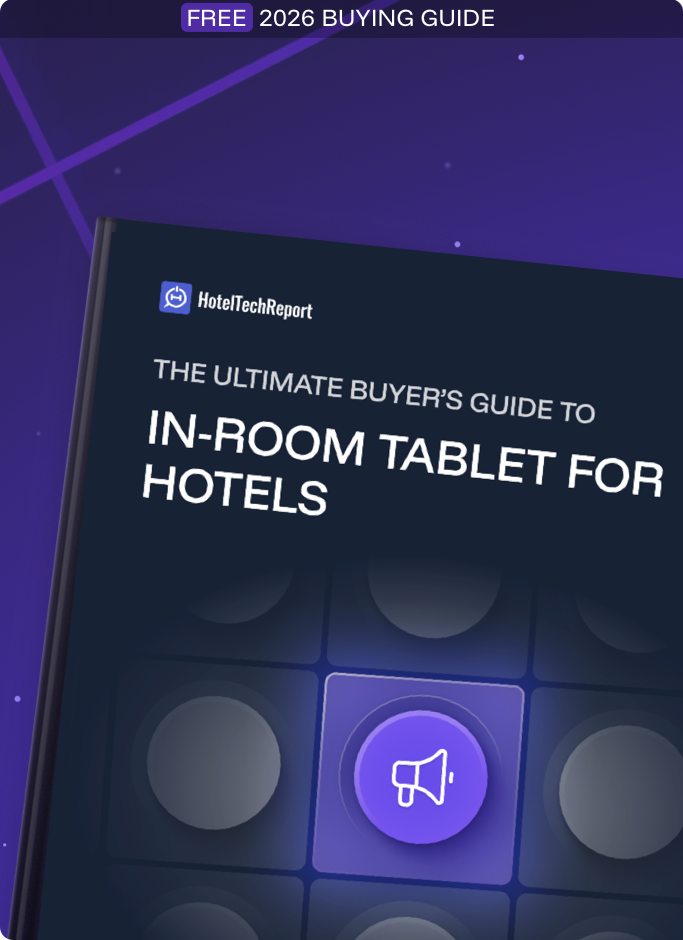
Download the Free Guide
Your guide was sent!
Your guide was successfully sent to .
This email may be incorrect
Our check detected that this address may have been entered incorrectly. Please confirm or correct it before we continue:
This looks like it may contain a typo.
Did you mean ?
What are In-Room Tablets in Hospitality
What are the most important features of guest room tablets?
Guest in-room tablets have evolved significantly from the early days of digital guest directories. What started as a replacement for printed compendiums has become a central guest engagement interface that connects travelers directly to hotel services, amenities, and staff. Modern platforms now function as an operational hub—linking guest requests, ordering systems, and internal workflows through integrations with the broader hotel technology stack.
For operators, the real value of these systems lies in their ability to streamline service delivery, reduce front desk workload, and create new in-stay revenue opportunities. When integrated properly with core systems like the PMS and POS, tablets can automate service requests, enable real-time ordering, and provide operational visibility across departments. The features below represent the capabilities hotels should evaluate when selecting a platform.
Capability Area | Feature | Description |
|---|---|---|
Guest Experience / Guest Engagement | Digital Guest Directory | Replaces printed room compendiums with dynamic hotel information such as amenities, hours, policies, and local recommendations that can be updated instantly across all rooms. |
Service Request Interface | Allows guests to request housekeeping, maintenance, or amenities directly from the tablet, reducing calls to the front desk and improving service response times. | |
Room Service & F&B Ordering | Guests can browse menus and place orders from the room, which can be routed directly to the POS or kitchen systems. | |
Concierge & Guest Messaging | Enables guests to communicate with hotel staff for assistance, recommendations, or reservations without calling the front desk. | |
Multilingual Guest Interface | Automatically presents content in multiple languages to accommodate international travelers and improve usability. | |
Operations & Workflow Management | Automated Request Routing | Service requests are automatically routed to the correct department (housekeeping, engineering, front desk), reducing manual coordination. |
Task Tracking & Status Updates | Allows staff to track service requests and update completion status, helping maintain accountability across departments. | |
Device Fleet Management | Provides centralized monitoring of all tablets in the property, including device status, connectivity, and remote troubleshooting. | |
Content Management System | Enables hotel teams to update menus, promotions, and directory content quickly without requiring vendor support or IT intervention. | |
Revenue & Commercial Impact | Upselling & Promotional Modules | Allows hotels to promote upgrades, spa services, dining offers, and late checkout opportunities directly through the tablet interface. |
Package & Experience Booking | Enables guests to reserve on-property experiences such as spa treatments, activities, or dining reservations during their stay. | |
Offer Personalization | Uses guest stay data or timing within the stay to surface relevant offers and promotions. | |
Revenue Tracking & Analytics | Tracks orders and upsell performance, helping operators understand which services drive the most ancillary revenue. | |
Integrations & Data | PMS Integration | Syncs guest information, stay dates, and folio data with the PMS to enable personalized experiences and automated charge posting. |
POS Integration | Connects ordering functionality to restaurant or room service POS systems so orders flow directly to the kitchen or outlet. | |
Service Optimization Integration | Connects tablet requests to staff task management or service optimization platforms to streamline internal workflows. | |
Reporting & Data Visibility | Provides operational insights into guest engagement, service requests, and ordering patterns to help improve service delivery and revenue strategy. |
When evaluating vendors, hoteliers should look beyond basic digital directory functionality and focus on platforms that integrate deeply with operational systems and automate guest service workflows. The strongest solutions act as a bridge between the guest and hotel operations—helping staff respond faster, capture more revenue, and maintain a consistent guest experience throughout the stay.
- Publication subscriptions (ex. newspapers, magazines)
- Travel information
- Apps & games
- Spa & Wellness Module
- Hotel facilities integrations
- Restaurant reservations
- View bill & express check out
- Secured web browsing
- Group & conference offerings
- Local city guides
- News & weather
- Digital Menus
- Bedside alarm
- TV & room controls
- Digital directory
- Publication subscriptions (ex. newspapers, magazines)
- Travel information
- Apps & games
- Spa & Wellness Module
- Hotel facilities integrations
- Restaurant reservations
- View bill & express check out
- Secured web browsing
- Group & conference offerings
- Local city guides
- News & weather
- Digital Menus
- Bedside alarm
- TV & room controls
- Digital directory
- Guest Marketing
- Video Concierge
- Guest Feedback Module (comment cards/reviews)
- Multi-lingual
- Spa & Wellness Module
- Guest messaging
- Digital concierge
- Guest Marketing
- Video Concierge
- Guest Feedback Module (comment cards/reviews)
- Multi-lingual
- Spa & Wellness Module
- Guest messaging
- Digital concierge
- Spa & Wellness Module
- Restaurant reservations
- Hotel facilities integrations
- Housekeeping requests
- In-room dining ordering
- Bell services
- Digital concierge
- Late checkout
- Bedside alarm
- Spa & Wellness Module
- Restaurant reservations
- Hotel facilities integrations
- Housekeeping requests
- In-room dining ordering
- Bell services
- Digital concierge
- Late checkout
- Bedside alarm
- Guest Marketing
- Loyalty program management
- Multi-currency
- Restaurant reservations
- In-room dining ordering
- Dynamic pricing
- POS & PMS Integration
- Digital Menus
- Guest Marketing
- Loyalty program management
- Multi-currency
- Restaurant reservations
- In-room dining ordering
- Dynamic pricing
- POS & PMS Integration
- Digital Menus
- Loyalty program management
- Restaurant reservations
- View bill & express check out
- Loyalty program management
- Restaurant reservations
- View bill & express check out
- Sponsorship opportunities
- Sponsorship opportunities
What are the ways that hotel tablets can be leveraged to improve the guest experience?
Interactive guest room tablets can be one of the highest ROI technology investments for hotels. While some properties use tablets primarily as a digital concierge, others leverage them as a revenue engine to promote room service, spa services, late checkout, or other hotel amenities.
The most effective platforms go beyond displaying information. When integrated with systems like the PMS, POS, and service optimization tools, guest room tablets can automate service requests, streamline guest communication, and surface revenue opportunities throughout the stay.
Selecting a vendor doesn’t have to be complicated. Most hotel operators evaluate solutions based on a few key factors:
Guest experience – Is the interface intuitive and useful for guests?
Operational efficiency – Does the system automate requests and reduce staff workload?
Revenue potential – Can the tablet drive incremental sales for hotel services?
Reliability & ROI – Is the hardware dependable and financially viable at scale?
The strongest vendors are those that have built their platform specifically for hotel environments, including both the software and hardware components. This typically results in better reliability, stronger integrations, and a clearer path to measurable ROI.
Key Operational Benefits of Guest Room Tablets
Impact Area | How Tablets Create Value | Operational Outcome |
|---|---|---|
Lower Operating Costs | Digital directories eliminate printed compendiums, menus, and in-room materials that must be reprinted frequently. | Reduced printing costs and faster updates to hotel information. |
Faster Guest Communication | Guests can request services or message the front desk directly from the tablet instead of calling. | Reduced phone volume and faster response times. |
Increased Service Awareness | Tablets highlight hotel amenities, dining outlets, spa services, and experiences guests may not otherwise discover. | Higher utilization of hotel services and amenities. |
Automated Service Requests | Requests like towels, housekeeping, or maintenance can route directly to staff task systems. | Less manual coordination and improved service efficiency. |
Real-Time Content Updates | Hotels can update menus, promotions, or policies instantly across all rooms. | Eliminates delays associated with printed materials. |
Critical Integrations for Guest In-Room Tablets Solutions
When evaluating an in-room tablet platform, it’s easy to get distracted by interface design and content features. But the real power of these systems comes from how well they connect to the rest of your hotel’s technology stack.
At a minimum, your platform should integrate seamlessly with:
✅ PMS for real-time guest profiles and folio posting
✅ POS for accurate F&B ordering and revenue capture
✅ Housekeeping or Service Optimization Tools for request routing
✅ Messaging or Ticketing Systems for internal coordination
These integrations shouldn’t rely on manual exports or email notifications. They should be real-time, bi-directional, and operationally embedded. Some vendors advertise “integration” when it’s really just a basic API connection or scheduled data push. It’s worth clarifying what is truly live, automated, and fully supported versus what requires workarounds.
Once those core operational integrations are validated, the next layer to consider is how the platform connects to your broader ecosystem — including CRM systems, upsell engines, guest feedback tools, and IoT room controls — to create a more unified guest journey.





Most Hotels would expect to have a system installed 6-8 weeks after signing contracts, they are obvious exceptions, as some larger properties may include a lot more content to setup.
The Future of Guest In-Room Tablets Solutions
Early in-room tablets primarily replaced printed directories. Today, the focus has moved toward driving ancillary revenue through strategic upselling and dynamic content placement.
Modern platforms now integrate with PMS and POS systems to trigger contextual offers such as late checkout, room upgrades, spa bookings, and dining promotions based on stay phase and guest profile.
Here’s what this could mean for your hotel:
Data-driven upselling during the stay. Offers can be timed around arrival, mid-stay, or pre-departure windows to maximize conversion.
Clear revenue attribution. Advanced dashboards track incremental revenue generated directly from tablet interactions.
Dynamic pricing alignment. Upgrade and add-on pricing can reflect real-time occupancy and demand conditions rather than static rate cards.
As hotels look to streamline service workflows, tablet platforms are becoming more tightly embedded within operational tech stacks.
Instead of simply forwarding requests to email inboxes, modern systems integrate directly with PMS, service optimization platforms, and internal task management tools — creating real-time routing, tracking, and accountability.
Here’s what this could mean for your hotel:
Automated department routing. Housekeeping, engineering, and concierge requests are assigned instantly without manual coordination.
Live status visibility. Guests can see request progress, reducing follow-up calls to the front desk.
Reduced service bottlenecks. Clear SLA tracking and escalation workflows improve consistency during peak periods.
The next evolution of in-room tablets is happening at the intersection of guest engagement and room automation.
As more properties adopt smart thermostats, lighting controls, and IoT-enabled devices, tablets are becoming centralized control hubs — connecting comfort settings, entertainment, and service requests within a single interface.
Here’s what this could mean for your hotel:
Unified in-room control. Guests manage lighting, temperature, and service requests from one screen instead of multiple interfaces.
Energy optimization opportunities. Integration with occupancy sensors and room controls can reduce energy waste.
Higher perceived tech sophistication. A seamless, responsive environment reinforces modern brand positioning.
Hoteliers Also Ask
Guest room tablets act as an in-room digital interface that allows guests to access hotel services without calling the front desk. They typically provide a digital guest directory, room service ordering, service requests, spa bookings, concierge messaging, and hotel information. Many systems also integrate with the PMS and POS to automate service delivery and capture additional revenue.
Pricing for hotel guest room tablets typically ranges from $5–$20 per room per month, depending on the vendor, hardware model, and integrations required. Some providers include hardware as part of a bundled platform, while others offer software-only solutions that run on third-party tablets. Total cost often depends on the number of rooms, integrations, and device management services.
Yes. Even as mobile guest apps grow in popularity, guest room tablets remain valuable because they provide a dedicated, always-available interface in every room. Many guests prefer the convenience of using a device already in the room rather than downloading an app, especially for quick service requests or ordering.
Yes. Most modern guest room tablet platforms integrate with property management systems (PMS) to access guest stay data and personalize the in-room experience. PMS integrations allow tablets to display guest names, enable automated folio posting for orders, and tailor offers based on stay details such as arrival date or length of stay.
Guest room tablets and mobile guest apps serve different purposes. Tablets guarantee a consistent in-room interface for every guest, regardless of whether they download an app. Mobile apps provide portability throughout the property. Many hotels deploy both, using tablets for in-room engagement and apps for pre-arrival and on-property communication.
Not always. Some vendors provide fully managed hardware solutions, including tablets, charging docks, and device management. Other vendors offer software-only platforms that run on commercially available tablets. Hotels should evaluate both options based on cost, reliability, and ease of device management.
Guest room tablets streamline operations by allowing guests to submit service requests directly from their room. Requests for housekeeping, amenities, or maintenance can automatically route to the appropriate department or task management platform. This reduces phone calls to the front desk and helps staff respond to guest needs more efficiently.
The most critical integrations typically include PMS, POS, and service optimization platforms. PMS integrations enable personalization and folio posting, POS integrations allow guests to place orders for food and beverages, and service optimization integrations ensure that guest requests are routed directly to staff workflows.
Guest room tablets can generate incremental revenue by promoting hotel services directly to guests during their stay. Hotels often use tablets to upsell room service, spa appointments, late checkout, dining reservations, and local experiences. Because tablets provide constant in-room visibility of services, they help increase awareness and conversion of ancillary offerings.
Hotels should prioritize platforms that offer service request automation, POS ordering, PMS integration, upselling capabilities, and centralized device management. Additional features such as multilingual interfaces, promotional modules, and analytics dashboards can further enhance guest engagement and revenue opportunities.
LAST UPDATED
APPS TESTED
CONTRIBUTING EXPERTS
Get Your Custom In-Room Hotel Tablets Analyst Report
- Ranked recommendations for your property
- Real operator reviews & pricing data
- Tailored to your size, market & integrations
Trusted by thousands of hoteliers worldwide
Takes 2 min · No credit card needed
Get Your Free AI Analyst Report
Custom recommendations tailored to your property


