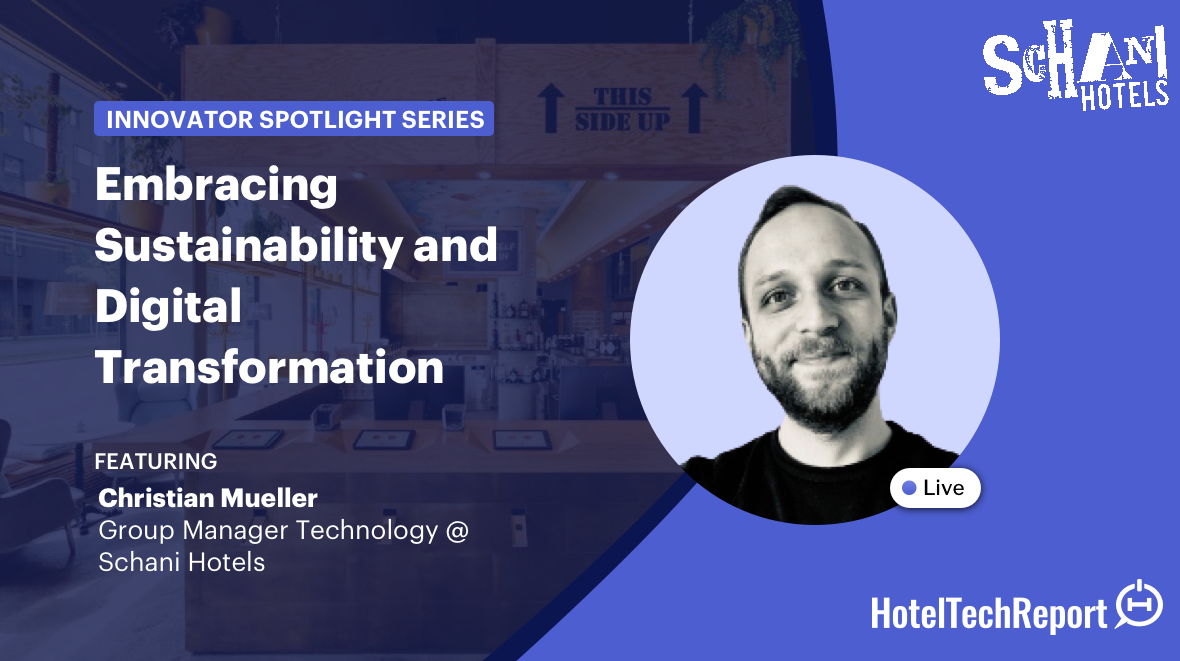
In an era where sustainability and digital innovation have become paramount in the hospitality industry, Schani Hotels has emerged as a trailblazer. At the forefront of their technological advancements and commitment to sustainable practices is Christian Mueller, the Group Manager of Systems Integration. With over a decade of experience in the hospitality sector and expertise in various Property Management System (PMS) providers, Christian has been instrumental in shaping Schani Hotels' approach to sustainability, enhancing the guest experience, and revolutionizing talent recruitment.
Vienna based Schani Hotels has gained recognition for their forward-thinking strategies in reducing their environmental footprint and providing a seamless digital guest journey. Christian's extensive knowledge and hands-on experience in the industry have propelled Schani Hotels to new heights, establishing them as a leader in sustainability and innovation.
Christian's tenure at Schani Hotels has seen a remarkable emphasis on sustainability throughout the organization. By implementing eco-friendly initiatives and leveraging innovative technologies, the hotel group has successfully reduced energy consumption, minimized waste, and embraced renewable resources. In this interview, Christian sheds light on the specific sustainability measures undertaken by Schani Hotels and how these initiatives have contributed to their success in reducing environmental impact while maintaining a high level of guest satisfaction.
In today's digital age, the guest experience extends far beyond the physical aspects of a hotel stay. Schani Hotels recognizes the importance of providing a seamless digital guest journey, from the moment of booking to post-stay interactions. Christian shares insights into the cutting-edge technologies employed by Schani Hotels, such as advanced Property Management Systems and personalized guest communication platforms. Discover how these digital tools have revolutionized the guest experience, enabling Schani Hotels to deliver tailored services, anticipate guest needs, and foster long-lasting relationships.
Recruiting top talent has always been a challenge for the hospitality industry, and Schani Hotels is no exception. However, Christian believes that technology holds the key to overcoming this recruiting crunch.
Join us in this exclusive interview with Christian, Group Manager of Systems Integration at Schani Hotels, as we dive into the fascinating world of sustainability, digital transformation, and talent recruitment in the dynamic landscape of the hospitality industry.
Schani Hotels' ESG Strategy Unpacked
HotelTechReport: Tell us about your background in hospitality and tech?
Christian: I am Christian, a Group Manager of Systems Integration for Schani Hotels. I have approximately 10 years of experience working in the hospitality industry with various properties in and around Munich, Germany. Following that, I have worked with different Property Management System (PMS) providers, namely Hetras PMS system, StaynTouch PMS system, Shiji Enterprise platform, and Guestline. Since April 2022, I have been employed by Schani Hotels. In my current role, I am responsible for establishing a scalable tech stack for our property. I oversee all our systems, ensuring their seamless integration, while also considering the aspects of digitalization and sustainability.
HotelTechReport: What are one to two super high priority business objectives that Schani Hotels is focused on right now? These can be tech related but don’t have to be.
Christian: Sustainability is a significant focus for us, alongside establishing a seamless digital and mobile guest journey. We are also committed to developing sustainable guest rooms by interconnecting various systems. Our aim is to revolutionize the way travel experiences unfold in the future.
HotelTechReport: I think both of those are very top of mind for hoteliers around the world - let’s double click on sustainability, can you talk about what you’re focusing on there?
Christian: We are consistently striving for sustainability and actively working towards reducing the environmental impact of our property. This involves implementing various measures. Firstly, we have installed photovoltaic panels on the rooftop of our property. Additionally, we have optimized the heating and cooling system for the entire building. Instead of having separate AC controls for each room, we have a centralized AC control for the entire building. However, we provide guests with the flexibility to adjust the temperature in their individual rooms within a certain range, ensuring minimal impact on neighboring rooms. Our goal is to maintain a consistent temperature throughout the year, aligning with our overall sustainability objectives. During the summer, we cool the entire building, while in the winter, we heat it. Similarly, in spring and fall, we maintain the same temperature settings. Our approach focuses on considering the entire year's footprint rather than fluctuating daily heating and cooling requirements.
Moreover, as we are currently constructing one of our upcoming properties, we aim to measure the environmental impact of individual rooms as well as the combined footprint of all our rooms. This involves monitoring water and electricity consumption, as well as the usage of gas for heating and the AC system. By gathering this data, we can determine the specific environmental footprint of the entire property.
Furthermore, we are actively seeking ways to go beyond these measures and are currently engaged in research to collaborate with individuals or companies that can assist us in measuring waste production for the entire property, rather than just individual rooms. This comprehensive approach will enable us to accurately assess the building's overall environmental footprint.
HotelTechReport: Are there any tools that you're using that make this job easier?
Christian: Indeed, acquiring all of that information is quite challenging, and we are currently in the phase of fine-tuning the process. There are possibilities to extract such information from your KNX system, digital room controls, and overall building controls. However, when it comes to real-time data, it largely depends on the vendor and the source of the data. In this regard, measuring electricity consumption is comparatively easier than measuring gas or heating consumption from the property. The latter often requires connections to third-party providers or the general heating/building provider. To address this, we have taken the approach of setting up our own databases to consolidate all this information. Once the databases are operational, we will display the live data on our website. Currently, we are in the construction phase of implementing these systems, and although they are not live yet, they will be ready for use when we open our next property.
HotelTechReport: Who is the one who decides within your organization what those benchmarks should be?
Christian: In our organization, we have a dedicated Sustainability Manager or Group Manager for Sustainability. This commitment to sustainability originates from our owners, specifically the family that owns Shani Hotels. As for the structure of our organization, we have also implemented a Group Manager for Systems Integration. I am currently responsible for defining the optimal structure for this center, ensuring it aligns with our objectives.
The focus on sustainability and the environment has been a longstanding priority for our owners and the family associated with Shani Hotels. In fact, their first property, the Umwelt Hotel in Austria, was renowned as an environmentally-friendly establishment. The construction of our flagship property, the Schani Hotel, further embodies this commitment to sustainability. Alongside sustainability, digitalization is another significant aspect we prioritize.
Therefore, both the Sustainability Manager and myself, as the Group Manager for Systems Integration, work closely together with the shared objective of developing a property that excels in both digitalization and sustainability.
HotelTechReport: How do you prioritize ESG efforts across the portfolio?
Christian: We aim to incorporate multiple initiatives across all our properties. While it may not be feasible to implement every aspect in each property, we strive to fulfill as many points as possible in every location. From a construction standpoint, there may be limitations in measuring certain types of consumption, making it impractical. However, whenever there is a viable solution available, we pursue that path.
Furthermore, if there are opportunities to reduce the frequency of cleaning for stayover rooms, we embrace the approach of allowing guests to decide. If guests request room cleaning, we provide the service free of charge. However, if there is no request or need for cleaning, we refrain from doing so. Consequently, by aligning with guest preferences, we conserve energy and water resources utilized in the cleaning process. These savings have been quantified through collaboration with our third-party vendors, and the specific figures are displayed on our website, reflecting the measurable impact of not cleaning rooms.
HotelTechReport: It feels like technology in hospitality took a huge leap forward in the last couple of years, is that all because of the pandemic?
Christian: No, the pandemic was not the sole catalyst for our sustainability initiatives, but it certainly had a significant impact on various aspects. It prompted us to consider cost reduction measures and prioritize the well-being of our staff. We also focused on minimizing the risk of infections and implementing preventive measures. However, even before the pandemic, sustainability was always a core consideration for our organization. We consistently sought ways to reduce our environmental footprint, conserve energy, and save water.
One aspect of sustainability involves maintaining cleanliness in guest rooms, while another aspect pertains to sourcing food for breakfast buffets. We reflect on the origin of the products we offer, considering whether they are locally sourced or imported from distant regions. Similarly, we scrutinize daily production waste, assess the use of plastic straws, and explore alternatives. We evaluate choices such as utilizing eco-friendly paper for printing instead of fresh paper or opting for recycled paper. These seemingly small steps collectively contribute to a more sustainable footprint across all our properties.
Furthermore, our commitment to sustainability extends to our digital approach. Embracing digitalization not only enhances the guest experience but also aligns with our sustainability goals. For instance, we minimize the need for excessive printing at the front desk, night audit reports, guest folios, and key card lists. We recognize that the traditional touchpoints in our industry can be transformed through technology advancements. We have embarked on a digital journey to adapt to these changes and streamline operations.
To facilitate this transformation, my role began with gaining a comprehensive digital overview of our Shani properties. This involved assessing the connectivity and data availability among our existing suppliers. By consolidating this information, we can make informed decisions that benefit the entire organization and each property individually. Our focus lies in selecting systems that cater to the needs of the entire organization, rather than operating on a property-by-property basis. We prioritize systems that offer structured chain and tenant levels, enabling us to implement changes at the tenant level, ensuring uniformity across properties. This approach allows for easier monitoring of the organization's performance, both on a yearly basis and in day-to-day operations. Managing and supporting systems at the tenant level proves more efficient and practical, particularly when configuring rates, rooms, structures, and guidelines. Setting up these aspects on a group level ensures consistency and simplifies maintenance tasks.
 Join 100k+ executives from world's leading hotel brands and get the latest insights delivered to your inbox once a week
How Mueller Approaches Technology in a Rapidly Shifting Market
HotelTechReport: What are some of the big tech initiatives you’re working on right now?
Christian: Certainly, introducing measures to reduce email usage and promote chat availability has been a significant step for the Schani outlets over the past year. We aim to minimize the reliance on lengthy email exchanges and instead encourage shorter messages or brief meetings within the organization. We acknowledge that even chat messages and online meetings leave a digital footprint and have an environmental impact. However, compared to sending emails with file attachments, the impact is significantly lighter. With email attachments, files are often downloaded, copied, uploaded again, and then sent via email, resulting in duplicate files and increased data storage requirements. In contrast, using chat conversations and collaborating on live files stored online reduces this digital footprint.
We have implemented training programs to ensure our staff members are proficient in utilizing these systems effectively. Interestingly, many of our employees are already familiar with chat environments from their personal usage of similar platforms. We have noticed a greater comfort and ease in using chat as a means of communication, compared to formal email writing. Some employees may not be accustomed to composing formal emails, as it was not a requirement during their education or personal interactions. Consequently, leveraging chat systems has facilitated the onboarding process for new staff members, as it aligns with their existing familiarity and enables quick and informal messaging to inform colleagues of important updates or incidents. Adopting these systems has proven to be advantageous for our organization.
Fresh Approaches to Labor and Distribution Challenges
HotelTechReport: With the high staff turnover rates, how that is affecting your business and what technology are you using, if any, to streamline those efforts.
Christian: It is becoming increasingly challenging to find and hire trained staff in the hospitality industry. The pandemic certainly played a role in this, but there are other factors at play as well. One key factor is that the systems typically used in hotels are often complex and not user-friendly for employees. I have always questioned why we rely on such intricate systems that take months for new employees to learn, not just for check-in and check-out procedures, but for their entire shift on the front desk. I believe it would be more advantageous to adopt systems that are easy to learn and operate, similar to popular social media platforms like WhatsApp, Facebook, or Instagram. This way, staff members would require only a few hours of training to perform their entire shift. Additionally, staff members feel more comfortable writing chat messages with guests rather than composing formal emails. The familiarity and ease of using chat platforms contribute to a more efficient and convenient guest communication experience.
HotelTechReport: Super interesting, so in a tight labor market easy to use tech actually makes it easier for hotels to recruit because they can expand their talent pool. Speaking of tech, let’s talk about your overall tech philosophy.
Christian: When considering software and systems, it is crucial to assess their long-term viability and compatibility. It is essential to select systems that will remain functional and supported in the coming years. Engaging in thorough discussions with vendors about their development roadmaps and understanding their plans for future enhancements is vital in making informed decisions.
We are constantly exploring new technologies to ensure we stay up to date with the available tech stack. This includes considering door lock providers, electricity providers, and other relevant factors during the construction of our properties. Additionally, we prioritize the accessibility of data through real OpenAPIs, enabling us to extract and utilize the data in real time. By having ownership and control over our data, we increase our independence from software providers, making it easier to switch providers if necessary.
Making forward-thinking decisions aligned with the future is crucial. It is evident that mobile devices and digitalization will play significant roles in the future. Embracing digitalization is not only important for our organization but also for the sustainability of our planet. Taking small steps towards a more sustainable future is within the reach of every individual, property, and company. Bringing together diverse perspectives and goals in our organization, we can navigate the digital landscape and contribute to a more sustainable future.
Moreover, we understand the importance of the digital guest journey. Our mobile application or web application partners, such as Like Magic, offer a seamless experience that starts with the booking engine and extends to the mobile room key, online service bookings, and even features like the ability to change invoice addresses or open accounts through the mobile app. These advancements in the digital guest journey are truly magical and have revolutionized the way guests interact with our properties.
Traditionally, hotels rely on dedicated desktop PCs with large monitors, keyboards, and mice for various tasks, including working on Excel files. However, in more modern properties, it is possible to perform tasks entirely on a mobile phone. This approach resonates well with staff members who are more accustomed to using mobile phones throughout the day. The frequency of mobile phone usage is significantly higher than the time spent in front of a PC, particularly for those in non-office roles.
Hotels also have the unique advantage of implementing contactless check-in processes through web apps or native applications. This enables guests to check in using their mobile phones, further enhancing the guest experience and convenience.
HotelTechReport: What is the one thing that you hold true about hotel technology that most people in the industry don't agree with?
Christian: Yes, there are many individuals who argue that OTAs (Online Travel Agencies) are detrimental to the hotel industry or hoteliers themselves due to the commission fees they charge. However, it is important to consider a different perspective. Take into account the amount of money spent on online advertising through platforms like Google or others. Then compare that expenditure to the commission typically paid to an OTA.
In an era where sustainability and digital innovation have become paramount in the hospitality industry, Schani Hotels has emerged as a trailblazer. Led by Christian Mueller, the Group Manager of Systems Integration, Schani Hotels has revolutionized the way luxury properties operate by prioritizing sustainable practices and embracing cutting-edge technologies. Through their commitment to reducing environmental impact and enhancing the guest experience, Schani Hotels has solidified its position as a leader in the industry.
Christian Mueller's extensive experience in the hospitality sector and expertise in Property Management System (PMS) providers have played a vital role in shaping Schani Hotels' approach to sustainability and innovation. By implementing eco-friendly initiatives and leveraging innovative technologies, the hotel group has successfully reduced energy consumption, minimized waste, and embraced renewable resources. Christian delves into the specific sustainability measures undertaken by Schani Hotels and their profound impact on reducing the organization's environmental footprint while maintaining exceptional guest satisfaction.
Recognizing the significance of the digital guest journey in today's digital age, Schani Hotels has prioritized providing a seamless experience from booking to post-stay interactions. Christian discusses the advanced technologies employed by Schani Hotels, including state-of-the-art Property Management Systems and personalized guest communication platforms. These digital tools have transformed the guest experience, enabling Schani Hotels to deliver tailor-made services, anticipate guest needs, and foster enduring relationships.
Talent recruitment has long been a challenge for the hospitality industry, but Schani Hotels is embracing technology as a solution. Christian believes that leveraging innovative systems can help overcome the recruiting crunch. In this interview, he shares insights into Schani Hotels' strategies for attracting top talent and highlights the role of technology in revolutionizing the recruitment process.
With a focus on sustainability, digital transformation, and talent recruitment, the hotel group continues to redefine the boundaries of excellence in the dynamic landscape of the hospitality industry. Join us in this exclusive interview with Christian Mueller as we explore the captivating world of Schani Hotels and their relentless pursuit of sustainability, digital innovation, and talent acquisition.