


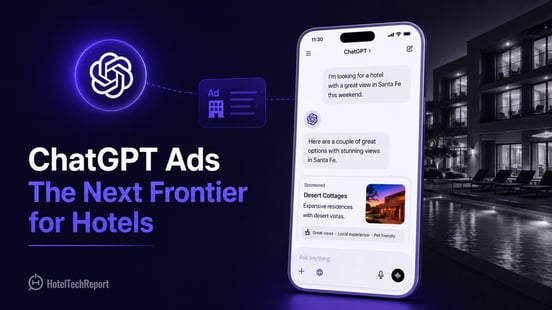
OpenAI began running ads inside ChatGPT in February 2026, starting with travel as one of the first commercial categories. For hotel operators, the ad product itself is still early. But the shift it signals, toward compressed, AI-generated recommendations where only a handful of properties get named, is already reshaping how travelers find and choose hotels. Whether you're running a 200-room independent or a boutique property competing against branded chains, your hotel marketing strategy needs to account for this.
Why Travel Is the First Industry to Watch
Travel sits squarely in the crosshairs of conversational AI advertising because travelers are already using these tools at scale. Fifty-six percent of travelers used AI for at least one trip last year, more than double the rate from the prior year. That's not early-adopter territory anymore.
The behavioral shift goes deeper than casual experimentation. According to a survey of 300 US travelers published by HFTP in January 2026, 78% of travelers who use AI have booked trips based primarily on AI recommendations. A Klook survey reported by CNBC in March 2026 puts global reliance on AI travel planners at 91%.
AI use specifically for accommodations planning has climbed 8 percentage points since 2023. When you combine rising adoption with high purchase intent, you get exactly the kind of query environment that attracts ad dollars. Travel was always going to be first.
 Join 100k+ executives from world's leading hotel brands and get the latest insights delivered to your inbox once a week
The Funnel Has Already Collapsed
Think about how someone searches for a hotel on Google. They type "hotels in Charleston SC," scan a page of results, click a few links, compare prices across tabs, read reviews on a separate site, and eventually book. That process has distinct stages: search, browse, evaluate, decide.
ChatGPT compresses all of those stages into a single exchange. By the time the model generates a response, the user has already told it where they're going, when they're traveling, what they want to spend, and what kind of experience they're after. The AI doesn't return a page of links to explore. It returns an answer, typically naming three to six properties that fit the stated criteria.
Discovery and evaluation happen in the same moment. A traveler doesn't browse through ChatGPT's response the way they'd scroll through a Google SERP. They read a curated shortlist, and the properties on it have already been filtered against their specific constraints.
How This Differs From Google Hotel Ads
Google organizes information and gives users tools to navigate it. You get a map pack, a list of sponsored properties, organic results, OTA links, review snippets, and price comparisons. A typical hotel search might surface 20 or more options across the page. The user does the work of narrowing down.
ChatGPT does the narrowing for the user. It synthesizes data from listings, reviews, and editorial sources, then presents a handful of recommendations. When a sponsored placement appears at the bottom of that response, it attaches to an already-filtered answer rather than sitting alongside dozens of competing links.
The competitive dynamics shift considerably. On Google, your hotel competes with every property that bids on the same keyword or appears in organic results. In a ChatGPT response, you're either on a shortlist of five or you're invisible. There is no page two to scroll to, no "next" button, no map to pan across. The ad format layers onto a condensed answer where each position carries more weight because there are so few of them.
Organic Visibility Still Drives the Shortlist
Here's the part that should shape how you think about spending: sponsored placements in ChatGPT appear to improve a property's position within a response, but they don't appear to manufacture inclusion from nothing. A hotel that doesn't exist in the data the model draws from (OTA listings, review platforms, travel editorial) is unlikely to surface in a sponsored format that's designed to be contextually relevant to the conversation.
Think of it like a restaurant recommendation from a well-traveled friend. If they've never heard of your place, no amount of advertising will get them to mention it over dinner. The organic foundation, your presence across Booking.com, Expedia, Google Business Profile, TripAdvisor, and travel blogs, is what feeds the model's understanding of your property.
Paid placement is a lever, but it works best when there's already something to amplify. A property with thin listings, outdated photos, and a handful of stale reviews won't benefit much from showing up as a sponsored result below a shortlist of well-reviewed competitors.
What Hotels Should Do Now
The ad product is in testing. Pricing, targeting options, and availability for individual hotels are still unclear. But the organic groundwork you can control right now, and it will determine whether paid placements are useful when they become available.
Audit your data consistency across platforms. Check your property name, address, category, amenity descriptions, and rate parity across every OTA, Google Business Profile, and review site where you're listed. AI models pull from multiple sources to generate answers, and conflicting information (different room counts on Expedia vs. Booking.com, outdated descriptions on TripAdvisor) creates noise that can push your property down or out of a recommendation. Make the information clean and uniform everywhere.
Build review volume and recency. AI travel recommendations lean heavily on review sentiment, and recent reviews carry more weight than a pile of praise from 2019. A steady cadence of guest reviews across Google, TripAdvisor, and OTA platforms strengthens the signal that your property is active, current, and worth recommending. If your post-stay review request process is inconsistent, fix it before worrying about ad budgets.
Monitor which properties appear in AI shortlists for your key queries. Run the searches your guests would run. Ask ChatGPT for "best family hotels in [your market] under $200" or "boutique hotels near [your landmark] with a pool." See who shows up. Do this regularly, because the model's outputs shift as its training data and retrieval sources update. If your comp set appears consistently and you don't, the problem isn't advertising. The problem is upstream.
How to Advertise Your Hotel on ChatGPT (Paid)
The ad product is still in testing. Pricing, targeting options, and availability for individual hotel properties have not been publicly disclosed. OpenAI has not launched a self-serve ad platform comparable to Google Ads.
Hotel operators who want to register interest can do so at openai.com/advertisers/. Until the product matures and opens to broader advertiser categories, the most productive investment is the organic foundation described above. The strength of your listings, reviews, and data consistency across platforms will determine whether a paid placement is effective when it becomes available. Properties focused on a direct booking strategy should treat AI visibility as another layer of that effort, since travelers who discover your hotel through a ChatGPT recommendation still need a compelling reason to book direct.
Frequently Asked Questions
Do ChatGPT ads change what the AI recommends?
No. Ads run on entirely separate systems from the model generating the answer. Advertisers cannot shape, rank, or alter ChatGPT's organic responses.
Which ChatGPT users see hotel ads?
Only users on Free and Go tier plans. Users on Plus, Pro, Business, Enterprise, and Edu plans do not see ads.
Can independent hotels advertise on ChatGPT?
The ad product is still in testing, and self-serve buying is not yet available. Independent hotels can register interest at openai.com/advertisers/ but should focus on organic visibility in the meantime.
How do I get my hotel to show up in ChatGPT recommendations?
Maintain consistent, accurate listings across OTAs, Google Business Profile, and review platforms. Build a steady flow of recent guest reviews. AI models pull from these sources when generating travel recommendations.
Is ChatGPT replacing Google for hotel search?
ChatGPT is not replacing Google, but it is compressing the search funnel. A Google SERP might show 20 to 30 hotel options. A ChatGPT response typically names 3 to 6. Both channels will coexist, but AI-generated shortlists are becoming a more common starting point for trip planning.
The Bigger Shift: Fewer Slots, Higher Stakes
A Google SERP for "hotels in Nashville" might show 4 sponsored results, a map pack with 3 pins, 10 organic links, and OTA carousels with dozens of properties. A ChatGPT response to the same query typically names 3 to 6. That's the entire visible competitive field.
As AI systems move from indexing to summarizing, the number of available slots shrinks dramatically, and the value of each slot rises in proportion. Absence from a Google SERP is a missed click. Absence from a ChatGPT shortlist means your property functionally doesn't exist for that traveler, in that moment, for that trip.
Whether OpenAI's ad product becomes a major distribution channel or a niche experiment, the underlying shift toward compressed recommendations is already well underway. The hotels that show up in those recommendations will be the ones with clean data, strong reviews, and consistent visibility across the sources AI models trust. Start with the organic foundation. The paid options will follow.