


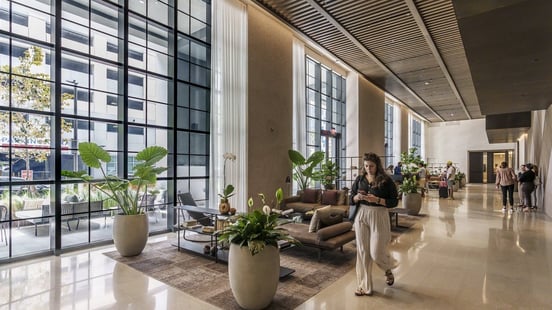
When a major event comes to downtown Miami, the busiest place in a hotel is usually the lobby. Arrivals bunch together, the phones don't stop, and every guest wants to get to their room at the same moment. For a 350-key lifestyle property like The Gale Miami Hotel & Residences, that rush is where a reputation for modern, effortless service is either confirmed or quietly undone.
Before Canary, The Gale was losing that battle on paper. Guests were filling out registration cards by hand at the desk, lines formed during peak arrivals, and travelers were being pinged by text from three different hotel systems. Today, arrivals take a signature, the lobby stays clear even on event nights, and the phone is answered by an AI agent fluent enough to impress the hotel's own IT chief in three European languages.
This is how The Gale got there with Canary Technologies, and what other hoteliers can borrow from the playbook.
At a glance
Property | |
Location | Downtown Miami, Florida |
Property type | Lifestyle hotel blending luxury hospitality with boutique-style living |
Size | 350 keys |
Project lead | Seth Wasserman, VP of Information Technology |
Starting point | Paper registration cards; guest texts coming from three separate systems |
Canary products | Mobile Check-In, Tablet Registration, AI Guest Messaging, AI Voice |
A modern hotel, forced back to paper
The Gale sits in the heart of downtown Miami and sells a specific promise: the polish of a luxury hotel with the feel of boutique-style living. It draws a heavily international crowd, and its location puts it in the middle of the action whenever the city hosts a major event.
That positioning makes the front desk unusually important. A guest who has chosen a design-forward lifestyle hotel expects the check-in to match the lobby. Paper forms and a queue send the opposite message.
The frustrating part was that The Gale had already solved this once. The hotel used digital registration cards from another provider until that product was phased out. With no replacement in place, the property went back to paper, and both staff and guests felt the difference. Front-desk agents were stuck processing manual paperwork, and guests were stuck in line waiting for them.
Looking for a platform, not another patch
The job of fixing it fell to Seth Wasserman, The Gale's VP of Information Technology. His first goal was simple: get the registration card off paper again. But the hotel's recent experience had exposed a deeper risk. A single-purpose tool can disappear, and when it does, the property is left rebuilding a workflow from scratch.
The Gale's requirements reflected that lesson. It needed digital registration that would work for every guest, whether they liked to handle formalities on their phone ahead of time or preferred to do it at the desk. It needed a way to keep the lobby moving when demand spiked. And longer term, it needed fewer systems talking to guests, not more.
Canary Technologies fit that brief because it approaches the guest journey as a single platform rather than a collection of separate tools. Arrival, guest messaging and phone calls all run on the same system. That meant The Gale could start with the problem in front of it and grow into the rest. It began with Canary's Mobile Check-In, then added Tablet Registration, AI Guest Messaging and AI Voice as each new need came into focus.
Fixing the front desk, then scaling it
With Mobile Check-In, guests complete their registration details before they ever reach the property. By the time they walk up to the desk, the card is already filled out, and Wasserman says staff usually need nothing more than a signature. His summary of the change: "It takes seconds instead of minutes."
Not every guest wants to check in on their phone, and The Gale didn't want to force them. Canary's Tablet Registration gives on-site guests a paperless option too, so the hotel can meet travelers however they prefer to arrive.
The tablets turned out to solve a second problem. On major event nights, The Gale can hand tablets to team members in the lobby and spin up extra check-in stations wherever the crowd builds. Wasserman describes the capacity as easy to dial up or down. Whether the hotel has two, four or eight people working arrivals, he says, the property never ends up with a lobby line.
One voice to the guest
The next problem was one many hotels don't notice until a guest complains. Over time, The Gale had accumulated several systems capable of texting guests: the hotel app, the property management system and the revenue management system. Each one sent its own updates at its own point in the journey. The hotel wasn't trying to overwhelm anyone, but from the guest's side of the phone, it could feel like a stream of messages from different senders.
Once The Gale saw that Canary's AI Guest Messaging could handle every messaging need the team had, it made a deliberate call. Wasserman explains that guests simply can't be getting texts from multiple systems all the time, so the hotel chose one and routed all guest communication through Canary.
The decision is notable less for the technology than for the discipline behind it. Rather than layering another tool on top, The Gale used the new platform as a chance to stop the other systems from texting guests.
Retiring "press 1, press 2"
The phone line was the last part of the guest experience still running on an older model. Callers to The Gale were greeted by a standard menu asking them to press numbers to reach the right department. It worked, but it hardly matched the rest of the property.
Canary's AI Voice replaced the menu with a conversational greeting, so calls feel personal from the first second. For a hotel with so many international travelers, the bigger test was language. Wasserman put the system through it himself, calling in German, French and Italian. He came away impressed that each response had its own distinct voice and an accurate accent.
What sealed it for him was what happens after the call. Because AI Voice and AI Guest Messaging run on the same platform, follow-up texts and any later communications automatically go out in the language the guest used. A traveler who calls in Italian keeps hearing from the hotel in Italian. Wasserman's verdict is that whether by phone or text, the conversation with Canary's AI feels natural.
What changed
The clearest result is at the front desk. Registration has gone from a multi-minute paperwork exercise to, at most, a signature, and guests now choose whether to handle it before arrival or on property. The manual work that frustrated staff is gone, and so is the waiting that frustrated guests.
The hotel has also gained flexibility it didn't have before. Event nights no longer mean a choice between a crowded lobby and permanently overstaffing the desk. Tablets let The Gale add capacity exactly when it's needed and pull it back afterwards.
Guest communication is quieter and more coherent. Instead of overlapping texts from the app, PMS and RMS, guests hear from the hotel through one channel. Calls are answered conversationally, in the caller's language, with follow-up messages that stay in that language.
Before and after
Before Canary | After Canary |
|---|---|
Paper registration cards completed at the desk | Card completed in advance; arrival needs only a signature |
Lobby lines during peak arrivals and major events | Tablet check-in stations scale with demand; no lobby line |
Guest texts from the hotel app, PMS and RMS | All guest messaging through a single channel on Canary |
"Press 1, press 2" phone menu | Conversational AI Voice that answers in the caller's language |
Phone calls and guest texts handled by separate systems | Follow-up texts sent automatically in the guest's language |
Open question: Canary's case study does not publish quantitative metrics (e.g., check-in adoption rate, call containment, message volume). Worth asking Canary for numbers before publishing.
The Canary stack at The Gale
The Gale runs four Canary products, adopted one at a time.
Product | What it does | How The Gale uses it |
|---|---|---|
Guests complete their registration card on their phone before arrival | The first Canary product adopted; replaced paper so arrivals need only a signature | |
Digital registration cards completed on a tablet at the property | A paperless option for guests who check in on site, and extra check-in stations on event nights | |
AI-assisted two-way texting with guests across the stay | The hotel's single guest-communication channel, replacing texts from the app, PMS and RMS | |
An AI agent that answers hotel phone calls conversationally | Replaced the phone menu; handles international callers in their language and triggers follow-up texts in that language |
Lessons for other hoteliers
The Gale's story is less about any single feature than about a sequence of good decisions. A few stand out for properties weighing similar moves.
Treat vendor continuity as a requirement. The hotel was pushed back to paper because a point solution was discontinued. Choosing a broader platform with an active roadmap gave it room to grow without starting over each time.
Design for your busiest night, not your average one. Pairing pre-arrival mobile check-in with tablets that staff can deploy on demand let The Gale absorb event surges without permanently adding desk space.
Count how many systems are texting your guests. If the app, PMS and RMS all send messages, guests experience noise rather than service. Consolidating onto one channel is as much an operational decision as a technology one.
Test AI in your guests' actual languages. Wasserman didn't take multilingual support on faith; he called the line himself in three languages. For hotels with international demand, that kind of hands-on test, including what happens in follow-up messages, is worth doing before signing.
Sources
Answering Every Call and Eliminating Lobby Lines at The Gale Miami, Canary Technologies customer story