
A year ago, the best hotel AI could tell your revenue manager what to do. This quarter, it does the thing itself and leaves the judgment calls for a person.
That is the whole story of the submissions we read for this report. The software that used to summarize the reviews and suggest a rate now answers the guest, works the lead, and moves the rate on its own. The work that stays with your team is the part that needs a human: the exception, the relationship, the call that carries real risk.
Every product here cleared one bar before we wrote a word about it. Each has recent, public feedback from working hoteliers showing the AI is moving their business, not only demoing well. We read the reviews first and the pitch second, and the ones without a real hotelier track record are not in this report.
The Shift Underneath All Eight Trends
Sort forty products by what their AI actually does and the same line keeps appearing. The machine has moved from assistance to agency. Last cycle it handed a person the answer. This cycle it completes the task.
That shift lands on the two lines a general manager actually watches. It pulls down labor, the largest cost a hotel can control, by taking repetitive work off the team. And it captures revenue that used to leak after the front desk went quiet, because an agent does not keep office hours.
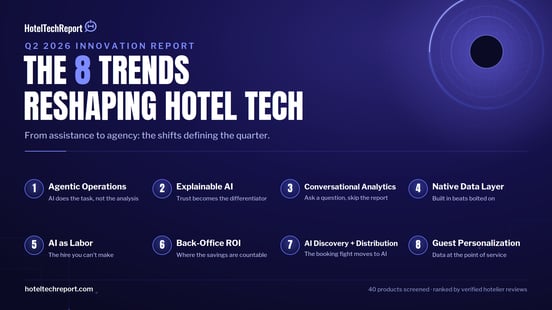
Eight trends carry that shift. Read on their own, here is what each one is.
Agentic operations. The clearest pattern in the data. Software that used to draft a reply or flag an anomaly now completes the job end to end: it works the lead, sends the answer, books the slot, moves the rate inside set limits. A person steps in for the exceptions.
Explainable AI. As the machine makes more of the pricing call, vendors are racing to show their work. A rate recommendation only holds if the revenue manager trusts it enough to leave it alone, so the products pulling ahead narrate the demand signals behind the number.
Conversational analytics. The report is becoming a conversation. Instead of opening a dashboard, a manager asks a question in plain language and gets the answer in seconds, which puts the data in front of the decision while the decision still matters.
A native data layer. The strongest tools build the intelligence into the core system rather than bolting it onto the side. When the AI reads from the same record the rest of the property writes to, the answers get sharper and the time spent reconciling numbers shrinks.
AI as labor. With hiring still hard and wages the largest controllable cost, several products are now sold the way you would describe a hire. Here is the work it takes off your team. The framing has moved from feature to headcount.
Back-office return. The first place AI pays for itself is finance and operations, where a miscoded invoice or a labor overage is a real number on the statement. That is where the measurable savings showed up this quarter.
AI discovery and distribution. The fight for the direct booking is moving off the search page and onto the AI assistants travelers now plan with. New tools watch how those models describe a hotel and defend the direct channel that keeps the commission as profit.
Guest personalization. Guest data is finally reaching the website and the front desk at the moment it matters, lifting the right upsell and turning more lookers into booked, returning guests.
Read together, the eight point one way. The question is no longer whether hotel software has AI, because nearly all of it now claims to. The question is what the AI does once it is in the building, and who on your team stops doing that work by hand. The rest of this report answers that by the team that will feel it first.
 Join 100k+ executives from world's leading hotel brands and get the latest insights delivered to your inbox once a week
Revenue Management: The System Moves The Rate, And Now It Explains Itself
Revenue management was the first place hotels trusted a machine with a decision, so it is the most crowded category here, and it splits in two. One set of tools sharpens the pricing call and shows its reasoning. The other defends the direct revenue that pricing depends on, as search and distribution shift under the channel.
Cloudbeds, Ask Signals. Cloudbeds lets a manager ask about revenue or operations in plain language and get a synthesized answer in seconds, drawn from one data set rather than four exports.
Duetto, Automated Date Boost. Triptease and Duetto connected the forecast to the spend. Paid campaigns now shift automatically toward the dates that need demand, so the budget follows the need-periods instead of the calendar.
Mews, Mews RMS. Mews folds pricing, strategy, and reporting into one workspace, with an autopilot that moves rates on its own. It is a direct argument against the old stack of a spreadsheet plus a bolted-on revenue management system.
Lighthouse, Ernest. Lighthouse built an assistant that answers commercial questions in plain language and shows its reasoning. Work that used to mean pulling three tools together before a Monday call now resolves in a few minutes.
FLYR, Pricing Explanations. FLYR now shows the demand signals behind each recommended rate in plain language. The point is adoption. A revenue manager who can see why the number moved is far more likely to let it stand, and to defend it in the owner review.
RoomPriceGenie, Revenue Intelligence. RoomPriceGenie brings its revenue insights directly into the property management system, so the recommendation sits where the work already happens instead of in a separate tab.
Operto, Operto ONE. Operto's agent watches for the predatory ads that pose as your own site in search results and works to outrank them, recovering the direct booking and the commission it would have cost.
Paraty, AI Bookings. Paraty replaces a single booking funnel with many, each tuned by the AI to the visitor's source and segment, with the goal of lifting direct conversion.
Sales And MICE: Agents That Chase The Lead You Used To Lose
Group and event business runs on response time. A lead that sits overnight is often a lead lost to the hotel that answered first. The products here close that gap by working the inquiry when no one is at the desk.
Canary, Agentic Sales Coordinator. Canary's coordinator works a group or event lead from first inquiry toward a booking without waiting for business hours, which is exactly where many of these deals quietly go cold.
MeetingPackage, AI Email Agent. MeetingPackage reads each meetings-and-events enquiry, fills the gaps, and returns a response in seconds, before the planner moves on to the next hotel on the list.
Event Temple, Booking Engine. Event Temple sells meeting space online around the clock, capturing the after-hours event demand that used to wait for a salesperson to log in.
Marketing: Defending The Direct Booking As Search Moves To AI
The marketing problem this quarter is that the search page is no longer the only front door. Travelers are starting to plan inside AI assistants, and the tools here either watch what those assistants say about a hotel or work to win the direct booking before an online travel agency does.
eviivo, AI Prompter and Translator. eviivo writes listing descriptions and translates them across languages in seconds, removing a copywriting and translation cost that small operators usually carry themselves.
Cendyn, Wayfinder. Cendyn's tool shows how the large AI models describe your hotel and flags when they drift from the facts, which matters more each month as guests plan their trips inside those assistants.
HiJiffy, Multi-Property Search. HiJiffy lets a chatbot search an entire portfolio and steer an undecided guest to the property that fits, before that guest drifts to an online travel agency.
Guest Experience: Service That Answers At Two In The Morning
Guest-facing AI stopped being a chat widget and started doing the front-desk job. It answers, it checks in, and it carries the guest's history to whoever is serving them, at the hours when the desk used to be the bottleneck.
Canary, AI Agent Studio. Canary's studio lets a hotel build its own agents from hospitality templates and automate whole workflows, reaching the cases that rule-based automation never could.
Yanolja, Pulse AI. Yanolja put an always-on front desk on WhatsApp, handling bookings, check-in, and upsells, and catching the revenue that leaks out of unanswered messages.
Akia, Voice AI. Akia answers the phone, takes bookings, and routes guests without adding a person, covering the calls that slip during a rush or overnight.
dailypoint, Bridge App. dailypoint puts each guest's history and preferences on staff phones at the point of service, so the person standing in front of the guest can act on what the data already knows.
HOTEZA, Wallet Keys. HOTEZA delivers room keys through Apple and Google Wallet, so a guest can skip the desk entirely. The savings are concrete: shorter queues, fewer plastic cards, less check-in labor.
Operations And The Back Office: The Morning Read, Done Before You Arrive
The back of house is where the savings are easiest to count, because the inputs are already numbers. These tools read the operational and labor data overnight and hand a manager the day's priorities before the shift starts.
Actabl, AI Insights. Actabl replaces the daily hour someone spends reading labor and performance reports with a short list of prioritized fixes each morning, in time to act before the cost lands on payroll.
Inn-Flow, AI Insights. Inn-Flow surfaces budget overruns, labor projections, and missing expenses on its own, catching the cost problems while they can still be corrected.
MARA, AI Research Assistant. MARA builds and delivers the report you describe in plain language out of your guest feedback, work that used to mean an analyst and an afternoon.
hotelkit, Knowledge AI. hotelkit answers staff questions instantly from the hotel's own procedures, replacing the search through documents or the wait for the one colleague who happens to know.
Finance And Accounting: The Close, Run From A Prompt
Finance is the cleanest test of return, since every output is a figure on the statement. The entry here runs recurring accounting work from a prompt, inside the system of record rather than beside it.
HIA, Native AI Agent. HIA runs recurring finance workflows from a prompt inside the accounting system, taking back-office hours off the team while the controller keeps the data and the permissions.
What To Watch, And Where To Start
The pattern to watch is explainability paired with the data layer. The products pulling ahead both act on their own and show the reasoning, and they sit on the same record the property already runs on. That combination is what earns a manager enough trust to leave the system alone, which is the entire point of automation.
Where to start is wherever your cost is most countable. Most hotels will see the fastest return in the back office and in the direct channel, not in the guest-facing features that demo best. Pick the line on your statement you can already measure, and choose the tool that moves it.
We will run this report every quarter. The bar does not change. We write about the products hoteliers are already vouching for, and we watch what the AI actually does once it is in the building.