


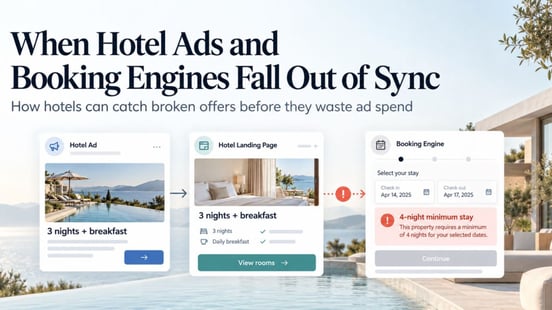
A hotel launches a summer campaign across Google Ads, social media and metasearch promoting a straightforward offer: stay three nights and get breakfast included. The same package appears on the landing page, and the corresponding rate plan is available in the booking engine.
Then the booking conditions change. The minimum stay becomes four nights.
Nothing appears technically broken. The ad still runs, the landing page still loads, and the booking engine remains online. But the hotel is now paying to promote an offer that guests can no longer book under the conditions being advertised.
That distinction matters. A functioning link does not necessarily mean a functioning offer. For hotels running campaigns across multiple systems, the more important question is whether the promise made in the ad still matches what a guest can actually purchase.
As campaign volume grows, manually checking those conditions becomes increasingly difficult. Campaign data may sit in Google Ads or Meta, offer copy may live in a CMS, restrictions may be managed in the CRS, and inventory may be controlled elsewhere. Each system can be operating normally while the overall booking journey has quietly fallen out of sync.
Why Offer Validation Is More Complicated Than Link Monitoring
Traditional website monitoring is good at detecting technical failures. It can confirm whether a landing page loads, whether a URL returns an error, or whether a booking engine is responding. What it usually cannot determine is whether the commercial promise behind the campaign is still valid.
A hotel might advertise a three-night package while the live rate plan requires four nights. It might promote breakfast as an included benefit when that inclusion has been removed. It might advertise a room type or price point that is no longer available for the dates shown in the campaign.
Those problems are easy to miss because the systems involved are often managed independently. The marketing team may still see an active campaign, while the revenue team has already changed the restriction in the CRS.
A more useful validation process therefore needs to compare the campaign promise with a source of truth in the booking environment.
Creating a Reference Point for Each Offer
The simplest place to start is by creating a structured reference record for every active campaign offer. That record can live in a spreadsheet, CRM or database and should define the conditions the campaign is expected to represent.
For a typical hotel promotion, that might include the campaign ID, property, rate-plan ID, booking and stay dates, occupancy, room type, minimum length of stay, advertised price, included benefits, landing-page URL and booking-engine URL.
The technology used to store this information is less important than the discipline of creating a reliable relationship between the campaign and the underlying offer. Without that mapping, an automated workflow has no dependable way to determine what should be checked.
Once the reference record exists, the hotel can begin comparing the expected conditions with live booking data.
For example, if a campaign promotes a three-night stay in a Deluxe King room with breakfast included through August 31, the validation process should be able to determine whether that rate plan is still active, whether the minimum stay is still three nights, whether the room type remains available, and whether breakfast is still part of the package.
Testing the Offer the Way a Guest Would
The strongest validation workflows do not simply check whether a rate plan exists. They attempt to reproduce an actual booking scenario.
That might mean testing a predefined stay from August 12 to August 15 for two adults in a Deluxe King room under a specific promotional rate plan. The system can then compare the result with the conditions described in the campaign.
This produces a more meaningful answer than a simple availability check. Instead of asking whether the rate exists somewhere in the system, the hotel is asking whether a guest can still complete the booking being advertised.
There are limits to this approach. Hotel pricing and availability are dynamic, and results may vary based on stay dates, occupancy, room type, geography, loyalty status, promotional codes and remaining inventory. A successful test for one scenario does not prove that the offer works under every possible condition.
For important campaigns, it is therefore more useful to define a small number of representative test scenarios rather than rely on one generic search. The purpose is not to prove universal availability. It is to identify meaningful drift between the campaign and the booking environment before that drift becomes expensive.
Turning Validation Into an Operating Workflow
An automated check is only useful if the result leads to a clear action.
A practical workflow should distinguish between three outcomes: the offer matches, the offer does not match, or the system is unable to verify the result. That third category is important because a temporary API failure or booking-engine outage should not be interpreted as proof that the offer itself is unavailable.
When a mismatch is detected, the system should also explain what changed. An alert that simply says a campaign failed validation creates more work for the marketing team. An alert that says the campaign advertises a three-night minimum stay while the live rate plan currently requires four nights gives the owner enough information to act immediately.
The response can also vary based on severity. A technical failure may simply require human review. An expired promotion or removed rate plan may justify pausing the campaign. A minor copy discrepancy may only require an alert.
The objective is not to automate every decision. It is to automate the detection process so that humans spend their time on the cases that actually need judgment.
Where AI Fits—and Where It Does Not
Most offer validation does not require artificial intelligence.
Structured values such as dates, rates, room types, restrictions and rate-plan IDs are usually better handled with deterministic rules. If the advertised minimum stay is three nights and the CRS returns four, no language model is needed to determine that the two conditions do not match.
AI becomes more useful when the discrepancy appears in language rather than structured data.
Consider an ad that says, “Breakfast included with every stay,” while the landing page says, “Complimentary breakfast is available with selected packages.” A keyword-based comparison might see the repeated reference to breakfast and treat the two statements as consistent. Semantically, however, they describe different conditions.
A language model can help compare those statements and determine whether they appear to match, conflict or remain ambiguous. In that context, AI is best used as a classification layer rather than a final decision-maker. Clear mismatches can be flagged, while uncertain cases are routed to a person for review.
That division of labor is important. Rules should handle structured booking data; AI should be reserved for ambiguity in language.
Starting With a Narrow Use Case
Hotels do not need to build a complex validation platform from the start. The first version can answer one narrow question: is an active campaign promoting an offer that has already expired?
That check only requires a list of active campaigns, the valid dates for each promotion, and a reliable way to associate the campaign with the correct offer.
Once that works consistently, additional checks can be added over time. The hotel might validate whether a rate plan is still active, whether minimum-stay restrictions have changed, whether the advertised room type is still available, or whether the landing page still describes the same conditions as the booking engine.
The goal should be to add checks that correspond to real failure modes, not to automate every possible edge case.
The Payoff Is Operational, Not Just Technical
The real value of automated offer validation is not that it eliminates human review. It is that it reduces the amount of human review required.
Instead of asking a marketing team to manually inspect hundreds of active promotions, the system can surface the small number of campaigns where something has materially changed.
That matters as hotels add more properties, channels, audiences and promotional offers. The more fragmented the campaign environment becomes, the harder it is to rely on manual quality control.
A well-designed validation process gives hotels a way to catch commercial errors before they turn into wasted media spend or booking friction. More importantly, it helps preserve consistency across the entire guest journey, from the first ad impression through the final booking step.

 Join 100k+ executives from world's leading hotel brands and get the latest insights delivered to your inbox once a week