



For years, the revenue management was defined by a single question: what rate should this room be tonight? It is a good question. The tools built to answer it have become genuinely impressive. Pricing intelligence is faster than it has ever been. Demand signals are sharper. Automation has removed real manual workload from teams that used to spend their mornings rate-shopping competitors and their afternoons rebuilding spreadsheets. Yielding by segment, room type, and channel, once the province of a handful of sophisticated operators, is now standard practice across most well-run hotels. Forecasts are more accurate. Strategy meetings start from better data. Revenue managers are better at the core job than they have ever been.
In that same decade, the commercial environment around them has shifted in a way that makes pricing excellence necessary but no longer sufficient on its own. The villain in this story isn't any single channel, system, or KPI. It's top-line obsession: the habit, embedded in dashboards, incentive plans, and ownership reporting, of treating revenue growth as a proxy for commercial health. That habit used to work. It works less and less every quarter.
The Scorecard Hotel Owners Care About Has Expanded
Owners and senior leadership are no longer just asking what RevPAR was. They are asking about margin, about cost of acquisition, about whether the revenue the hotel generated actually translated into profit. The revenue manager often does not have a clean answer, because most of the systems they use were never built to give one. The data backs them up. Global RevPAR has grown 19% since 2019. Over the same period, the cost of acquiring those bookings has surged 25%. That gap, surfaced in HotStats and Duetto's joint analysis earlier this year, is the cleanest read on a problem the industry has been feeling for a while: the cost of revenue is rising faster than the revenue itself. What the gap produces, downstream, is a collapse in flow-through. The share of every incremental revenue dollar that converts to profit used to sit around 50% historically. In 2025 it ran at 18% in the Americas and 29% in Europe. Hotels are doing more business than ever and keeping less of it. Many of the operators who hit their RevPAR targets last year quietly missed their flow-through targets, and ownership noticed. Labor compounds the squeeze. Wage cost per occupied room rose 12.8% in 2025, and 21.1% in Q4 alone, according to HotelData.com's latest analysis. HVS describes the broader shift bluntly: the expense base has reset higher since the pandemic, while RevPAR growth has softened and now trails inflation in most markets. The cost structure of the hotel is no longer aligned with the revenue the operating model can generate. The metric the business cares about has changed. The metrics that answered the old question are still in the dashboard, doing their job. They just no longer answer the question being asked.
 Join 100k+ executives from world's leading hotel brands and get the latest insights delivered to your inbox once a week
Same Room, Different Profit
Two hotels with identical RevPAR can produce dramatically different profit outcomes. Two bookings for the same room on the same night can contribute very different amounts to the bottom line. This is the operational reality that has pulled the discipline forward.
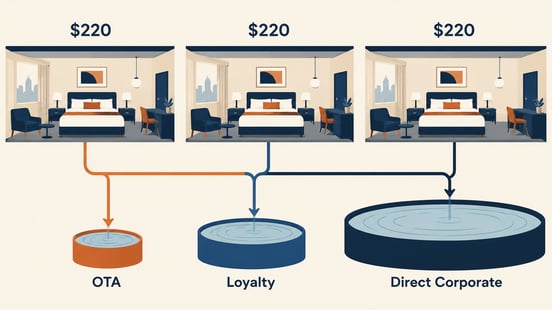
Consider three bookings for the same $220 room, on the same night, at the same hotel:
Booking | ADR | Acquisition cost | Operational cost | Net contribution |
|---|---|---|---|---|
OTA transient | $220 | ~28% (commission, cancellation risk, lost data) | Standard | Lowest |
Loyalty member, direct | $220 | ~12% (loyalty cost, processing, marketing) | Higher (amenity entitlements, F&B credit, recovery) | Middle |
Direct corporate | $220 | ~6% (negotiated, predictable) | Standard | Highest |
The room is the same. The rate is the same. The profit isn't close. A $240 OTA booking with 28% acquisition cost and elevated cancellation risk can contribute less profit than a $205 direct corporate booking with predictable labor demand. Pricing for the rate alone returns yes on the first booking; the P&L returns something different.
This is the operational reality that sits on three levers traditional revenue management was never asked to weigh.
The first is channel mix. OTA commissions sit at 15-25% on standard tiers and push toward 30% on preferred placements. The true cost of OTA distribution, once cancellations, lost guest data, and brand dilution are accounted for, runs closer to 30-35% of every booking. Cancellation rates alone tell part of the story: roughly 50% on Booking Holdings platforms versus around 18% on direct channels.
The second is the cost of acquisition more broadly. A direct booking is not free either. After payment processing, booking engine fees, and digital acquisition spend, a $200 room booked direct nets somewhere around $162-176, versus $160 from an OTA. The gap is real but smaller than the marketing line implies. Every booking has a cost, and most revenue dashboards show the rate without showing what came out of it.
The third is the one most articles miss. The cost of brand and loyalty business keeps climbing: gifts, F&B, service recovery, and amenities for loyalty members on the operations side; brand fees, distribution fees, marketing fees, and franchise fees on the corporate side. CBRE's asset management group puts it bluntly: commissions are growing almost three times faster than revenue per available room. Michael Belanger, VP of Commercial Strategy at GCP Hospitality, framed the implication for owners on a recent episode of the Hotel Tech Insider podcast. When you stack franchise fees, distribution fees, marketing fees, and brand commissions against the OTA commission, "in some cases, they're almost equal." That gives owners a fair question to ask. A loyalty member booking direct still carries a cost.
In the most candid conversations, some commercial leaders will admit the uncomfortable version: at certain hotels, the highest-volume booking channels are among the least profitable, and nobody has been measuring the gap because the metric in the meeting was rate.
Pricing for the rate alone ignores all three of these. The question "did we price the room well?" can return yes on a booking that hurt the P&L. That is the gap, and that is what commercial performance management is starting to close.
What Ahead-of-the-Curve Looks Like
The practitioners already operating in commercial performance management mode don't tend to make a big deal of it. They've widened the lens. So what does the expansion actually look like on a Tuesday morning? It looks like the revenue manager sitting with finance every week instead of every quarter. It looks like RMS rules that factor in housekeeping cost per occupied room before they recommend opening a closed segment. It looks like loyalty offers are scored against contribution margin rather than enrollment count. It looks like the GM and the director of revenue making the call on a 200-room group together because the labor model is part of the decision, not a downstream consequence of it. The artifacts of the old discipline were rate calendars and BAR strategies; the artifacts of the new one include channel-level contribution dashboards, net ADR alongside ADR, and forecasts that drive staffing models in the same loop.
In recent conversations on the Hotel Tech Insider podcast, four operators sketched out what the expanded discipline looks like in their own portfolios.
Roberto Pacaccio, who runs revenue and expense across five independent hotels in San Francisco, doesn't track RevPAR as his working metric. He tracks breakeven per room. Technology, in his account, didn't raise the ceiling. It lowered the floor. "Our breakeven point went down pretty drastically after we implemented all that we've talked about." His working number is the rate at which the hotel stops losing money. That is a different conversation from the one that starts with ADR.
Ben Campbell, who runs Hospitality America's 20-property Hilton and Marriott portfolio, evaluates booking decisions down to the penny against labor cost per occupied room, by segment. A crew booking and a leisure transient booking on the same night carry different cost-to-deliver. His GMs and directors of sales make commercial decisions with that visibility attached, not after the fact. "Once we understand that forecasting, looking further out 30, 60, 90, now we can start making decisions with our expense ratios quicker." The forecast moves and the expense ratio moves with it.
Joe Pettigrew, who oversees L+R Hotels' 113-property global portfolio and previously ran more than a thousand hotels at Starwood Capital, is rebuilding L+R's market segmentation from scratch rather than inherit the USALI standard most operators default to, because USALI "has been around for like twenty years," he points out. "A very different world than it is today." On the broader shift, he is direct about what adopting modern revenue tooling actually requires. "It has to come with a philosophical change in revenue management and the way that you view your revenue strategy overall."
The pattern repeats at scale. Minor Hotels, the parent of Anantara and NH Hotels, has publicly moved its commercial scorecard from RevPAR to net RevPAR and total profitability. The 2025 results show what disciplined commercial strategy looks like when the metric being optimized is no longer the top line: 32% profit growth on rate-led, not volume-led, expansion (occupancy up 1 percentage point, ADR up 3%, RevPAR up 4%). NH Hotel Group went further. In restructuring its commercial strategy, NH released roughly 1 million room nights from less profitable customer segments. Turning away unprofitable business and growing into the gap is a rare, named example of profit-first revenue management in action. Smaller operators are moving too. BOB Hotels, a boutique brand, shifted its mix from 70% OTA reliance to nearly 50% direct bookings in under a year. Channel mix is movable, and the operators paying attention are moving it.
The Discipline is Expanding, Not Being Replaced
The pricing discipline is not going anywhere. The tools, the signals, the automation: all of it remains the foundation. RevPAR is a useful metric for what it measures.
What has changed is the lens. The most forward-thinking revenue managers and commercial leaders aren't doing different work. They are doing the same work with broader visibility, and they are asking a bigger question.
The question is no longer just whether you priced the room well. It is whether the strategy you ran actually delivered the profit your hotel needed, and whether you have the visibility to know.
That shift will not stop at the dashboard. Commercial performance management implies that the org chart itself is going to change: revenue, sales, marketing, and finance functions converge into commercial teams that operate from a single view of contribution by segment, by channel, by stay date. The revenue manager who today owns rate strategy will, within a few years, be expected to own the line from booking to retained dollar. The hotels that build that capability now will have it when ownership starts asking for it by default.
The revenue managers and GMs who are already operating that way aren't waiting for the rest of the industry to catch up. They are already having the conversation owners are asking for.
This piece was produced in partnership with Duetto, whose Revenue & Profit Operating System brings revenue and profit insights into a single platform.