


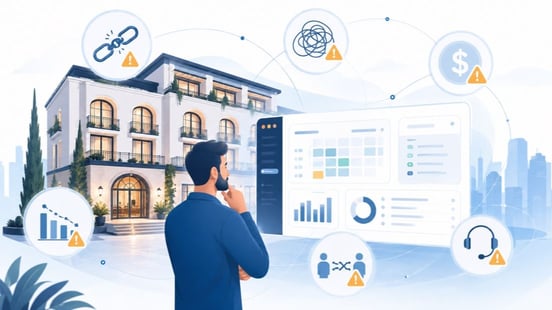
Your choice of hotel property management system (PMS) shapes the course of your business for years to come, either setting you up for success or setting you back in a competitive marketplace. From daily workflows and guest satisfaction to overall revenue potential, your PMS touches every corner of your property. To help you choose with confidence, we’ve outlined the most common pitfalls independent hoteliers face when evaluating a new system—and how to avoid them.
Pitfall #1: Falling Into the "Feature Bloat" Trap
Boutique properties don’t need the same complicated technology as large chain hotels. Extra software features may result in a cluttered user interface, steeper learning curve, and higher costs that fail to deliver a return on investment (ROI).
Before shopping for your new system, conduct a quick SWOT analysis (strengths, weaknesses, opportunities, and threats) for your property. Establish concrete 5-10 year business goals so you can select a platform that meets your actual operational needs without paying for unnecessary bells and whistles.
Pitfall #2: Overlooking Hidden Costs of Ownership
What you see isn’t always what you pay. A hotel property management system may initially seem budget friendly, but keep an eye out for these hidden fees that quickly inflate your total cost of ownership:
Tiered Support Fees: Ensure direct customer support is included in your base subscription. Some vendors charge extra for "premium" tiers just to get a live human on the phone.
Per-User Licensing Fees: Avoid systems that charge per user profile. As your seasonal staffing changes or your business grows, these additional seat licenses become a financial burden. Look for a flat-rate subscription model instead.
Direct Booking Commission Fees: Direct bookings are meant to eliminate middleman fees; vendors that charge a commission on reservations generated through your own website completely defeat the purpose.
Opaque Setup and Cancellation Fees: Some vendors tack on arbitrary setup costs or steep early-exit penalties that aren't clear until you try to leave. Ensure your provider clearly outlines all standard contract terms, notice periods, and setup fees in plain English before you commit.
Upgrade Fees: All PMS software requires upgrades to stay secure and functional. Ensure that upgrade fees won’t trap you on an older, unsupported version down the road.
Pitfall #3: Treating Payment Processing as an Afterthought
Many operators select a PMS first and figure out payments later. This separation frequently results in a clunky, disconnected check-in procedure and a higher risk of manual accounting errors.
Instead of wrestling with third-party middleware, look for a PMS like WebRezPro with its own embedded payment processor. This enables seamless daily reconciliation, tighter data security (PCI compliance), and faster check-ins.
Pitfall #4: Ignoring Integration Flexibility
A modern, cloud-based PMS should act as a hub allowing information to flow freely and securely to and from your other critical tools. A thriving hotel relies on an ecosystem of interconnected technologies, including channel managers, point-of-sale (POS) systems, smart locks, and guest messaging apps. Strong integrations give you the flexibility to adopt best-in-class software as your property grows, without replacing your core system.
Choosing a closed PMS creates data silos and missed revenue opportunities. Ensure your prospective PMS features a robust integration marketplace so you can build your ideal hospitality tech stack.
Pitfall #5: Neglecting the Mobile and Guest-Facing Experience
Independent hoteliers are rarely chained to a desk; they are on the floor checking rooms, greeting guests, or managing operations remotely. Choosing a legacy system restricted to desktop computers or even a cloud-based PMS with a poor mobile interface is a recipe for frustration for guests and staff alike.
Furthermore, a clunky mobile booking experience will decimate direct conversions. Consider these statistics:
50% of hotel bookings happen on mobile devices.
60% of travelers research hotels on mobile.
It’s easy to get obsessed with the backend dashboard and forget to audit the booking engine from a guest's perspective. If the booking flow is clunky, requires too many steps, or feels outdated, guests will head straight back to OTAs like Expedia or Booking.com.
Pro tip: Book a test reservation yourself—or better yet, ask a friend unfamiliar with your system to do so—to uncover any hidden friction points.
The Impact of Direct Booking Engines on AI Search (GEO)A modern booking engine doesn't just serve human guests; it feeds AI search tools. Modern AI travel assistants rely on your booking engine’s structured data (schema markup) to pull real-time rates and availability for travelers. If your booking engine lacks clear schema markup, Generative Engine Optimization (GEO) breaks down, and AI search platforms may omit your property entirely. As generative AI becomes a primary way travelers discover and plan trips, a strong GEO strategy is no longer optional; it determines whether your property appears in next-generation search results. |
Pitfall #6: Discounting the Value of Support and Onboarding
Implementing a new PMS is a major operational transition, and you shouldn't have to navigate it alone. Look for a vendor that provides a fully guided onboarding experience rather than simply handing over a login and leaving you to figure it out yourself.
Beyond initial setup, reliable ongoing support is critical. When your system experiences a hiccup at 10:00 PM on a holiday weekend, you can’t afford to wait on a generic corporate chatbot; you need fast access to live, expert assistance.
Finally, consider how easy the system is for your team to learn. With high staff turnover being an industry-wide reality, an intuitive user interface ensures seasonal or new employees can learn to check a guest in confidently during their very first shift.
Future-Proofing Your Hotel Operations
The right hotel property management system acts as an accelerator for your business, streamlining daily workflows, protecting your data, and unlocking new revenue streams. Take the time to audit software thoroughly from both the staff and guest perspectives to find a platform that supports long-term growth.