

Sorry, this functionality is only available for verified hoteliers
The project dashboard is a free tool that is only available to verified hoteliers to make adopting new technology easier by streamlining their research and simplifying their communication workflow.

10 Best Direct Booking Tools for Hotels in 2026

By Jordan Hollander
Last updated on March 5, 2026

Jordan Hollander
CEO @ Hotel Tech Report
Jordan is the co-founder of HotelTechReport, the hotel industry's app store where millions of professionals discover tech tools to transform their businesses. He was previously on the Global Partnerships team at Starwood Hotels & Resorts. Prior to his work with SPG, Jordan was Director of Business Development at MWT Hospitality and an equity analyst at Wells Capital Management. Jordan received his MBA from Northwestern’s Kellogg School of Management where he was a Zell Global Entrepreneurship Scholar and a Pritzker Group Venture Fellow.
-
517
articles contributed
Our reviewers evaluate software independently. Learn how we stay transparent, read our review methodology, and tell us about any tools we missed.
This list is based on research we’ve conducted since 2017, analyzing dozens of Direct Booking Tools using verified hotelier reviews, product deep dives, and our proprietary HTScore.
Direct bookings are one of the most powerful levers a hotel has to improve profitability. Every reservation captured on your own website instead of through an OTA protects margin, strengthens the guest relationship, and gives your team greater control over pricing, marketing, and the booking journey.
But not all direct booking tools deliver the same results. Some simply add promotional messaging to your website, while others function as true conversion infrastructure—using behavioral targeting, rate transparency, and automated campaigns to influence guest decisions in real time. Choosing the right platform can materially impact your distribution costs and direct channel performance.
I’ve spent years working at the intersection of hotel operations, technology, and digital distribution, helping hoteliers evaluate the systems that power their businesses. One thing has become very clear: the difference between the right and wrong technology in this category can have a meaningful impact on a hotel’s ability to compete with OTAs.
At Hotel Tech Report, our analyst team has spent countless hours researching and demoing direct booking tools used across the global hotel industry. To help you save time and reduce risk, we surveyed 1394 hoteliers across 81 countries, analyzing verified hotelier reviews alongside hands-on product testing. We evaluate not just feature lists, but the factors that actually determine success in real operations—workflow depth, integration reliability, conversion impact, and segment fit.
As you explore this guide, we’ll help you answer questions like:
What are the different types of direct booking tools available in the market?
Which direct booking tools consistently increase website conversion rates?
How do different platforms approach rate comparison, incentives, and behavioral targeting?
Which solutions integrate most reliably with booking engines and revenue management workflows?
What separates simple website widgets from full conversion optimization platforms?
Which tools perform best for independent hotels vs multi-property groups?
Inside this guide you'll find:
Rankings & Reviews: Verified hotelier feedback from thousands of real users
Expert Insights: Analysis of how the category is evolving
Comparisons: Side-by-side breakdowns of leading platforms
Pricing: How vendors structure pricing and what impacts total cost
Integrations: The systems that matter most for your direct booking strategy
Our goal with this guide is simple: help you identify the direct booking tools that are the best fit for your hotel’s operating model. By combining verified hotelier data, hands-on product analysis, and Hotel Tech Report’s tech-buying frameworks, this guide will help you cut through vendor noise and confidently shortlist solutions that actually work in real hotel operations.
- 1.
- 2.
- 3.
- 4.
- 5.
- 6.
- 7.
- 8.
- 9.
- 10.
Over 2M+ Leading Hotel Professionals Trust Our Advice




Get Your Custom Direct Booking Tools Analyst Report
- Ranked recommendations for your property
- Real operator reviews & pricing data
- Tailored to your size, market & integrations
Trusted by thousands of hoteliers worldwide
Takes 2 min · No credit card needed
LAST UPDATED
APPS TESTED





CONTRIBUTING EXPERTS


How to Choose the Right Direct Booking Tools Provider
This list is already personalized based on your hotel’s size, type, and location. Direct booking strategies can vary widely depending on your market, tech stack, and distribution mix. Want to refine the results further? Use the filters to narrow your shortlist by country, region, integrations, and other operational criteria to see which direct booking tools are the best fit for your specific setup.
Best Direct Booking Tools by Property Type
These rankings are driven by real hotelier feedback and product usage data—not vendor claims. By analyzing thousands of verified reviews, implementation signals, and performance metrics across different hotel segments, we identify the direct booking tools that consistently deliver measurable conversion improvements.
Because the needs of a 300-room resort differ significantly from those of a boutique hotel or independent property, our rankings highlight the solutions that perform best within specific operational environments. The result is a set of recommendations grounded in real-world performance from hotels most similar to yours, helping you quickly identify platforms that are proven to increase direct bookings and reduce OTA dependency.
Q3 2026 Direct Booking Tools Survey Rankings
Based on HTR's Q3 2026 quarterly Direct Booking Tools survey insights, these are the products that are currently most recommended by each size of hotel.
Q3 2026 Direct Booking Tools Survey Rankings
Based on HTR's Q3 2026 quarterly Direct Booking Tools survey insights, these are the products that are currently most recommended by each size of hotel.
| Best for | Hoteliers | Recommended | |
|---|---|---|---|
Best Direct Booking Tools for Small Hotels (up to 49 rooms)
Small
up to 49 rooms
|
283 Hoteliers |
7 products recommended
Smart Host GmbH
, The Hotels Network
, The Guestbook
and 4 others
|
|
|
|
|||
Best Direct Booking Tools for Mid-sized Hotels (50-99 rooms)
Mid-sized
50-99 rooms
|
280 Hoteliers |
6 products recommended
The Hotels Network
, The Guestbook
, Smart Host GmbH
and 3 others
|
|
|
|
|||
Best Direct Booking Tools for Large Hotels (100-499 rooms)
Large
100-499 rooms
|
542 Hoteliers |
4 products recommended
The Hotels Network
, Triptease
, The Guestbook
and 1 others
|
|
|
|
|||
Best Direct Booking Tools for Enterprise Hotels (500+ rooms)
Enterprise
500+ rooms
|
142 Hoteliers |
4 products recommended
The Hotels Network
, The Guestbook
, Triptease
and 1 others
|
|
|
|
|||
Best Direct Booking Tools for Small Hotels (up to 49 rooms)
Best Direct Booking Tools for Mid-sized Hotels (50-99 rooms)
Best Direct Booking Tools for Large Hotels (100-499 rooms)
Best Direct Booking Tools for Enterprise Hotels (500+ rooms)
Create Free Account
Join 1.5M+ hoteliers making data-driven decisions



By proceeding you agree to our Terms of Service and Privacy Policy
What you'll get




Best Direct Booking Tools Reviews
Direct Booking Tools Features & Comparison


 79 HT Score
78 HT Score
100 HT Score
91 HT Score
79 HT Score
79 HT Score
78 HT Score
100 HT Score
91 HT Score
79 HT Score
Discover popular comparisons
How We Evaluate Direct Booking Tools
Direct booking tools play a critical role in helping hotels reduce dependency on OTAs, increase profit margins, and build stronger relationships with guests. The best solutions don’t just add a booking button to your website—they actively help convert website visitors into paying guests through personalization, incentives, and intelligent conversion tactics.
At Hotel Tech Report, we evaluate direct booking tools based on their ability to increase website conversion rates, enhance the guest booking experience, and seamlessly integrate into the hotel’s existing technology stack.
Hotel direct booking tools are designed to increase the percentage of reservations made through a hotel’s own website rather than through OTAs or other third-party channels. These platforms typically sit on top of a hotel’s website and booking engine, influencing guest behavior during the booking journey through messaging, incentives, pricing transparency, and personalization.
Unlike booking engines—which handle the transactional process of completing reservations—direct booking tools focus on shaping the decision process before the booking is finalized. They address common reasons guests leave hotel websites, reinforce the advantages of booking direct, and guide visitors toward completing reservations.
However, not all direct booking tools solve the same problem. Some platforms focus on converting existing website visitors, while others help hotels engage guests earlier in the research process or attract more demand to the direct channel.
Understanding the Different Types of Direct Booking Tools
When analyzing this category, the most meaningful differences between platforms tend to revolve around where they operate in the direct booking funnel:
Traffic generation vs conversion optimization – Some platforms focus on bringing new visitors to the hotel website, while others convert visitors who have already arrived
Guest engagement depth – Tools range from simple conversion widgets to full conversational engagement and personalized booking experiences
Marketing vs operational ownership – Some solutions are primarily run by marketing teams, while others involve reservations staff or guest services teams
Data and personalization capabilities – Platforms vary significantly in how they use behavioral data, segmentation, and targeting
These differences lead to four primary types of direct booking tools used across the industry.
Direct booking funnel overview
Funnel Stage | Type of Tool | Primary Goal |
|---|---|---|
Traffic Acquisition | Demand Generation Platforms | Bring more potential guests to the hotel website |
Guest Engagement | Live Chat & Conversational Booking | Answer questions and guide guests toward booking |
Booking Experience | Website Personalization Platforms | Tailor the website experience based on visitor behavior |
Conversion Optimization | Conversion Widgets | Encourage visitors to complete a reservation |
*Note: While we consider website live chat tools to be Direct Booking Tools (since they improve direct bookings and web conversion), they also have overlap with chatbots which is why we have a dedicated and seperate category for Live Chat & Chatbots
Conversion Optimization Widgets
Conversion optimization widgets are the most widely used type of direct booking tool. These platforms focus on improving the conversion rate of visitors who are already on the hotel’s website.
They typically appear as overlays, notifications, or banners that provide real-time messaging designed to reduce booking hesitation.
Examples include:
Price comparison widgets showing OTA vs direct rates
Exit-intent messages when a visitor is about to leave the website
Scarcity messaging such as “Only 2 rooms left”
Limited-time promotional offers
Best-rate guarantee messaging
Evaluation Area | Details |
|---|---|
Best-Fit Hotel Profiles | Independent boutique hotels, small hotel groups, and properties with steady website traffic but limited marketing resources |
Typical Buyer / Owner | Marketing manager, revenue manager, or general manager at smaller properties |
Strengths | Quick implementation with minimal technical effort; immediate improvement in website conversion; easy for small teams to manage; relatively low cost |
Tradeoffs | Limited personalization capabilities; messaging can become repetitive if not optimized; does not increase website traffic |
When This Type Is the Wrong Fit | Hotels seeking advanced personalization, sophisticated marketing automation, or large-scale digital campaigns |
Live Chat & Conversational Booking Solutions
Live chat platforms allow hotels to engage with website visitors in real time, answering questions that might otherwise prevent a booking.
Guests can ask about availability, amenities, policies, packages, or local information while browsing the website.
Some platforms rely on human agents such as reservations teams, while others use AI chatbots with human escalation for more complex inquiries.
Evaluation Area | Details |
|---|---|
Best-Fit Hotel Profiles | Resorts with complex guest questions, luxury hotels emphasizing service, and properties with active reservations teams |
Typical Buyer / Owner | Reservations manager, guest services manager, or marketing/eCommerce team |
Strengths | Removes booking friction through real-time answers; builds trust during the booking journey; supports upselling and personalized recommendations; can capture leads |
Tradeoffs | Requires staffing or AI automation to scale; response speed impacts effectiveness; requires coordination between marketing and reservations teams |
When This Type Is the Wrong Fit | Small hotels without staff capacity to manage chat or properties seeking purely automated conversion optimization |
Website Personalization Platforms
Website personalization platforms dynamically adapt the website experience based on visitor behavior, location, and segmentation data.
Instead of showing the same experience to every visitor, these tools tailor messaging and offers in real time.
Capabilities often include:
Behavioral segmentation
Targeted promotions
Campaign management
A/B testing and experimentation
Evaluation Area | Details |
|---|---|
Best-Fit Hotel Profiles | Large urban hotels, resorts, and multi-property groups with dedicated marketing teams |
Typical Buyer / Owner | Digital marketing teams, eCommerce managers, or CRM/loyalty teams |
Strengths | Highly targeted messaging; strong alignment with CRM and loyalty programs; supports experimentation and ongoing optimization; improves relevance of offers |
Tradeoffs | Higher implementation complexity; requires strong integrations and data infrastructure; requires ongoing campaign management |
When This Type Is the Wrong Fit | Small hotels without marketing resources or properties seeking simple plug-and-play conversion improvements |
Direct Booking Demand Generation Platforms
Demand generation platforms focus on bringing more potential guests to the hotel website, rather than only converting visitors who already arrived.
These platforms help hotels compete with OTAs by driving additional traffic through digital marketing initiatives such as:
Metasearch advertising
Retargeting campaigns
Paid acquisition strategies
Direct channel marketing optimization
Evaluation Area | Details |
|---|---|
Best-Fit Hotel Profiles | Hotels heavily reliant on OTAs, multi-property groups, and properties investing in digital marketing acquisition |
Typical Buyer / Owner | Marketing director, digital acquisition team, or revenue management leaders |
Strengths | Increases total direct booking demand; helps hotels compete with OTA marketing spend; supports metasearch and remarketing strategies; can significantly reduce OTA share |
Tradeoffs | Requires marketing budget and active campaign management; results depend on demand conditions and marketing execution |
When This Type Is the Wrong Fit | Hotels with very limited marketing budgets or properties focused only on improving website conversion |
How to choose the right type
The best direct booking tool depends largely on where your biggest opportunity exists in the direct booking funnel.
Hotels with strong website traffic but low conversion rates often benefit most from conversion optimization widgets or personalization platforms. Properties that receive frequent guest questions during the booking process may benefit from live chat engagement tools. Meanwhile, hotels seeking to reduce OTA dependence may invest in demand generation platforms that attract more direct traffic.
In many cases, the most effective direct booking strategies combine multiple types of tools across the funnel—from generating demand to converting visitors once they reach the hotel’s website.
Hotel direct booking tools are designed to increase the percentage of reservations made through a hotel’s own website rather than third-party channels. These platforms sit on top of a hotel’s booking engine and website, using conversion optimization tactics, rate transparency, and personalized messaging to encourage guests to complete reservations directly.
Rather than simply displaying a booking button, modern direct booking tools actively guide the booking journey—addressing common reasons guests abandon the website, reinforcing the value of booking direct, and presenting targeted incentives that drive conversion.
Capability | Description | Operational Value |
|---|---|---|
Best Rate Comparison & Parity Messaging | Displays real-time comparisons between the hotel’s direct rate and OTA pricing to reinforce best-rate guarantees | Builds trust with guests and prevents them from leaving the website to check other channels |
Website Conversion Messaging | Uses pop-ups, banners, and notifications (such as scarcity messaging or limited-time offers) to encourage users to complete bookings | Increases website conversion rates by addressing hesitation during the booking process |
Behavioral Triggers & Exit Intent Offers | Detects user actions such as leaving the booking page or browsing multiple dates and surfaces targeted incentives | Recovers potential lost bookings and reduces website abandonment |
Personalized Offers & Targeted Messaging | Delivers dynamic messages or discounts based on factors like location, device type, or browsing behavior | Improves relevance of offers and increases the likelihood of direct booking |
Rate Monitoring & OTA Leakage Detection | Tracks pricing across OTAs to identify parity issues and ensure the direct channel remains competitive | Protects the integrity of direct pricing and helps revenue teams maintain channel control |
Campaign Management & A/B Testing | Allows marketing teams to launch, adjust, and test different conversion campaigns on the hotel website | Enables continuous optimization of direct booking strategies based on performance data |
Performance Analytics & Attribution | Provides reporting on website conversion rates, campaign performance, and incremental direct revenue | Gives marketing and revenue teams visibility into the ROI of direct booking initiatives |
Unlike traditional booking engines that primarily handle the transactional process of completing reservations, direct booking tools focus on influencing guest behavior before the booking is finalized.
Operationally, these platforms act as a conversion optimization layer within the hotel’s digital ecosystem. When integrated with systems such as the booking engine, rate shopping tools, CRM platforms, and web analytics tools, they provide visibility into booking behavior and allow hotels to actively steer guests toward direct reservations.
For marketing and revenue teams, this creates a measurable pathway to increase website conversion rates, reduce OTA dependency, and improve overall distribution profitability without requiring significant changes to the core booking engine infrastructure.
At first glance, many hotel direct booking tools appear very similar. Most vendors promise higher website conversion rates, reduced OTA dependency, and tools to promote best-rate guarantees. On the surface, these platforms often share common features such as pop-ups, rate comparison widgets, and promotional messaging.
However, the real differences between solutions become clear once you examine how they operate within the hotel’s digital ecosystem. Some platforms function as simple messaging layers on top of the website, while others provide sophisticated behavioral targeting, campaign automation, and deep integrations with booking engines, CRM platforms, and revenue management systems.
This distinction matters because direct booking tools influence one of the most important metrics in hotel distribution: the percentage of reservations captured through the hotel’s own website. Platforms that lack strong integrations, personalization capabilities, or performance analytics may generate superficial engagement without delivering meaningful conversion improvements.
Our evaluation framework focuses on operational performance, integration depth, automation capabilities, and measurable revenue impact. The goal is to help hoteliers identify platforms that truly influence guest booking behavior and drive incremental direct revenue—rather than tools that simply add marketing widgets to the website.
Evaluation Scorecard
Capability | Importance | What to Ask Vendors | What Good Looks Like | Red Flags / Weak Implementations |
|---|---|---|---|---|
Booking Engine Integration | ★★★★★ | Which booking engines are natively supported? Is pricing and availability synced in real time? | Deep integration with major booking engines enabling accurate rates, inventory awareness, and seamless booking handoff | Manual configuration or delayed data syncing that risks showing inaccurate pricing |
Rate Parity Monitoring & OTA Comparison | ★★★★☆ | How does the platform monitor OTA pricing? How often is rate data refreshed? | Automated monitoring of OTA rates with real-time comparison widgets displayed to guests | Static messaging claiming “best rate” without live rate verification |
Behavioral Targeting & Personalization | ★★★★☆ | Can campaigns adapt based on user location, device type, referral source, or browsing behavior? | Dynamic messaging and offers triggered by user behavior and contextual signals | One-size-fits-all pop-ups with no segmentation or targeting capabilities |
Campaign Management & Marketing Controls | ★★★★☆ | Can hotel teams create and adjust campaigns independently? Is A/B testing supported? | Intuitive campaign builder with rule-based targeting and built-in experimentation tools | Vendors must manually configure campaigns or changes require technical support |
Conversion Optimization Tools | ★★★★☆ | What tools exist to reduce abandonment during the booking process? | Exit-intent triggers, urgency messaging, price comparisons, and promotional offers that activate at key points in the booking funnel | Generic website banners with no behavioral logic |
CRM & Guest Data Integration | ★★★☆☆ | Does the platform integrate with CRM or loyalty systems to personalize offers? | Ability to deliver segmented offers based on guest profiles, loyalty status, or past stays | No integration with guest data systems, limiting personalization |
Analytics & Conversion Attribution | ★★★★☆ | How does the platform measure incremental bookings or revenue impact? | Clear reporting dashboards showing conversion lift, campaign performance, and incremental revenue | Only basic click metrics without direct revenue attribution |
Website Performance & Load Impact | ★★★☆☆ | How does the solution affect page speed and website performance? | Lightweight scripts that load asynchronously without impacting page performance | Heavy scripts that slow down booking pages or degrade user experience |
Multi-Property & Campaign Scalability | ★★★☆☆ | Can campaigns be managed across multiple properties from a centralized dashboard? | Centralized campaign management with property-level customization for hotel groups | Each property requires independent configuration and management |
Compliance, Privacy & Data Handling | ★★★☆☆ | How does the platform handle GDPR and guest data privacy requirements? | Clear data governance policies with secure data handling and consent management | Limited transparency around data collection or storage practices |
Dealbreaker Questions
These questions can quickly help hotel teams eliminate weak vendors before investing time in deeper demonstrations.
Does the platform integrate directly with the booking engine in real time?
Accurate pricing and availability are essential. Platforms relying on delayed or indirect data feeds risk showing outdated information that undermines guest trust.
Can hotel teams manage campaigns independently without vendor support?
Marketing teams should be able to launch promotions, adjust targeting rules, and test messaging without needing technical assistance or vendor intervention.
How does the platform measure incremental direct bookings?
Strong vendors provide clear analytics showing how many bookings and how much revenue were generated as a result of the platform’s campaigns.
Does the solution support behavioral targeting and segmentation?
Modern direct booking tools should adapt messaging based on guest behavior, location, and device type. Platforms that rely only on generic pop-ups typically deliver weaker conversion improvements.
Asking these questions early in the evaluation process helps hoteliers quickly identify platforms that deliver measurable conversion improvements and sustainable direct booking growth, rather than tools that rely on superficial website messaging.
Direct booking tools can deliver meaningful gains in conversion rate and distribution profitability—but the right solution often depends on the type of hotel operating the technology. A platform designed for a 400-room resort with a dedicated digital marketing team may be unnecessarily complex for a 20-room boutique hotel, while lightweight tools built for small properties may lack the capabilities required for large-scale marketing and demand generation.
Hotels also differ significantly in how they generate demand, how their teams are structured, and how much operational complexity they manage. Some properties rely heavily on paid digital marketing and loyalty programs to drive website traffic, while others primarily depend on OTAs for discovery and need tools that convert that traffic more effectively.
For these reasons, the most successful technology selections align the platform with the hotel’s operational model, marketing resources, and distribution strategy—not just property size.
Below is a breakdown of how software needs typically vary across four common hotel segments.
Segment Overview
Hotel Segment | Primary Direct Booking Focus | Typical Team Ownership |
|---|---|---|
Large Hotels & Resorts | Personalization, campaign optimization, and marketing scalability | Marketing, digital commerce, and revenue teams |
Boutique & Independent Hotels | Improving website conversion with simple tools | Marketing managers, revenue managers, or GMs |
Small Hotels & B&Bs | Simplicity and automation with minimal management | Owner-operators or general managers |
Budget Hotels, Motels & Limited-Service Properties | Price transparency and fast booking decisions | Operations or revenue management |
Large Hotels & Resorts: Prioritizing Personalization, Scale & Marketing Control
Large hotels and resorts typically operate with dedicated marketing, revenue management, and digital commerce teams. These properties often generate significant website traffic through brand marketing, loyalty programs, metasearch advertising, and paid acquisition channels.
Because of this scale, direct booking tools are often used as part of a broader direct channel optimization strategy, where marketing teams actively run campaigns, test offers, and personalize the website experience to increase conversion rates.
Defining Characteristics
High website traffic volumes driven by brand and marketing investment
Multiple operational departments including marketing, revenue, and distribution
Strong reliance on digital marketing channels and loyalty programs
Complex guest journeys involving multiple room types and packages
Higher expectations for personalization and premium guest experiences
Common Needs & Preferences
Advanced behavioral targeting and segmentation
Integration with CRM, analytics, and marketing tools
Multi-property campaign management capabilities
Strong reporting and conversion analytics
Tools that support ongoing experimentation and optimization
Key Features and Needs
Feature Title | Description | Why It’s Critical | Feature Type |
|---|---|---|---|
Behavioral Personalization | Dynamically adapts website messaging and offers based on visitor behavior | Large hotels rely on targeted marketing to improve conversion across diverse guest segments | Feature |
CRM & Guest Data Integration | Connects guest profiles and loyalty data to marketing campaigns | Enables personalized offers and loyalty messaging during the booking journey | Integration |
Advanced Campaign Management | Allows teams to run multiple campaigns and promotional tests simultaneously | Supports ongoing digital marketing experimentation and optimization | Feature |
Multi-Property Campaign Control | Centralized management of campaigns across hotel portfolios | Essential for brands or hotel groups managing multiple properties | Infrastructure |
Conversion Analytics & Attribution | Tracks the revenue impact of campaigns and booking behavior | Helps justify marketing spend and improve conversion performance | Feature |
Boutique & Independent Hotels: Maximizing Conversion with Limited Marketing Resources
Boutique and independent hotels typically operate with lean teams where marketing, distribution, and operations responsibilities often overlap. While these properties frequently rely on OTAs for visibility, increasing direct bookings is a major priority for improving margins and strengthening brand identity.
Direct booking tools for this segment should focus on high-impact conversion improvements that require minimal ongoing management.
Defining Characteristics
Smaller teams with limited marketing bandwidth
Heavy reliance on OTAs for discovery and traffic
Moderate website traffic volumes
Strong emphasis on brand storytelling and guest experience
Limited technical resources for implementation
Common Needs & Preferences
Simple setup and easy campaign management
Conversion-focused tools that work out of the box
Transparent pricing and clear ROI
Minimal technical maintenance
Reliable booking engine integrations
Key Features and Needs
Feature Title | Description | Why It’s Critical | Feature Type |
|---|---|---|---|
Conversion Messaging Widgets | Pop-ups and banners highlighting promotions or best-rate guarantees | Helps convert guests who arrive from OTA price comparisons | Feature |
Rate Comparison Messaging | Displays real-time comparisons between OTA and direct rates | Reinforces best-rate guarantees and builds trust with guests | Feature |
Booking Engine Integration | Ensures messaging aligns with real-time pricing and availability | Prevents guest confusion and booking friction | Integration |
Campaign Templates | Pre-built promotional campaign formats | Allows small teams to launch campaigns without marketing expertise | Feature |
Simple Performance Reporting | Basic dashboards showing conversion and booking performance | Helps hoteliers measure the impact of direct booking tools | Feature |
Small Hotels & B&Bs: Simplicity, Automation & Low Operational Overhead
Small hotels and bed & breakfasts often operate with extremely lean staffing models. Owners or general managers typically handle marketing, guest communication, and distribution management themselves.
For this segment, the most effective solutions prioritize simplicity, automation, and minimal operational overhead.
Defining Characteristics
Owner-operated or very small teams
Limited technical and marketing expertise
Lower website traffic volumes
Heavy dependence on OTAs for guest discovery
Highly budget-conscious technology decisions
Common Needs & Preferences
Quick installation with minimal technical setup
Tools that run automatically without active campaign management
Affordable pricing structures
Clear and simple interfaces
Basic conversion optimization functionality
Key Features and Needs
Feature Title | Description | Why It’s Critical | Feature Type |
|---|---|---|---|
Lightweight Website Integration | Simple scripts or plugins that add booking conversion features | Enables easy deployment without technical expertise | Infrastructure |
Automated Conversion Prompts | Pre-configured offers and booking reminders | Helps improve conversion without manual campaign management | Feature |
Best-Rate Messaging | Reinforces direct booking value on the website | Prevents guests from leaving to compare OTA pricing | Feature |
Low-Cost Subscription Model | Pricing structures designed for smaller properties | Keeps technology accessible for small operations | Pricing Model |
Simple Reporting Dashboard | Easy-to-read insights into website bookings and campaign performance | Provides visibility without complex analytics | Feature |
Budget Hotels, Motels & Limited-Service Properties: Efficiency and Price Transparency
Budget hotels and limited-service properties operate with streamlined teams and highly price-sensitive guests. Operational efficiency and quick booking decisions are central to the business model.
Direct booking tools in this segment are most effective when they focus on clear pricing transparency and automated messaging that encourages fast booking decisions.
Defining Characteristics
Minimal operational departments and staffing
Price-sensitive traveler segments
Heavy reliance on OTAs and aggregator platforms
High focus on operational efficiency
Standardized guest experiences with limited customization
Common Needs & Preferences
Automation over manual campaign management
Clear pricing transparency messaging
Tools requiring minimal staff involvement
Cost-effective technology investments
Reliable booking engine compatibility
Key Features and Needs
Feature Title | Description | Why It’s Critical | Feature Type |
|---|---|---|---|
Rate Transparency Messaging | Displays direct rate comparisons versus OTA pricing | Encourages guests to book directly without leaving the site | Feature |
Automated Booking Incentives | Automatically promotes discounts or perks for direct bookings | Drives faster booking decisions among price-sensitive guests | Feature |
Booking Engine Compatibility | Ensures seamless reservation flow between website and booking engine | Prevents booking friction and abandoned reservations | Integration |
Lightweight Website Scripts | Low-impact technology that does not slow website performance | Maintains operational simplicity and reliability | Infrastructure |
Cost-Efficient Pricing Model | Affordable pricing for high-volume, lower-margin operations | Ensures the platform remains financially viable | Pricing Model |
Choosing the right direct booking tool ultimately depends less on property size and more on how your hotel generates demand and manages its digital marketing efforts. Aligning the technology with your operational structure and distribution strategy is the most reliable way to maximize conversion performance and long-term ROI.
Everything You Need to Know About Direct Booking Tools
Not sure where to start with hotel direct booking tools? This section is your crash course. We’ll walk you through what direct booking tools actually do, how they help convert website visitors into guests, and which capabilities truly impact conversion rates.
You’ll also learn what features to expect—from rate comparison widgets and behavioral targeting to campaign management and performance analytics—along with how pricing typically works and which integrations matter most (such as booking engines, rate shopping tools, and CRM platforms).
Finally, we’ll cover the operational benefits, common implementation pitfalls, and the key trends shaping how hotels drive more profitable direct reservations. The goal is to give you a clear, practical understanding of the category so you can confidently evaluate solutions based on real operational value—not just marketing claims.
2026 Direct Booking Software Buyer's Guide


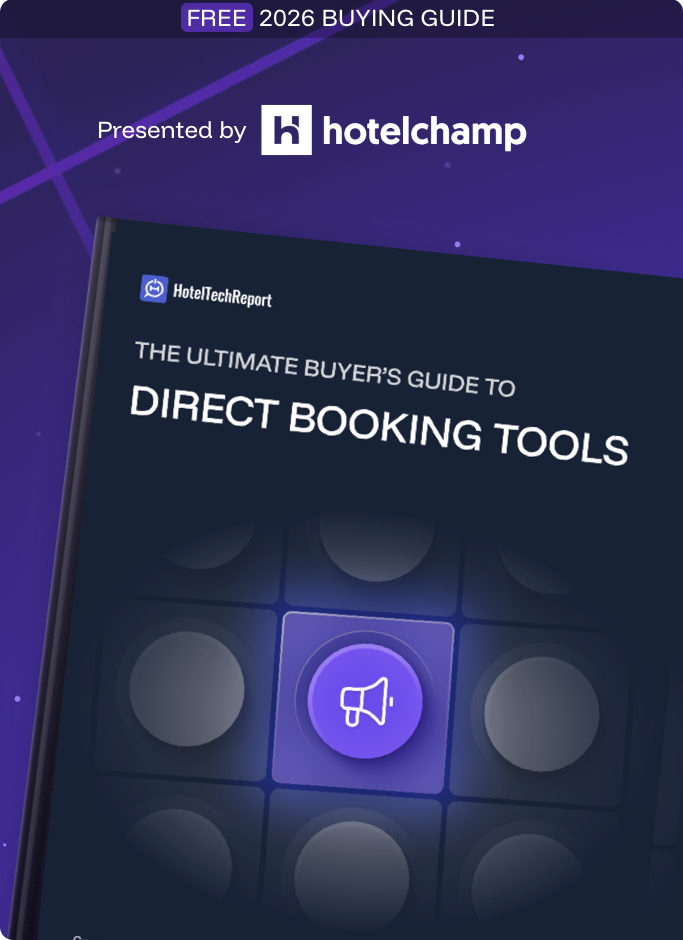
Download the Free Guide
Your guide was sent!
Your guide was successfully sent to .
This email may be incorrect
Our check detected that this address may have been entered incorrectly. Please confirm or correct it before we continue:
This looks like it may contain a typo.
Did you mean ?
What is a Direct Booking Platform?
A hotel direct booking tool is software designed to help hotels capture more reservations through their own website instead of third-party channels like OTAs. These platforms sit on top of a hotel’s website and booking engine and work by influencing guest behavior during the booking journey—encouraging visitors to complete their reservation directly.
The primary goal is to increase website conversion rates and reduce OTA dependency. Direct booking tools do this by reinforcing best-rate guarantees, presenting targeted incentives, answering guest questions, and personalizing the booking experience. In practice, they help hotels address common points of booking friction such as price comparison, uncertainty about amenities or policies, and hesitation during the checkout process.
Most solutions fall into a few broad categories depending on where they operate in the direct booking funnel. Conversion optimization tools use widgets such as rate comparison messaging, exit-intent offers, and scarcity notifications to encourage bookings. Live chat and conversational tools allow hotels to answer guest questions in real time and guide visitors toward completing reservations. Website personalization platforms tailor offers and messaging based on visitor behavior or location. And demand generation platforms help hotels attract more website traffic through marketing channels like metasearch and retargeting.
Together, these tools help hotels capture more direct demand, improve distribution profitability, and strengthen relationships with guests by owning the booking experience and the underlying guest data.
Key Features to Look For in Hotel Direct Booking Tools
Direct booking tools have evolved significantly over the past decade. Early solutions focused primarily on simple website widgets that displayed promotional messages or best-rate guarantees. Today’s platforms play a much more strategic role in hotel distribution by actively influencing guest behavior during the booking journey.
Modern solutions operate as a conversion optimization layer on top of the hotel website and booking engine, using behavioral triggers, rate transparency, and targeted messaging to encourage guests to complete reservations directly. When properly implemented, these tools help reduce OTA leakage, increase website conversion rates, and reinforce the value of booking direct.
For hotel teams, the most effective platforms go beyond marketing pop-ups. They support automated campaign management, integration with core hotel systems, and measurable performance analytics that show how direct booking initiatives impact revenue. The capabilities below represent the features that matter most when evaluating solutions in this category.
Capability Area | Feature | Description |
|---|---|---|
Guest Engagement & Booking Journey Optimization | Rate Comparison Widgets | Displays real-time comparisons between the hotel’s direct rate and OTA pricing to reinforce best-rate guarantees and prevent guests from leaving the website to check other channels. |
Dynamic Website Messaging | Uses targeted banners, notifications, or prompts to highlight promotions, value-added packages, or limited-time offers during the booking journey. | |
Behavioral Trigger Messaging | Automatically displays relevant messages when certain user behaviors occur, such as browsing multiple dates or showing exit intent during the booking process. | |
Geo-Targeted Offers | Delivers location-based offers or messaging tailored to the guest’s geographic market, supporting international marketing campaigns and regional pricing strategies. | |
Mobile Optimization | Ensures messaging and booking prompts are optimized for mobile users, who represent a growing share of hotel website traffic. | |
Operations & Workflow Management | Campaign Management Dashboard | Central interface where marketing teams create, adjust, and manage website campaigns without requiring developer support or vendor intervention. |
Automated Trigger Rules | Allows hotels to define rules that control when messages appear based on user behavior, booking patterns, or referral sources. | |
A/B Testing & Experimentation | Enables teams to test different messages, offers, or campaign formats to identify which strategies generate the highest booking conversion rates. | |
Multi-Property Management | Allows hotel groups to manage campaigns across multiple properties from a centralized dashboard while maintaining property-level customization. | |
Revenue & Commercial Impact | OTA Leakage Prevention | Detects when guests are comparing prices across channels and reinforces the advantages of booking directly on the hotel website. |
Direct Booking Incentive Management | Supports value-added incentives such as discounts, upgrades, or perks that encourage guests to book directly rather than through OTAs. | |
Conversion Rate Optimization Tools | Provides features like urgency messaging, scarcity notifications, and promotional prompts that help reduce booking abandonment. | |
Campaign Performance Analytics | Tracks how campaigns influence booking behavior, including conversion lift, revenue generated, and incremental direct bookings. | |
Integrations & Data | Booking Engine Integration | Connects directly with the hotel’s booking engine to ensure pricing, availability, and booking flows remain accurate and seamless. |
Rate Shopping Integration | Pulls real-time OTA pricing data to support accurate rate comparison messaging and parity monitoring. | |
CRM & Guest Data Integration | Connects with guest profile and loyalty systems to support segmented messaging and personalized booking offers. | |
Web Analytics Integration | Syncs with analytics platforms to provide deeper insights into website traffic, user behavior, and campaign performance. |
When evaluating direct booking tools, it’s important to look beyond surface-level messaging features. The strongest platforms combine behavioral targeting, campaign automation, and reliable integrations with booking and pricing systems. These capabilities allow hotel teams to continuously refine their direct booking strategy and capture more reservations through their own website rather than third-party channels.
- Surge Alerts
- Instant redeemable rewards
- Pop-up & Exit Intent Messages
- Price Comparison
- Review compilation widget
- SMS Reminders
- A/B Split Testing
- Tab Abandonment Alerts
- Form Autofill
- Surge Alerts
- Instant redeemable rewards
- Pop-up & Exit Intent Messages
- Price Comparison
- Review compilation widget
- SMS Reminders
- A/B Split Testing
- Tab Abandonment Alerts
- Form Autofill
- Custom Segment Messaging
- Booking Engine Data Sync
- A/B Split Testing
- Custom Segment Messaging
- Booking Engine Data Sync
- A/B Split Testing
- Pop-up & Exit Intent Messages
- Pop-up & Exit Intent Messages
- Metasearch Survelliance
- Parity Reports
- OTA Parity Live Feed
- Metasearch Survelliance
- Parity Reports
- OTA Parity Live Feed
- Facebook Messenger Integration
- Live Chat
- SMS Reminders
- Facebook Messenger Integration
- Live Chat
- SMS Reminders
- Instant redeemable rewards
- Instant redeemable rewards
- Analytics dashboard
- Messaging Analytics
- A/B Split Testing
- Analytics dashboard
- Messaging Analytics
- A/B Split Testing
How can direct booking platforms improve profitability and efficiency?
- Boost website conversion: Dynamic, personalized digital experiences are now an essential part of any high-converting website - from retailers to OTAs. Hotels that want to convert more web visitors and increase direct bookings need the data-driven conversion optimization that a Direct Booking Platform can provide.
- Parity management & monitoring: Hotels that are being undercut by OTAs see a 30% decrease in conversion. This means that taking control of price parity and transparently offering guests the best price direct should be at the top of any hotelier’s agenda. A Direct Booking Platform allows hoteliers to easily monitor, manage and optimize their parity to offer guests a trusted, fair price direct.
- Lower OTA expenses/increase direct bookings: Shifting direct bookings to your website means that you are shifting business from high cost third parties to low-cost proprietary platforms. These platforms have fixed expense associated which means that you’ve already paid for them - a Direct Booking Platform helps you to maximize that investment by learning continuously from a wealth of data to offer a better, more effective and more personalized digital experience to customers.
Critical Integrations for Direct Booking Tools
When evaluating hotel direct booking tools, it’s easy to focus on the visible features—pop-ups, rate comparison widgets, or promotional messaging on the website. But the real value of these platforms depends on how well they integrate with the systems that power your hotel’s distribution, pricing, and guest data.
At a minimum, a direct booking tool should work seamlessly with the core systems that control your website booking experience:
Booking Engine to ensure accurate rates, availability, and a seamless reservation handoff
Rate Shopping Tools to verify OTA pricing and support real-time rate comparison messaging
Website CMS or Website Builder to deploy campaigns and messaging without slowing down the site
Web Analytics Platforms to track user behavior and measure conversion performance
These integrations are essential because direct booking tools operate as a conversion optimization layer on top of your website and booking engine. If the data feeding into the platform isn’t accurate or updated in real time, messaging about pricing, availability, or promotions can quickly become misleading—hurting guest trust and booking conversion.
Once those core connections are in place, the next step is ensuring the platform can integrate with the broader hotel tech stack. The integrations below are the ones that matter most for hotels looking to build a data-driven direct booking strategy and reduce OTA dependency over time.
Pricing for hotel direct booking tools typically follows a SaaS subscription model, though the structure can vary depending on how vendors align their pricing with booking performance or website traffic. Most solutions charge either a fixed monthly fee per property or a performance-based model tied to the number of bookings or revenue generated through the platform.
Unlike some hotel technology categories, direct booking tools generally do not require physical hardware. However, costs can still vary significantly depending on integration requirements, feature sophistication, and the scale of deployment across multiple properties. For example, tools with advanced personalization, CRM connectivity, or campaign automation capabilities may sit at a higher price point than basic rate comparison widgets.
When evaluating pricing, hotels should focus on total cost of ownership rather than the base subscription price. Factors such as onboarding, integration with booking engines or rate shopping tools, support services, and multi-property management capabilities can influence the long-term investment required to operate the platform effectively.
Common Pricing Models
Pricing Model | How It Works | Typical Cost Considerations |
|---|---|---|
Per-Property Subscription | Hotels pay a fixed monthly or annual fee for each property using the platform. | Pricing often varies based on feature tiers, number of campaigns, or level of support included. |
Revenue Share / Commission | The vendor takes a percentage of incremental bookings or revenue generated through the platform. | Can reduce upfront costs but may become expensive for high-performing properties with strong website traffic. |
Tiered SaaS Plans | Vendors offer multiple pricing tiers based on feature access, campaign limits, or personalization capabilities. | Higher tiers typically include advanced targeting, analytics, and integration options. |
Traffic or Booking Volume Pricing | Pricing scales based on website traffic levels or number of bookings influenced by the platform. | Hotels with higher website traffic may face higher costs but also benefit from greater conversion potential. |
Portfolio or Multi-Property Licensing | Hotel groups negotiate pricing based on the number of properties using the platform. | Often provides volume discounts but may require centralized management capabilities. |
What Impacts Pricing the Most
Property size and website traffic volume – Hotels with higher website traffic often require more robust campaign capacity and analytics processing.
Integration requirements – Connecting with booking engines, rate shopping tools, CRM platforms, and analytics systems can influence setup and ongoing costs.
Feature sophistication – Platforms offering behavioral targeting, personalization, and advanced campaign automation typically command higher subscription tiers.
Multi-property deployments – Hotel groups managing campaigns across several properties may require centralized dashboards and expanded user access.
Evaluating ROI
When assessing direct booking tools, hotels should evaluate ROI based on conversion improvements and reduced OTA dependency rather than just subscription cost. Even modest increases in website conversion rates can translate into significant savings on OTA commissions.
The most successful implementations combine strong conversion tools with effective campaign management and pricing transparency—allowing hotels to capture more direct reservations while improving the profitability of their distribution strategy.




The integration can vary depending on how long the providers take to complete their work. The highest varying factor is the booking engine integration. As a general rule of thumb, the more we have worked with that booking engine, the quicker and smoother the integration will be. The biggest factor that influences the time taken for implementation is based on the number of hotels being integrated and if any issues arise during the quality checks.
The Future of Direct Booking Tools
Modern direct booking tools are moving beyond static promotional messaging and toward dynamic, behavior-driven personalization. Instead of displaying the same message to every visitor, platforms can now adapt offers based on browsing behavior, device type, location, and past guest history.
This shift is driven by tighter integrations with booking engines, CRM systems, and web analytics tools, allowing platforms to better understand how guests interact with hotel websites.
Here's what this could mean for your hotel:
Dynamic booking incentives. Hotels can present targeted offers such as mobile-only discounts, geo-specific promotions, or loyalty perks based on who is visiting the website.
Higher website conversion rates. Messaging appears at the exact moments when guests are most likely to abandon the booking process.
More relevant marketing campaigns. Offers can align with guest preferences and booking intent rather than generic promotions.
Guests frequently leave hotel websites to compare prices on OTAs before completing a booking. To address this behavior, direct booking tools are increasingly focused on rate transparency and automated parity monitoring.
By integrating with rate shopping platforms, these tools can display real-time comparisons between OTA rates and direct website pricing. This reassures guests that they are receiving the best available rate without needing to check other channels.
Here's what this could mean for your hotel:
Reduced OTA leakage. Guests are less likely to leave the website to verify pricing on other channels.
Stronger best-rate guarantees. Hotels can confidently reinforce their pricing advantage.
Improved trust during the booking process. Transparent pricing builds confidence and reduces booking hesitation.
Direct booking technology is increasingly overlapping with digital marketing and conversion optimization platforms. Instead of acting solely as website messaging tools, modern solutions provide campaign management, experimentation, and performance analytics that help marketing teams continuously improve booking conversion.
These platforms now allow hotels to test offers, analyze user behavior, and adjust messaging strategies in real time.
Here's what this could mean for your hotel:
Continuous conversion optimization. Marketing teams can run experiments and refine campaigns based on real booking data.
Greater visibility into direct booking performance. Analytics show how campaigns influence revenue and distribution mix.
Closer alignment between marketing and revenue teams. Campaigns can support pricing strategies and demand patterns more effectively.
Hoteliers Also Ask
Direct Booking Platforms boost the performance of your current website and booking engine with tools that add a layer of personalization to your website. The most effective platforms track user behavior on hotel websites and then serve tailored messages and promotions based on that behavior - for example, an early-bird offer to a guest searching six months in advance of their stay. Platform providers with significant data scale are able to automate much of the optimization experience by constantly feeding their learnings from thousands of websites back into the platform for the benefit of every client. Providing the right message at the right time improves the guest experience and has a significant impact on direct bookings (reducing OTA commission costs for the hotel). A Direct Booking Platform enables a hotelier to test and optimize their website content in order to increase conversion. With every booking, hoteliers can learn to target and convert more guests.
A direct booking platform should help all teams across a business to do their jobs and see value from the tools. A good answer from a vendor would explain that their tool encourages collaborative working between teams because Marketing, Revenue, Reservations, eCommerce and Senior Management can all get an overview of the work being done, the ROI of marketing campaigns, online messaging and conversations, as well as the overarching direct booking trends over time. A great direct booking solution offers products that are designed to work together seamlessly, allowing your team to do the same.
Accurate pricing data is also integral to driving direct bookings. Guests will shop around to find the cheapest price, and if your direct booking software displays incorrect data they will book elsewhere. A good answer from a vendor on pricing data accuracy would give assurance that there is a team committed to constantly checking and maintaining price accuracy, with emergency engineers on call 24 hours a day if there are any issues. The team should also be working continuously with UX designers to ensure that the 99.5% accurate pricing data is displayed to guests in the most effective way.
If your hotel website has below industry average conversion rates or traffic you should strongly consider a direct booking platform. A hotel’s website is a key channel to drive direct bookings. Direct customers bring richer data, more revenue and better direct relationships. Customers will visit the hotel website on their path to book but hotels can often miss the opportunity to convert those web visitors into direct bookers by not optimizing their website to drive bookings. Similarly, if your hotel is experiencing frequent parity breaches it may be time to consider a direct booking platform. Hotels that are being undercut by OTAs see a 30% decrease in conversion on average. This means decreased revenue, more money paid to OTAs in commission, less data and insights on the behavior of customers/what makes them convert and no direct relationship with guests. The frequency at which the hotel website is displaying the same rates as those on OTAs. The more an OTA ‘undercuts’ a hotel by displaying a cheaper rate, the lower the hotel’s direct website conversion rate.
Responsibility often sits with marketing or eCommerce teams since these tools influence website performance and digital campaigns. In smaller properties, revenue managers or general managers may oversee them. In larger hotel groups, direct booking initiatives are often managed by centralized digital marketing teams working alongside revenue management.
No. A booking engine handles the transactional side of reservations—displaying rates, availability, and processing the booking. Direct booking tools operate on top of the website and booking engine to influence guest decisions before the booking is finalized. They act as a conversion optimization layer rather than a reservation system.
They combine both. Some features focus on pricing transparency—such as showing guests that the direct website rate matches or beats OTA prices. Others focus on marketing tactics like personalized offers or urgency messaging. The most effective platforms align these strategies to support both revenue management and digital marketing goals.
These platforms influence booking decisions by presenting targeted messages at key moments in the booking journey. For example, if a guest is about to leave the booking page or comparing multiple dates, the system can surface incentives or best-rate confirmations. The goal is to reduce hesitation and encourage guests to complete reservations directly on the hotel website.
Most teams evaluate performance through website conversion rate improvements and incremental direct bookings. By comparing conversion rates before and after implementation, hotels can estimate the impact on revenue. Many platforms also provide analytics showing how specific campaigns or messages contributed to completed reservations.
Hotels with consistent website traffic tend to see the greatest impact. This often includes boutique hotels, urban properties, resorts, and branded hotels investing in digital marketing. Properties that already generate website visits through SEO, paid ads, or brand recognition can significantly increase direct booking conversion with the right optimization tools.
They can help reduce OTA reliance by improving how effectively hotels convert website visitors into direct guests. However, they are most effective when combined with a broader direct booking strategy that includes strong website design, competitive pricing, digital marketing campaigns, and clear value propositions for booking direct.
One common mistake is assuming the software alone will increase bookings without a broader direct channel strategy. If the hotel website has low traffic or poor user experience, conversion tools will have limited impact. Another mistake is failing to regularly review campaign performance and adjust messaging based on guest behavior.
In most cases, yes. While some campaigns can run automatically once configured, the best results typically come from ongoing optimization. Marketing teams may adjust messaging, test new promotions, and monitor performance data to improve website conversion over time.
LAST UPDATED
APPS TESTED
CONTRIBUTING EXPERTS
Get Your Custom Direct Booking Tools Analyst Report
- Ranked recommendations for your property
- Real operator reviews & pricing data
- Tailored to your size, market & integrations
Trusted by thousands of hoteliers worldwide
Takes 2 min · No credit card needed
Get Your Free AI Analyst Report
Custom recommendations tailored to your property


