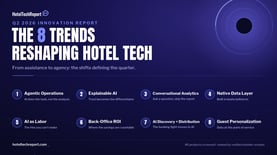




As hotels face higher guest demands and operational challenges, artificial intelligence (AI) is emerging as a key tool to improve efficiency and elevate the guest experience. From automating front-desk operations to predicting guest preferences, AI is helping hotels operate smarter, faster, and more profitably.
As margins tighten and staff shortages persist, AI-driven systems are becoming indispensable to sustaining both efficiency and personalization. In this article, we break down how AI is redefining every aspect of hotel operations and how modern platforms are enabling this transformation at scale.
Understanding How AI Is Powering The Next Generation Of Hotel Operations
Artificial intelligence in hospitality extends far beyond chatbots. It combines machine learning, natural language processing (NLP), and predictive analytics to automate decision-making and improve outcomes in real time.
According to Deloitte’s 2024 Travel and Hospitality Outlook, more than 60% of hotel executives identified AI-driven automation as their top technology priority for the next 18 months.
Today, AI is reshaping hotel operations across multiple functions:
-
Smart concierge and guest communication: AI-powered assistants respond to guest calls, WhatsApp messages, and pre-booking inquiries instantly — handling reservations, add-on services and amenity requests without delay.
-
Automated task management: Predictive models assign housekeeping or maintenance tasks based on occupancy data, and staff availability, reducing downtime.
-
Dynamic resource management: Machine learning monitors inventory, energy usage, and staffing levels to optimize resources.
-
Predictive insights: AI forecasts occupancy, identifies guest behavior trends, and helps managers make data-backed operational decisions.
Transforming The Concierge Experience Through AI
Traditional concierge desks rely heavily on manpower — assisting guests with cab bookings, reservations, sightseeing, or handling special requests. With staffing challenges and growing guest volumes, this manual approach can be inefficient.
AI now enables 24/7 digital concierge assistants that manage all guest communications through chat or voice, automating routine inquiries such as:
-
“What’s the pool timing?”
-
“Can I get a late checkout?”
-
“Book me a table for dinner.”
These systems reduce manual workload while improving accuracy and response speed. They can also escalate complex requests to on-duty staff when needed.
Forbes Hospitality Council notes, “AI is not replacing the concierge; it’s scaling hospitality by ensuring no guest query ever goes unanswered.”
AI-driven guest messaging, AI-assisted self-check-in, AI operational assistant, is embedded in PMS platforms like that helps hotels manage guest interactions and thousands of communications across multiple channels seamlessly, reducing the dependency on manual follow-ups while maintaining a personalized touch.
Enhancing Guest Journeys With AI-Based Pre-Booking And Communication
AI is also transforming the pre-booking phase of the guest journey. Intelligent booking assistants can showcase room views, recommend amenities, and simulate virtual tours — responding instantly to guest queries via chat or WhatsApp.
According to McKinsey (2024), hotels using AI-based booking assistance see a 15–25% increase in direct bookings due to faster responses and personalized recommendations.
AI And The Future Of Zero-Interface Hotel Operations
One of the most powerful trends in hospitality tech is zero-UI (zero user interface) operations — where staff and guests interact with hotel systems through natural language commands instead of complex dashboards.
Voice-enabled AI tools now allow hoteliers to issue instructions such as:
“Amend guest stay for room 206.”
“Process early check-in.”
“Log maintenance request for AC unit.”
AI interprets and executes these commands directly through integrated property management systems. Guests can also manage stays, request upgrades, or check out digitally — eliminating long queues or repetitive front-desk interactions.
Smarter Revenue Management Through AI-Powered Dynamic Pricing
AI has fundamentally changed dynamic pricing in hospitality. By analyzing booking trends, competitor rates, seasonality, and local demand signals, AI models continuously optimize room prices to maximize revenue and occupancy.
Unlike rule-based systems, AI dynamically reacts to real-time market changes — ensuring every rate adjustment aligns with demand elasticity and guest behavior.
Skift Research (2024) found that AI-driven pricing systems can yield 10–15% higher RevPAR compared to static or manually managed strategies.
Measurable Impact Of AI On Hotel Performance
Hotels implementing AI-driven automation report measurable operational gains:
-
20–30% faster response times to guest requests (Skift Research, 2024)
-
Up to 25% reduction in front desk workload
-
Higher guest satisfaction scores, driven by speed and personalization
-
10–15% increase in direct revenue through dynamic pricing and intelligent upselling
These systems ensure efficiency without sacrificing the human element — allowing staff to focus on empathy and personalized experiences while AI handles repetitive administrative tasks.
Overcoming Implementation Challenges
Adopting AI requires thoughtful planning and change management. Common challenges include:
|
Challenge |
Strategy |
|
Data accuracy |
Validate and train AI models on verified data through pilot programs before full-scale deployment. |
|
Staff resistance |
Emphasize AI as a support tool; offer skill-building programs to increase adoption. |
|
Legacy integration |
Use API-first platforms to connect AI modules incrementally to existing systems. |
|
Budget concerns |
Build a business case around measurable labor savings and service consistency improvements. |
The Road Ahead: From Reactive To Predictive Hospitality
As hotels consolidate their digital ecosystems, AI will evolve from reactive automation to predictive, autonomous operations. Systems will soon anticipate maintenance needs, adjust staffing levels dynamically, and personalize guest touchpoints automatically.
Chip Rogers, President & CEO of the American Hotel & Lodging Association, notes: “AI is not replacing hospitality—it’s redefining it, empowering teams to deliver the personalized service guests have always valued.” (AHLA, 2024).
For hotels, adopting AI is not just about technology — it’s about building resilience, agility, and guest-centricity.