

Hospitality workforce management software forecasts how many staff each department needs, builds schedules against that forecast, and tracks hours and labor cost as shifts happen. Hotels use it to tie labor to occupancy, cut overtime and stay inside the labor budget the owner approved.
Labor is one of the largest costs in any hotel, and the right staffing level moves every day with occupancy, group business and call-outs. A housekeeping manager scheduling from last week's spreadsheet staffs for last week's demand. Workforce management software replaces that guess with a plan built from the property management system forecast and your labor standards, then shows managers in real time when a department is running over.
This guide explains how the software works, how it differs from labor management and HR systems, what it costs, and which platforms hoteliers rate highest on Hotel Tech Report. For the full ranked list, see the hotel labor management software rankings.
What Is Hospitality Workforce Management?
Workforce management (WFM) in hospitality is the process of matching staff hours to guest demand: forecasting how much work each department will have, scheduling the right people for it, tracking the hours they actually work, and comparing labor cost to budget. Workforce management software automates each step.
A typical hotel system has four parts:
Forecasting: pulls occupancy, arrivals, departures and group business from the property management system and converts them into labor hours by department using labor standards, such as minutes per occupied room in housekeeping.
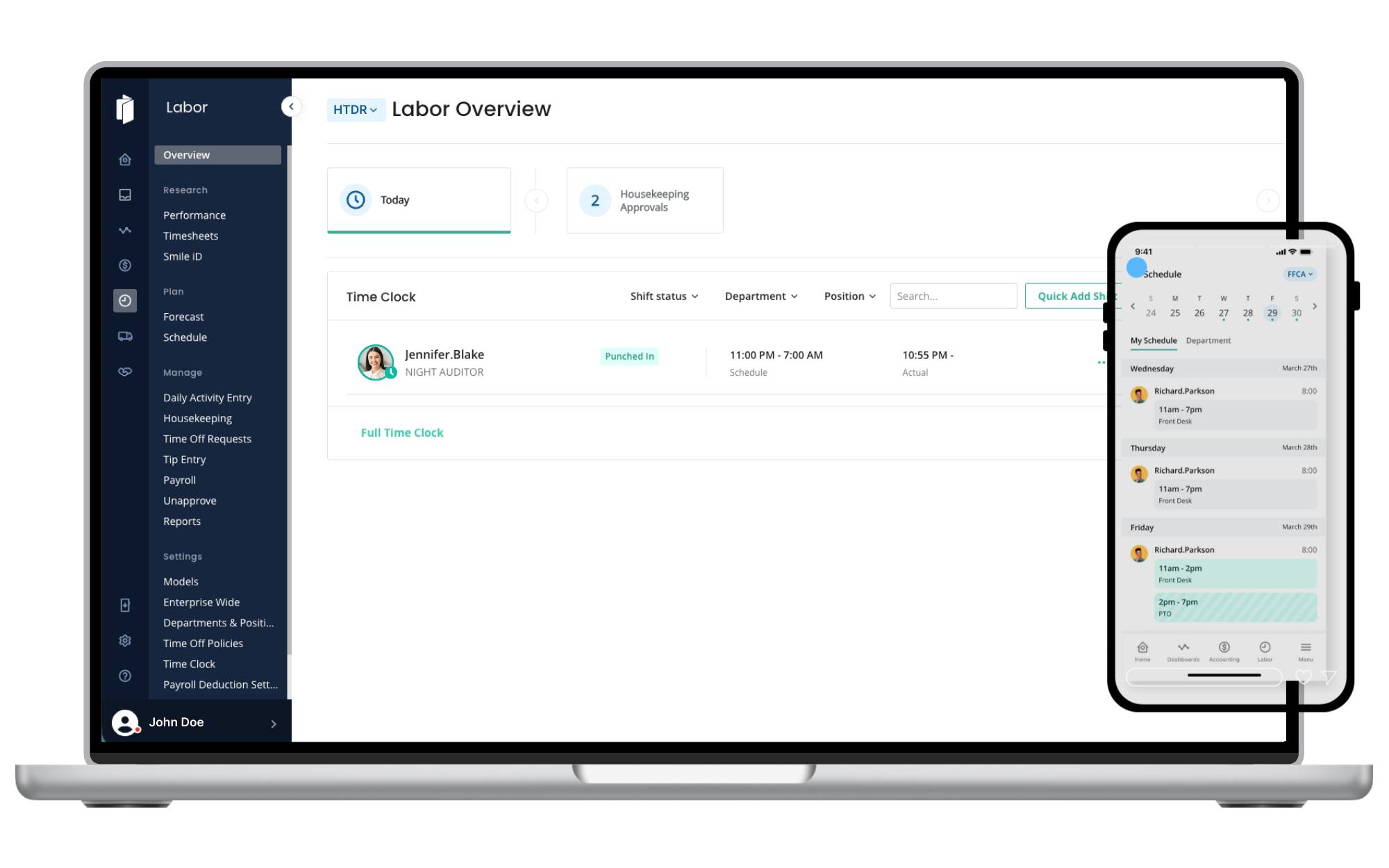
Scheduling: builds shifts against that forecast, respects availability and skills, and publishes schedules to a staff mobile app.
Time and attendance: records clock-ins and clock-outs, flags missed punches and approaching overtime, and applies pay rules.
Labor cost reporting: compares scheduled and actual hours with budget by department, property and portfolio.
Workforce Management Software Shortlist
Here are the top-rated scheduling and workforce management systems covered in this article:
 Join 100k+ executives from world's leading hotel brands and get the latest insights delivered to your inbox once a week
Workforce Management vs Labor Management vs HR Software
The terms overlap, and vendors use them loosely.
Labor management usually means planning and controlling labor cost: forecasting, labor standards and budget tracking. In the US hotel market, "labor management system" is the most common name for the category.
Workforce management is broader. It adds scheduling, time and attendance, compliance and employee self-service. Most hotel platforms ranked on Hotel Tech Report cover both.
Rostering is the term hotels in the UK, Ireland and Australia use for staff scheduling. Hotel rostering software belongs to the same category.
HR and payroll systems manage employee records, hiring, benefits and pay. Workforce management sends approved hours to them and does not replace them.
Key Benefits of Workforce Management Software for Hotels
Hotels buy workforce management software for four results.
Lower labor cost per occupied room. Schedules built from the occupancy forecast stop overstaffing on slow days, and real-time overtime alerts catch small overruns before payroll closes.
Less time spent scheduling. Managers start from a system-built schedule instead of a blank spreadsheet, and hoteliers reviewing these platforms on Hotel Tech Report often cite copying last week's schedule and adjusting it in minutes.
Accurate payroll. Hours, job codes and pay rules flow to payroll without re-keying, which cuts corrections and compliance risk.
Visibility above the property. General managers, management companies and owners see labor productivity, such as minutes per room cleaned, across departments and hotels, and can compare properties.
Every dollar saved on labor flows to gross operating profit, which is why owners and asset managers watch labor productivity closely.
Features to Look For in Hotel Workforce Management Software
Labor standards by department and task, so forecasts turn into hours automatically.
PMS integration that syncs occupancy, arrivals and departures in real time.
Automated scheduling that respects availability, skills, overtime limits and local labor laws.
A staff mobile app for schedules, shift swaps and time-off requests.
Time clock options such as mobile, kiosk or biometric clock-in.
Real-time overtime and budget alerts for department managers.
Payroll and HR integrations that export approved hours and pay rules.
Multi-property dashboards and benchmarking for management companies and owners.
Tip pooling and gratuity distribution for food and beverage teams.
The 3 Top-Rated Hospitality Workforce Management Systems in 2026
These are the highest-rated scheduling and workforce management systems on Hotel Tech Report, ranked by HT Score, which is calculated from verified hotelier reviews. Below are the top three by HT Score: Actabl's Hotel Effectiveness PerfectLabor, which leads with more than 600 reviews, followed by Inn-Flow and M3. Rankings update every quarter on the scheduling and workforce management page, where you can filter by hotel size, type and region.

 HT Score

Learn More

 ×
 HT Score
Learn More

 ×
 HT Score
Learn More

 ×
How to Choose a Workforce Management System
Start with how your hotel operates, then test each vendor against it.
Match the system to your structure. A single limited-service hotel needs fast scheduling and time tracking. A full-service resort or a management company needs forecasting, labor standards and multi-property reporting.
Confirm the PMS and payroll integrations. Ask whether occupancy syncs in real time and whether hours export to your payroll provider without manual files.
Test the staff app. Adoption by hourly staff decides whether managers still handle swaps and time-off requests by text message.
Ask about implementation. Find out how long setup takes, who builds your labor standards and what training is included.
Read reviews from similar hotels. Filter reviews by property size and type before you book demos.
How much does hotel workforce management software cost?
Most platforms charge per room per month. Among systems ranked on Hotel Tech Report, published ranges run from about $2 to $4 per room per month for lighter scheduling and timekeeping tools to $5 to $7 for full labor management platforms with forecasting and labor standards. Time clock hardware, implementation and payroll connectors can add to first-year cost, so ask each vendor for a total quote at your room count.
Hospitality workforce management FAQ
What is the best workforce management software for hotels?
On Hotel Tech Report, Actabl (Hotel Effectiveness PerfectLabor), Inn-Flow and M3 are the systems hoteliers recommend most, and Inn-Flow won Best Scheduling & Workforce Management in the 2026 HotelTechAwards. See the full hotel labor management software rankings.
Is workforce management part of HR?
It sits between operations and HR. Operations leaders own scheduling and labor cost, and HR owns employee records and pay. The workforce management system connects the two by sending approved hours to the HR and payroll system.
Does workforce management software cover restaurants and spas inside the hotel?
Yes. Hotel-specific platforms schedule food and beverage outlets, spas and other departments alongside rooms, including tip pooling. Standalone restaurants usually choose restaurant-specific scheduling tools.