


It seems like everyone is talking about how technology is changing the world – from the spread of remote work to the rise of AI like ChatGPT. However, it’s rare to find advice that can help you make buying decisions and bring the right technology to your business. In the hotel industry, there’s no shortage of exciting vendors that build cutting-edge technology, but it can also prove difficult to separate out the tech your hotel really needs versus systems that sound cool and futuristic. HotelTechReport.com Innovation Analyst Alain Derderian sat down with Thibault Catala, Co-Founder of Vertell Asset Management, COO at Faern Hotels and Resorts and Founder of Catala Consulting, to glean wisdom about technology in the hotel space. Catala draws on his 15-year career in revenue management, having worked with everything from major luxury brands like Four Seasons to small independent boutiques, to share insights that can help hoteliers build the right tech stack with high quality tools that work well together, use technology to unlock net new revenue opportunities, and future proof their businesses.
“Hotel technology needs to make life easier and simpler for everyone from a guest perspective, from an employee perspective and from an operator perspective with access to more data. It needs to make everyone’s lives easier and simpler - not more complicated. If it makes life more complicated, then you’re probably working with the wrong tools,” Catala told HotelTechReport. In this interview Catala talks about how to select the right tools for your individual business needs and then how to make those tools work together to maximize the return on investment you get from each. Let’s dive in!
Why now is the time to embrace technology
Why begin to build or upgrade your tech stack now? As Catala explains, we’re living in a unique time where two major shifts have driven change in the technology world. First, the shift from on-premise to cloud-based systems have pushed technology costs down. Cloud-based systems can deliver better functionality at lower cost, especially when compared to old-school systems that require installation on your computer’s hard drive and expensive updates over time. More recently, the shift toward remote work has pushed technology companies to deliver innovations that make remote collaboration smoother. Software like Microsoft 365 and Teams allow corporate teams to work with on-site teams more effectively, and for hotels to leverage staff members who work with a portfolio of properties or aren’t needed in the office every day. These changing dynamics open a great opportunity for your hotel to bring its technology up to speed.
 Join 100k+ executives from world's leading hotel brands and get the latest insights delivered to your inbox once a week
How to build and optimize your tech stack
Since technology is so crucial to hotel operations and strategy today, we asked Catala how to go about setting up the ideal tech stack for your property, which is often easier said than done.
“First of all, I believe there is not a solution that fits all and one solution for everyone. What works for me may not be working for you or may not be working for someone else. So it's not as simple as copy pasting a tech stack, a shiny tech stack that you have seen in a competitor. It's making sure you understand what you need. Making sure you understand your guest journey and map out your guest journey.. And based on this, look into building the tech stack based on this guest journey.”
Since each property or hotel group is unique, there’s no out-of-the-box solution that will work well for every property. Catala suggests starting your technology shopping process with a guest journey mapping exercise. Together with a group of stakeholders (like department heads and frontline employees who will actually use the systems on a daily basis), walk through your guest journey from pre-booking through post-stay. You can then begin to build your tech stack around the key points in your unique guest journey.
“We look at what is important for us, we assign features that we are looking for from a score of one to five, and we review all the different elements, and we score them based on those features. And then we look at what's the highest score, and we'll fit into the system.”
Catala recommends highlighting the points where tech can solve challenges or enhance the guest experience, and then you can begin reaching out to vendors who provide systems that serve those needs. For example, maybe there’s an opportunity for you to more efficiently prompt guests to post reviews on sites like Tripadvisor and Google. Without a tech solution, your team may have to manually reach out to guests with this request. This task is a prime example of a point in the guest journey that can yield great results with a tech solution in place.
 HT Score

Learn More

 ×
×
How to choose the right tech for your hotel
Once you’ve narrowed down what kind of technology you want to implement, like a revenue management system or a customer relationship management tool, then you need to involve the most relevant group of people as you start the search for the right vendor. In Catala’s experience, he’s seen hotel leaders make the mistake of not including a cross-functional group in the tech buying process. Including a mix of leadership and line-level employees, especially the staff members who will be using the system regularly, will yield better decisions and make implementation easier across the organization.
“Something which is very important is that every time you change tech stack, you need to involve the team. There will be resistance, there will be people [who] don't like to change, but you need to involve them and to make them participate in this change. And sometimes you may have an idea, the data showing some idea, but the staff will have a different one because they are the one experiencing it on a daily basis.”
Catala also provides advice on selecting a vendor, starting by participating in demos with vendors that seem interesting. After each demo, revisit your goals and analyze how the system would suit your needs. Don’t just opt for a vendor with a friendly salesperson or with an endorsement from a well known brand. In order for your technology to continue to serve you long-term, you must pick a system with the core functionality that you need.
“Remove the emotion, remove the human element. Sometimes it's good to remove this human element on the selection. Just look at the data. Just look at what is important to you and for your business.”
Leveraging technology to adopt a net revenue approach
With the right systems in place, you can keep a pulse on what’s happening in your business without having to dig too deep. As a hotel leader, Catala recommends starting your day with a few important reports: a daily reservations report to show the new reservations and cancellations from the prior day, a pickup report for each property, and an Excel-based scorecard that tracks main KPIs. At Faern, Catala gets this data from his property management system, Mews, and he can investigate further if something is not pacing the way he expected. These reports enable him to prevent potential revenue losses by quickly catching lags in performance.
In addition to staying on top of rooms revenue, Catala spoke about his experience using technology to capture ancillary revenue in addition to nightly rate. He reflected that many hoteliers focus so much on room revenue, that “sometimes we are forgetting a lot about spa revenue, F&B revenue…But nowadays, there's a big shift which has already been happening for a few years, it's accelerating now from RevPAR to TRevPAR.” TRevPAR, or total revenue per available room, calculates the total spend, per night, from each guest on property, including any spend in your outlets. Technology can not only help you quantify TRevPAR, but also capture more of it through tactics like cross-promotion, upsells, mobile ordering, and more.
Why Mews is Catala's Preferred Property Management System
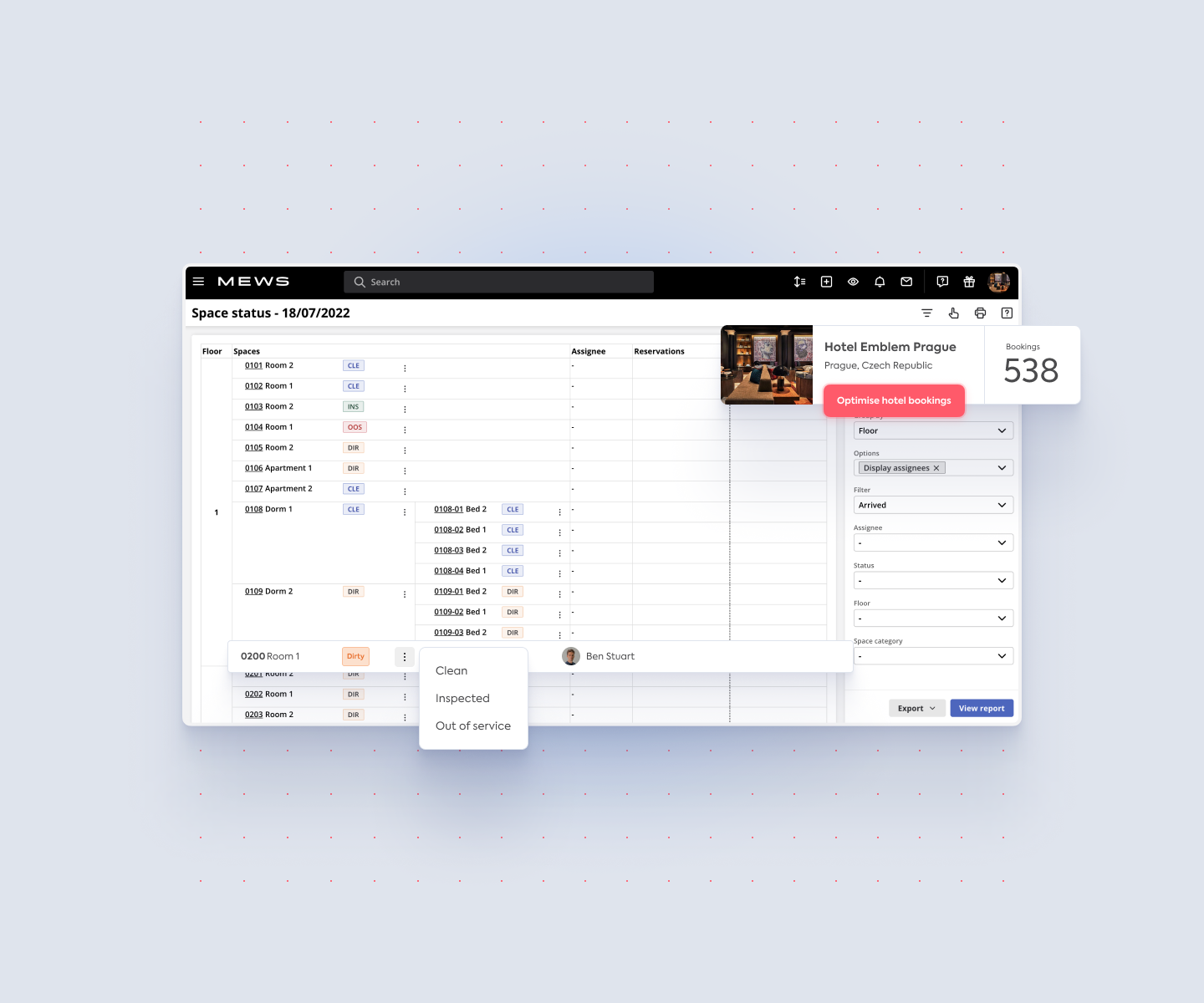
You might be wondering which tech solutions Catala uses himself, so we asked him which systems move the needle in his own experience. Faern chose to work with Mews as their property management system, because of its ability to easily plug in (and unplug) other systems. This enables the Faern team to grow and shift their technology platform as business needs change, making their business future-proof. Since Faern’s business model encourages experimentation and optimization, Mews is a great fit.
"I believe there's not one solution that fits all, as I mentioned, but I believe the PMS is at the heart of all the tech stack. So once we have built our, and we choose our PMS, use with the PMS, we then connected all the different system on top of it. But it's not like it's the end of the, you select one system for the next 30 years, I believe tech stack should be a plug and play. So we identify if there's something working or not, and we change if we see fit," Catala told HotelTechReport.
 HT Score
Learn More

 ×
×
Artificial intelligence, smarter hotel distribution and sustainability top of mind
Where does Catala hotel technology heading in the future? We asked where hoteliers should focus their efforts and investment, and Catala mentioned several ways technology can enhance the guest experience in the future. For instance, technology can deliver more personalized guest communication that garners better engagement.
“I believe personalization will increase in importance, mostly because people are tired of being spammed with irrelevant information, and we need to evolve towards this much more hyper-personalization of communication, hyper-personalization of stay and experience.”
Another theme that Catala sees for the future is AI-driven technology like ChatGPT. Not only can this technology deliver value to guests, like more helpful chatbots, but it can also provide intelligence for revenue management systems.
Along with smarter revenue management systems, Catala predicts that the industry will shift to be more accepting of OTAs. Rather than viewing them as a necessary evil, Catala highlights that OTAs can actually make good financial sense when compared to all the marketing costs associated with direct bookings.
“A lot of people are pointing fingers at online travel agencies such as Booking.com or Expedia because they believe they are eating the commission and the margin. However, if you really look at your data, if you look at your net RevPAR, you can see this by channels. Look at your direct bookings, your website, you look at your OTA, wholesalers, and so on. You will see that your net RevPAR coming from Booking.com or Expedia are sometimes higher than via your direct channels.”
And one final theme that will be relevant for all hoteliers, Catala also sees a heavier focus on sustainability in the future:
“Sustainability is about making sure you understand your metrics, you understand your consumption of water, you understand your waste, and technology can do a great job at helping you identify risks and opportunities in your ESG program. Yes, sometimes sustainability can be expensive, but I think it's an expense that we cannot be cheap about because that's for the benefit of everyone.”
Whether you’re upgrading your tech stack or starting from scratch, Catala’s tech-buying advice is relevant for any hotelier or hospitality leader. Keeping Catala’s data-focused approach in mind, your hotel can leverage technology to reach your goals of higher revenue, better guest satisfaction, and more sustainable operations.