


Sorry, this functionality is only available for verified hoteliers
The project dashboard is a free tool that is only available to verified hoteliers to make adopting new technology easier by streamlining their research and simplifying their communication workflow.

10 Best Hotel Keyless Entry Systems 2026

By Jordan Hollander
Last updated on May 28, 2026

Jordan Hollander
CEO @ Hotel Tech Report
Jordan is the co-founder of HotelTechReport, the hotel industry's app store where millions of professionals discover tech tools to transform their businesses. He was previously on the Global Partnerships team at Starwood Hotels & Resorts. Prior to his work with SPG, Jordan was Director of Business Development at MWT Hospitality and an equity analyst at Wells Capital Management. Jordan received his MBA from Northwestern’s Kellogg School of Management where he was a Zell Global Entrepreneurship Scholar and a Pritzker Group Venture Fellow.
-
517
articles contributed
Our reviewers evaluate software independently. Learn how we stay transparent, read our review methodology, and tell us about any tools we missed.
This list is based on research we’ve conducted since 2017, analyzing dozens of Hotel Keyless Entry Systems using verified hotelier reviews, product deep dives, and our proprietary HTScore.
Hotel Keyless Entry Systems directly impact some of the most critical moments in the guest journey—arrival, room access, and property security. When implemented well, they reduce front desk congestion, eliminate keycard friction, and enable fully digital check-in experiences that improve operational efficiency while elevating guest satisfaction.
Today’s leading platforms go far beyond simply unlocking doors with a smartphone. The best Hotel Keyless Entry Systems function as operational infrastructure, connecting door lock hardware, property management systems, contactless check-in tools, and guest apps to automate access control and streamline the entire arrival workflow.
To help you save time and reduce risk, we surveyed 650 hoteliers across 57 countries, combining verified hotelier reviews with hands-on product demos to evaluate workflow depth, integration strength, and segment fit. The result is a practical, operator-focused guide designed to help you cut through vendor marketing and understand how these systems actually perform in real hotel environments.
In this guide, you’ll find answers to critical questions like:
How compatible is a vendor’s mobile key platform with my existing door lock hardware?
Will the system integrate with my PMS to automatically issue and revoke digital keys?
Does the mobile key experience require guests to download an app—or can it work via web check-in?
What security standards and encryption protocols protect digital room access?
How complex is the installation process and what hardware upgrades might be required?
Which solutions work best for hotels like mine based on size, type, and operational model?
By combining large-scale hotelier feedback with our structured vendor evaluation framework, this guide gives you a clear, research-backed path to identifying the Hotel Keyless Entry System that best fits your hotel’s technology stack, operational model, and guest experience strategy.
- 1.
- 2.
- 3.
- 4.
- 5.
- 6.
- 7.
- 8.
- 9.
- 10.
Over 2M+ Leading Hotel Professionals Trust Our Advice




Get Your Custom Hotel Keyless Entry Systems Analyst Report
- Ranked recommendations for your property
- Real operator reviews & pricing data
- Tailored to your size, market & integrations
Trusted by thousands of hoteliers worldwide
Takes 2 min · No credit card needed
LAST UPDATED
APPS TESTED





CONTRIBUTING EXPERTS


How to Choose the Right Hotel Keyless Entry Systems
This list is already personalized based on your hotel’s size, type, and location. Want to go deeper? Use the filters to tailor your shortlist by country, region, and even your existing door lock system or PMS to see which Hotel Keyless Entry Systems are the best fit for your property.
Best Hotel Keyless Entry Systems Reviews
Hotel Keyless Entry Systems Features & Comparison


 92 HT Score
50 HT Score
81 HT Score
76 HT Score
46 HT Score
92 HT Score
50 HT Score
81 HT Score
76 HT Score
46 HT Score
Discover popular comparisons
How We Evaluate Hotel Keyless Entry Systems
Looking to give your guests the ability to use their smartphone as a key to their room? Mobile key not only helps cut down on key cards but it also eliminates common guest friction points ranging from frustrating keycard demagnetization to lost keys and also allows for a more streamlined and contactless check-in experience.
Hotel Keyless Entry Systems are transforming how hotels manage room access and the guest arrival experience. By enabling guests to unlock their rooms with their smartphones, hotels can streamline operations, reduce front desk congestion, and deliver a modern, tech-forward stay experience that travelers increasingly expect.
We surveyed 650 hoteliers across 57 countries to create this in-depth guide and help you find the best fit Mobile Key solution for your hotel. Inside you’ll find everything you need to know including product rankings, feature comparisons, price benchmarking, integration interoperability and more.
Not all Hotel Keyless Entry Systems are designed the same way. While most solutions promise “mobile room access,” the underlying architecture, guest experience model, and infrastructure requirements can differ significantly.
Understanding the main types of keyless entry systems helps hoteliers quickly identify which solutions align with their property’s operational model, existing door hardware, and guest journey strategy.
How we determine the types
Within this category, products tend to differ along a few key operational vectors that directly impact how hotels deploy and use the technology:
Lock hardware architecture: Whether the solution requires new smart locks, works with existing locks via retrofit modules, or operates independently through external access devices.
Guest access delivery model: Whether digital keys are delivered through a branded mobile app, web-based check-in link, or other credential methods such as digital wallets.
Integration depth with hotel systems: The level of connectivity with PMS, contactless check-in, guest apps, and other guest journey platforms.
Operational ownership and complexity: Whether the system is managed primarily by hotel IT/engineering teams or by operations/front desk staff through software workflows.
These factors create several distinct approaches to implementing mobile key technology.
Comparison Preview
Type | Primary Differentiator | Best For | Team Involvement / Control Model | Typical Integration Requirements | Tradeoffs |
|---|---|---|---|---|---|
Smart Lock–Native Systems | Purpose-built IoT door locks designed for mobile credentials | New builds, renovations, luxury and large hotels | IT, engineering, and operations jointly manage infrastructure | PMS, guest apps, building access systems | Highest hardware cost and installation complexity |
Retrofit Mobile Key Platforms | Enable mobile keys on existing lock hardware | Existing hotels upgrading access without replacing locks | Operations and IT manage software and lock integrations | PMS, digital check-in platforms | May have hardware compatibility limits |
Guest App–Centric Mobile Key Platforms | Mobile key embedded within a branded guest app experience | Lifestyle hotels, brands focused on digital guest engagement | Marketing, digital experience, and operations teams | Guest apps, PMS, messaging tools | Requires guests to download an app |
Web-Based Digital Key Systems | Mobile key delivered through browser-based check-in without app download | Limited-service, independent hotels, and high-turnover properties | Operations-led with minimal IT involvement | PMS and contactless check-in tools | Fewer guest engagement capabilities |
Smart Lock–Native Systems
Smart lock–native platforms replace or install door hardware that is specifically designed for mobile credentials using Bluetooth, NFC, or other wireless communication standards. These systems are typically deployed during new hotel construction or major renovation projects.
Category | Details |
|---|---|
Best-fit hotel profiles | Large full-service hotels and resorts; luxury and upscale brands; new builds where lock hardware is installed during development |
Typical buyer / owner | IT leadership, engineering teams, facilities management, corporate technology teams |
Strengths | Built specifically for mobile credentials and IoT connectivity; highly reliable access infrastructure; supports multi-area access control (rooms, elevators, amenities); scales across large properties and portfolios; enables advanced security and monitoring capabilities |
Tradeoffs | Requires replacing door lock hardware; high upfront capital investment; longer deployment timelines during installation |
When this type is the wrong fit | Existing hotels trying to avoid major hardware upgrades; smaller properties with limited capital budgets |
Retrofit Mobile Key Platforms
Retrofit mobile key systems allow hotels to enable digital keys without replacing their existing door lock hardware. Instead, these platforms connect to compatible lock systems or add small hardware modules that enable mobile access functionality.
Category | Details |
|---|---|
Best-fit hotel profiles | Independent hotels; mid-sized properties; existing hotels upgrading technology without renovations |
Typical buyer / owner | General managers, operations leaders, IT teams managing system integrations |
Strengths | Lower hardware investment compared to replacing locks; faster deployment timelines; modernizes access control without major renovation; supports contactless check-in initiatives |
Tradeoffs | Compatibility depends on existing lock models; fewer advanced smart-building capabilities; performance may vary depending on legacy infrastructure |
When this type is the wrong fit | Hotels with very old or unsupported lock hardware; properties seeking fully integrated smart-building ecosystems |
Guest App–Centric Mobile Key Platforms
These systems deliver mobile keys through the hotel’s branded mobile app, often alongside features such as messaging, service requests, and digital check-in. The mobile key becomes part of a broader digital guest experience platform.
Category | Details |
|---|---|
Best-fit hotel profiles | Boutique and lifestyle hotels; brand-managed properties; hotels focused on digital guest engagement |
Typical buyer / owner | Marketing teams, digital experience leaders, guest experience departments, operations teams |
Strengths | Integrates mobile key into the broader guest journey; enables guest engagement features; supports personalization and loyalty integration; reinforces brand identity through mobile experience |
Tradeoffs | Requires guests to download an app; adoption varies by guest demographics; app development and maintenance adds operational complexity |
When this type is the wrong fit | Hotels with mostly transient or one-night stays; properties without a guest app strategy |
Web-Based Digital Key Systems
Web-based digital key systems deliver mobile credentials through browser-based check-in workflows rather than requiring a dedicated hotel app. Guests typically receive their key through a secure check-in link.
Category | Details |
|---|---|
Best-fit hotel profiles | Limited-service hotels; independent properties; high-turnover or self-service hotels |
Typical buyer / owner | General managers, operations teams, front desk leadership |
Strengths | No app download required for guests; faster adoption and lower friction; quick implementation; minimal technical overhead for hotel teams |
Tradeoffs | Limited guest engagement features; fewer branding opportunities; reduced flexibility for deeper integrations |
When this type is the wrong fit | Hotels prioritizing branded mobile app experiences; luxury properties focused on personalized digital guest journeys |
How to choose the right type
Selecting the right Hotel Keyless Entry System depends less on feature lists and more on how the technology fits your property’s infrastructure and guest experience strategy.
The most important factors are whether the solution requires new lock hardware, how digital keys are delivered to guests, the level of integration with your PMS and digital check-in workflows, and which internal teams will manage the platform.
By focusing on these operational vectors—hardware compatibility, guest access model, integration depth, and organizational ownership—hoteliers can narrow the market to the systems most likely to deliver reliable, scalable mobile key access for their specific property type.
Hotel Keyless Entry Systems function as the digital infrastructure that manages how guests and staff access rooms and restricted areas throughout the property. Instead of relying on physical keycards, these platforms generate secure mobile credentials that allow guests to unlock doors using their smartphones.
By connecting door lock hardware with systems like the PMS and contactless check-in tools, keyless entry platforms automate the process of issuing, managing, and revoking room access. This reduces front desk workload, eliminates common issues like lost or demagnetized keycards, and enables a more streamlined arrival experience.
Capability | Description | Operational Value |
|---|---|---|
Mobile Room Key | Generates secure digital room keys that guests can access through a smartphone app or web-based check-in | Eliminates physical keycards, reduces replacement costs, and enables guests to go directly to their room |
Automated Key Issuance | Automatically issues digital keys when a guest completes online check-in or when a reservation becomes active in the PMS | Removes manual key creation tasks from front desk staff and accelerates the check-in process |
Contactless Check-In Integration | Connects with digital check-in platforms to allow guests to check in and receive their key before arrival | Reduces front desk congestion and enables fully contactless guest journeys |
Access Control Management | Allows hotels to define which areas guests and staff can access, including rooms, elevators, parking, and amenities | Improves property security and ensures controlled access to restricted areas |
Key Revocation & Expiration | Automatically deactivates digital keys after checkout or when reservations change | Prevents unauthorized room access and eliminates the need to collect keycards |
Staff & Operational Access | Issues digital credentials for housekeeping, maintenance, and other staff roles | Simplifies key management and allows hotels to control staff access permissions centrally |
Guest Authentication & Security | Uses encryption and authentication protocols to securely validate mobile keys before unlocking doors | Protects against unauthorized access while maintaining compliance with security standards |
Activity Logging & Audit Trails | Tracks door access activity, including when rooms are unlocked and by whom | Provides visibility into access events for security monitoring and operational auditing |
Unlike traditional keycard systems, Hotel Keyless Entry Systems operate as part of the hotel’s broader digital guest journey infrastructure. When integrated with the PMS, guest apps, and contactless check-in platforms, they automate access workflows throughout the stay—from digital check-in and room entry to automatic credential expiration at checkout.
Operationally, these platforms serve as a control layer between the hotel’s reservation system and its physical access infrastructure. By synchronizing guest data with door lock hardware in real time, hotels can ensure that access permissions are always accurate while reducing manual administrative work for front desk and operations teams.
1. Large Hotels & Resorts
If you’re running a large hotel or resort, your access control system must support high guest volume, multiple access points, and enterprise security standards. Mobile key becomes more than a convenience feature—it becomes a critical part of the guest journey and operational workflow.
Guests often expect to skip the front desk entirely, unlocking their room, elevators, gym, and other restricted areas directly from their phone. To make this work reliably, your keyless entry system must integrate deeply with PMS, mobile apps, and access control infrastructure across the property.
Large properties also require enterprise-grade reliability and security, since thousands of digital keys may be issued daily.
Defining Characteristics:
Multiple access points including elevators, parking, spa, and amenities
High guest volume with peak arrival periods
Enterprise procurement processes involving IT and security teams
Deep integrations with PMS, guest apps, and building access systems
Strong emphasis on security, reliability, and scalability
Common Needs & Preferences:
Seamless digital key delivery integrated with digital check-in
Secure access control across multiple hotel areas
Reliable performance during peak guest arrival times
Enterprise security protocols and administrative controls
Key Features and Needs
Feature Title | Description | Why It’s Critical |
|---|---|---|
Multi-Area Access Control | Mobile key access for rooms, elevators, amenities, and parking | Large resorts require controlled access across multiple areas of the property |
Enterprise Lock Integrations | Compatibility with major lock providers (Assa Abloy, Dormakaba, Salto, etc.) | Allows large hotels to integrate mobile key without replacing entire lock infrastructure |
Digital Check-In Integration | Automated mobile key delivery tied to online check-in | Enables guests to bypass the front desk and go directly to their room |
Advanced Security & Encryption | Secure digital credential generation and authentication | Protects against unauthorized access and ensures compliance with enterprise security policies |
Scalable Deployment | Infrastructure capable of issuing thousands of mobile keys daily | Ensures reliability during peak arrival periods and large group check-ins |
2. Boutique & Lifestyle Hotels
Boutique hotels thrive on design-forward guest experiences and memorable stays. Mobile key technology can enhance that experience by making arrival feel modern, effortless, and frictionless.
Rather than waiting in line at reception, guests can check in digitally and go straight to their room, aligning with the personalized and seamless experience boutique properties aim to deliver.
Boutiques also tend to value technology that integrates cleanly with their guest-facing mobile apps and communication platforms, ensuring the digital experience reflects the property’s brand identity.
Defining Characteristics:
Experience-driven guest journey and design-focused branding
Lean operational teams with limited IT resources
High expectations for seamless and modern guest experiences
Often paired with branded mobile apps or guest messaging platforms
Strong focus on convenience and personalization
Common Needs & Preferences:
Smooth mobile-first guest experience
Easy mobile key activation without complicated steps
Integration with guest apps, messaging, and digital check-in
Technology that enhances brand perception and innovation
Key Features and Needs
Feature Title | Description | Why It’s Critical |
|---|---|---|
App-Based Mobile Key | Guests unlock rooms directly through the hotel’s mobile app | Reinforces brand experience and delivers a modern arrival journey |
PMS & Guest App Integration | Automatic key delivery through integrated guest journey tools | Eliminates manual key creation and simplifies staff workflows |
Intuitive Guest Experience | Simple key activation and unlocking process | Ensures guests adopt the technology without needing assistance |
Custom Branding Options | Ability to embed mobile key within branded hotel apps | Maintains brand consistency across digital touchpoints |
Mobile Guest Journey Integration | Integration with messaging, upselling, and check-in tools | Enhances guest engagement and personalization opportunities |
3. Independent Hotels & Small Properties
For independent hotels, mobile key technology is often about simplifying operations while modernizing the guest experience.
Owners and small teams frequently manage multiple responsibilities, so a keyless entry system must be easy to install, easy to manage, and affordable. Systems that integrate directly with PMS and automate digital key delivery help reduce front desk workload while offering guests a convenient self-service option.
Retrofit solutions that work with existing door locks are particularly attractive for smaller properties looking to avoid costly hardware replacements.
Defining Characteristics:
Small operational teams with limited technical support
Budget-conscious technology decisions
Focus on improving efficiency and guest convenience
Limited tolerance for complicated installations
Preference for simple, integrated solutions
Common Needs & Preferences:
Plug-and-play installation with minimal hardware changes
Simple digital key management for staff
Affordable pricing and predictable costs
Easy-to-use guest interface
Key Features and Needs
Feature Title | Description | Why It’s Critical |
|---|---|---|
Retrofit Lock Compatibility | Mobile key works with existing lock hardware | Avoids costly door lock replacements |
Automated Key Issuance | Keys generated automatically through PMS integration | Saves staff time and reduces manual processes |
Simple Key Management | Staff can issue or revoke keys in seconds | Keeps operations manageable for small teams |
Guest-Friendly Unlocking | Clear instructions and intuitive mobile key use | Encourages adoption and minimizes support requests |
Transparent Pricing | Predictable monthly or per-room pricing | Helps independent hotels manage technology budgets |
4. Limited Service Hotels, Motels & Self-Service Properties
For budget hotels, motels, and self-service properties, keyless entry technology can significantly reduce staffing needs and streamline operations.
Many of these properties rely on self check-in, kiosks, or automated guest journeys where mobile key replaces traditional front desk processes entirely. The focus is less on premium guest experiences and more on efficiency, automation, and cost reduction.
Mobile key also helps minimize issues with lost or demagnetized keycards, which can be common in high-turnover environments.
Defining Characteristics:
High guest turnover with short stays
Lean staffing models or unattended reception
Heavy OTA booking volume
Strong focus on operational efficiency and automation
Low tolerance for complex or expensive tech
Common Needs & Preferences:
Self-service guest access without front desk assistance
Reliable unlocking with minimal guest support required
Integration with kiosks, check-in tools, and PMS
Affordable and easy-to-maintain technology
Key Features and Needs
Feature Title | Description | Why It’s Critical |
|---|---|---|
Self Check-In Integration | Mobile key delivered after automated check-in | Enables front-desk-free operations |
Fast Mobile Unlock | Quick and reliable unlocking via Bluetooth or NFC | Reduces guest friction and support requests |
OTA & PMS Integration | Keys generated automatically once booking is confirmed | Keeps room access synced with reservations |
Minimal Hardware Requirements | Simple installation without major infrastructure upgrades | Keeps deployment cost low |
Cost-Efficient Pricing | Affordable per-room or subscription pricing | Aligns with tight operational margins |
If you’ve ever tried comparing Hotel Keyless Entry Systems side-by-side and ended up more confused than when you started, you’re not alone.
On the surface, most vendors promise the same thing: guests can unlock their room using their smartphone. But once you dig deeper, the differences between platforms quickly become much more complicated.
Some solutions require new door lock hardware, others work with existing locks. Some require a hotel mobile app, while others deliver keys through web-based check-in. Some offer deep integrations with your PMS and guest journey tools, while others operate as standalone systems.
What initially looks like a simple technology decision often turns into a complex operational one.
Here’s why comparing Hotel Keyless Entry Systems is more complicated than it seems:
1. Not All Mobile Key Solutions Work With the Same Lock Hardware
One of the biggest differences between vendors lies in door lock compatibility.
Some mobile key systems require replacing your existing locks with Bluetooth or NFC-enabled hardware, which can be a major investment. Others provide retrofit solutions that allow hotels to enable mobile keys without replacing every door lock on the property.
For hotels with hundreds of rooms, the difference between retrofit compatibility and full hardware replacement can represent a massive cost difference.
Without understanding these infrastructure requirements early in the evaluation process, hotels can easily underestimate the true cost of implementation.
2. The Guest Experience Can Vary Dramatically Between Platforms
Not every mobile key solution delivers the same guest experience.
Some systems require guests to download the hotel’s mobile app before accessing their key. Others deliver mobile keys directly through a web-based check-in link, eliminating the need for an app entirely.
While app-based solutions may provide richer guest engagement features, requiring an app download can also reduce adoption rates depending on the type of property and guest demographic.
The right approach often depends on your guest profile, brand strategy, and mobile adoption expectations.
3. Integration Depth Matters More Than Most Hotels Realize
Many vendors claim they “integrate with PMS systems”, but the depth of that integration can vary significantly.
In some cases, integration simply means that staff manually trigger mobile keys after check-in.
In more advanced implementations, keys are automatically generated and delivered when a guest completes digital check-in, with room access synchronized in real time with the PMS.
These differences may seem subtle during a demo but can have a huge impact on operational efficiency once the system is deployed.
4. Security and Access Control Capabilities Differ Widely
Replacing physical keys with digital credentials introduces new security considerations.
Leading keyless entry platforms offer advanced encryption, authentication protocols, and administrative controls that allow hotels to issue, revoke, and manage access permissions instantly.
Other systems may offer more limited security controls, which can create operational risks if access credentials are not managed properly.
Because room access is such a critical part of hotel operations, the reliability and security architecture behind the mobile key system matters as much as the guest-facing functionality.
5. Implementation Complexity Can Vary Significantly
Some keyless entry solutions can be deployed quickly with minimal hardware upgrades. Others require door lock replacements, network infrastructure upgrades, or property-wide installation projects.
For large hotels, implementation timelines can vary from a few weeks to several months depending on the system selected.
Understanding the true deployment scope, installation costs, and operational disruption involved is critical before selecting a vendor.
6. Mobile Key Adoption Depends Heavily on Your Hotel Type
The final challenge is that mobile key technology is used very differently depending on the type of hotel.
A luxury resort may use mobile keys to enable a fully contactless guest journey, integrating room access with mobile check-in, guest messaging, and personalized services.
A boutique hotel may prioritize mobile key as part of a modern guest experience strategy, reinforcing brand perception and convenience.
Meanwhile, a budget motel or self-service property may deploy mobile keys primarily to reduce front desk staffing and operational costs.
Without considering these operational differences, every vendor can appear equally capable—until the system is live.
The Bottom Line
Comparing Hotel Keyless Entry Systems is difficult because the category sits at the intersection of hardware infrastructure, guest experience technology, and hotel operations.
Two platforms may appear similar in a feature checklist, but the differences in hardware compatibility, integration depth, security architecture, and deployment complexity can dramatically impact how well the system works for your property.
Choosing the right solution isn’t about finding the one with the most features—it’s about finding the one that actually fits the way your hotel operates.
How Our Framework Simplifies the Process
That’s why we built our vendor selection framework around a simple principle:
Hotel technology should be evaluated in the context of how hotels actually operate.
Instead of treating every property the same, our methodology groups hotels into four operational segments:
Large Hotels & Resorts
Boutique & Lifestyle Hotels
Independent Hotels & Small Properties
Limited Service Hotels, Motels & Self-Service Properties
Each segment has different priorities when it comes to mobile key technology—whether that’s enterprise security, guest experience innovation, operational efficiency, or cost control.
By organizing vendors around these real-world operational contexts, our framework helps hoteliers:
Identify which mobile key features actually matter for their property type
Compare vendors designed for similar operational models
Avoid systems that look good in demos but don’t align with real workflows
Our rankings and insights are powered by verified hotelier reviews, implementation feedback, and continuously updated integration data, ensuring that recommendations reflect real-world performance rather than marketing claims.
In a category where many solutions promise a “contactless guest experience,” our framework helps you identify the Hotel Keyless Entry System that truly fits your hotel’s infrastructure, operations, and guest expectations.
Everything You Need to Know About Hotel Keyless Entry Systems
Not sure where to start with Hotel Keyless Entry Systems? This section is your crash course. We’ll walk you through what mobile key technology actually is, what features to expect, how pricing typically works, which integrations matter most (hint: PMS, door lock systems, and digital check-in platforms), and what to consider when it comes to installation and deployment. We’ll also cover the benefits, common pitfalls, and trends shaping the category. It’s everything you need to get oriented—and it’s based on real-world insights from thousands of hoteliers.
2026 Keyless Entry Buyer's Guide | Free Download


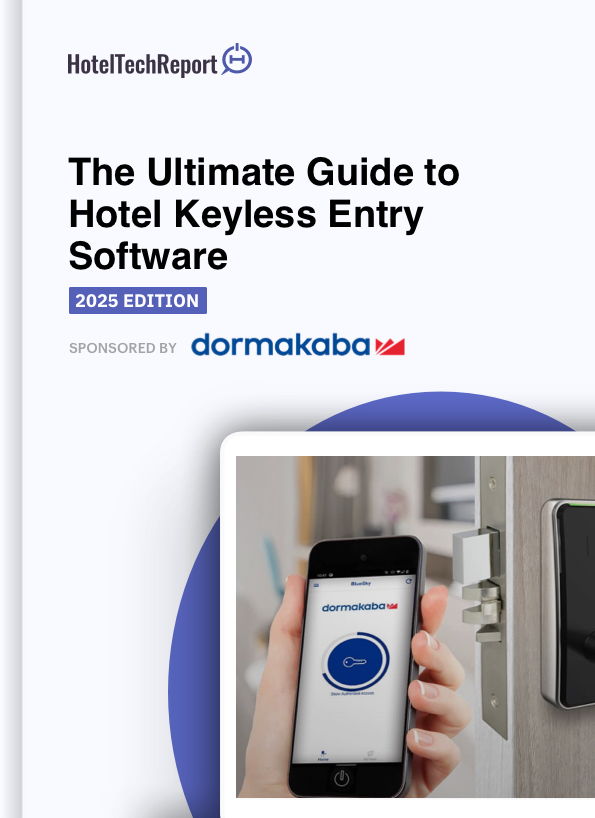
Download the Free Guide
Your guide was sent!
Your guide was successfully sent to .
This email may be incorrect
Our check detected that this address may have been entered incorrectly. Please confirm or correct it before we continue:
This looks like it may contain a typo.
Did you mean ?
What is Mobile Key in the Hotel Industry?
What are the most important features of mobile keys for hotels?
Hotel Keyless Entry Systems have evolved from simple mobile key utilities into a core component of the digital guest journey. Early implementations focused primarily on replacing plastic keycards with smartphone-based credentials. Today’s platforms operate as part of a broader access management layer that connects door lock infrastructure with the hotel’s PMS, digital check-in workflows, and guest-facing applications.
For hotel operators, the difference between basic and advanced systems comes down to how well the platform automates access workflows and integrates with the rest of the tech stack. A reliable mobile key experience can reduce front desk workload, eliminate keycard management issues, and enable guests to go directly to their room after arrival. When these systems are tightly integrated with reservations and check-in processes, access permissions can be issued and revoked automatically without staff intervention.
Modern keyless entry platforms also support operational visibility and security oversight. By centralizing access control across guest rooms, staff credentials, and restricted areas, hotels gain better control over who can access different parts of the property while reducing administrative overhead. The most capable platforms connect seamlessly with core systems like the PMS, guest apps, and contactless check-in tools to ensure that room access aligns with real-time guest and operational workflows.
Feature Evaluation Table
Capability Area | Feature | Description |
|---|---|---|
Guest Experience / Guest Engagement | Mobile Room Key | Allows guests to unlock their room using their smartphone via Bluetooth, NFC, or secure web credentials, eliminating the need for physical keycards and enabling direct-to-room arrivals. |
Contactless Check-In Integration | Connects with digital check-in workflows so guests can receive their mobile key before arrival, reducing front desk lines and streamlining the check-in process. | |
App or Web-Based Key Delivery | Delivers digital keys through a branded mobile app or browser-based check-in experience, giving hotels flexibility based on guest demographics and mobile adoption. | |
Multi-Area Guest Access | Extends mobile credentials to elevators, parking garages, gyms, or other guest-access areas, allowing hotels to manage property access consistently across facilities. | |
Operations & Workflow Management | Automated Key Issuance | Automatically generates and delivers digital keys when a reservation becomes active or a guest completes online check-in, removing manual key creation from front desk workflows. |
Staff Access Credentials | Issues digital keys to housekeeping, maintenance, and other staff roles with defined access permissions, reducing the need for physical master keys. | |
Access Control Permissions | Enables hotels to configure which rooms or areas can be accessed by specific guests or staff members, improving security and operational control. | |
Key Revocation & Expiration | Automatically deactivates digital credentials when guests check out or reservations change, ensuring that access rights stay aligned with guest stay status. | |
Revenue & Commercial Impact | Frictionless Arrival Experience | Allows guests to bypass the front desk and go directly to their room, improving guest satisfaction scores and reducing operational bottlenecks during peak arrival times. |
Upsell & Pre-Arrival Integration | Integrates with pre-arrival communication or upsell platforms so guests can upgrade rooms or purchase add-ons during digital check-in before receiving their mobile key. | |
Reduced Keycard Costs | Eliminates or significantly reduces the need for plastic keycards, lowering recurring supply costs and reducing operational friction when keys are lost or demagnetized. | |
Integrations & Data | PMS Integration | Synchronizes reservations, check-in status, and room assignments with the PMS so digital keys are issued and revoked automatically based on guest stay data. |
Door Lock Hardware Compatibility | Integrates with major lock manufacturers to enable mobile access without requiring hotels to replace their entire door lock infrastructure. | |
Security & Encryption Framework | Uses encrypted credentials and authentication protocols to ensure that digital keys are secure and compliant with modern access control standards. | |
Access Logs & Reporting | Tracks door unlock events and access activity, giving hotel teams visibility into guest and staff access patterns for operational oversight and security auditing. |
Together, these capabilities determine how well a keyless entry platform fits into a hotel’s operational model. Basic solutions may provide mobile unlocking functionality, but the most valuable systems automate access workflows, integrate tightly with the PMS and guest journey tools, and give hotel teams centralized visibility into property access and security.
- Door Hardware and Locks
- Door Lock Upgrade Kit
- Door Hardware and Locks
- Door Lock Upgrade Kit
- Access Management (Cloud Based)
- Access Management Solution (Server Based)
- Guest Management Dashboard
- Google Wallet Integration
- Multi-Property Management
- Notifications
- Access Management (Cloud Based)
- Access Management Solution (Server Based)
- Guest Management Dashboard
- Google Wallet Integration
- Multi-Property Management
- Notifications
- Mobile App
- Whitelabel Capability
- Remote Checkin
- Keyless Entry
- Apple Watch App
- Mobile App
- Whitelabel Capability
- Remote Checkin
- Keyless Entry
- Apple Watch App
- Door Lock Upgrade Kit
- Apple Watch App
- Developer SDK
- Google Wallet Integration
- Door Lock Upgrade Kit
- Apple Watch App
- Developer SDK
- Google Wallet Integration
How can keyless entry help hotels improve profitability and efficiency?
- Guest Convenience: A key benefit for hotel guests is the convenience of using their own smart device as a secure room key to access their room, eliminating the need to keep track of a physical key and the worry of losing it. It also saves time for guests by allowing them to check in remotely and go directly to their room upon arriving at the property, skipping the queue at the front desk.
- Increased Security: In addition to the advanced digital encryption that is built in to Mobile Keys, the solution provides added security, since a guest’s smartphone is less likely to be misplaced than a plastic keycard and typically is password-protected by the user, providing a secondary layer of digital security. Should a guest lose their phone, Mobile Keys can typically be instantly revoked through the system and reassigned in real time by the hotel staff. Remote keyless entry can enable your hotel team to improve security via security system and access remote control and manage access even when off property.
- Added Revenue Opportunities: Mobile Key solutions are typically app-based, allowing hoteliers to offer and promote a variety of revenue-generating amenities, services and offers to maximize ancillary room revenue. This, includes room upgrades, internet, room service, restaurant & spa bookings and other optional on-property offers. Since the Mobile Key is used often by the guest to access the room, it encourages download and frequent use of the app, maximizing the resulting revenue opportunities available within the app.
-
Meeting Modern Guest Expectations: Hotels aim to go one step further, to exceed the guests' expectations so far, so they know exactly what to expect before arrival. To save time and patience, keyless entry technology will certainly simplify and facilitate their stay. Checking-in online, receiving a digital key on their smartphone, accessing all hotel services directly through the mobile application, and going directly to their rooms without waiting at the front desk is just that. Plus, additional information about accommodation equipment, Wi-Fi, parking, and transportation to nearby places will help them know what to pay attention to before the trip, or make a travel plan.
-
Sustainable Solution: Considering that a keyless entry system has no cost compared to plastic key cards or regular keys, and doesn’t involve the plastic material consumption, it contributes drastically to cost-effectiveness and sustainability. This can be especially beneficial for environmentally conscious guests, but also attractive as it provides them with proof that the hotel is fully aware of the environment preservation, such as, for example, the accumulation of plastic waste. Sustainable solution is equally useful for hoteliers and guests. Anyway, it’s in the hotel's interest to rationally distribute costs and build a positive reputation among guests, which naturally leads to profitability.
-
Enhancing Loyalty and Security: If guests' safety is improved, their loyalty is also increased. This is inseparable considering their undisturbed and peaceful stay that makes them come back again at some point. In addition to not being lost like physical keys, digital keys each have a unique code for the guest, making them an authorized user of the accommodation, and giving them a personalized experience they may not be used to. Even in case of loss, the system can provide a new password. Such a sense of security increases the chance of a lasting relationship between the hotel and the guest.
Critical Integrations for Hotel Keyless Entry Systems
When you're evaluating a Hotel Keyless Entry System, it’s easy to get overwhelmed by long lists of integrations and technical specifications. But here’s the key thing to understand: mobile key technology doesn’t operate in isolation—it sits at the intersection of your door lock infrastructure, PMS, and guest journey technology.
At a minimum, your keyless entry solution should integrate with:
Door Lock Hardware to enable secure Bluetooth or NFC-based room access
Property Management System (PMS) to automatically issue and revoke mobile keys based on reservations and check-in status
Digital Check-In or Guest App Platforms to deliver mobile keys directly to guests before arrival
These integrations should be seamless and reliable, because they directly impact guest access to their room—one of the most critical moments in the guest journey.
Some vendors offer fully integrated ecosystems where mobile key functionality is deeply embedded into their platform, while others rely on third-party integrations with lock manufacturers or guest-facing apps. It’s important to understand whether these connections are native integrations or loosely connected partnerships, as this can affect system reliability, data synchronization, and support responsiveness.
Once these foundational integrations are in place, here are the additional connections that can significantly enhance the value of your Hotel Keyless Entry System by tying it into the broader technology ecosystem that powers your hotel operations.
Pricing for Hotel Keyless Entry Systems typically combines software subscriptions with physical hardware components such as smart locks, retrofit modules, or door access controllers. In many cases, hotels pay a recurring SaaS fee for the mobile key platform while also investing in compatible door lock hardware or upgrade kits during implementation.
Some vendors offer software-only platforms that integrate with existing lock infrastructure, while others package the hardware and software together as a single solution. Because access control is tied directly to physical infrastructure, the upfront investment can vary significantly depending on whether a property needs to replace or upgrade its door locks.
For this reason, hotels should evaluate total cost of ownership rather than just the monthly subscription price. Implementation costs, hardware compatibility, integration requirements with systems like the PMS or contactless check-in tools, and the operational complexity of deployment can all influence the long-term cost of adopting a mobile key solution—especially for multi-property portfolios.
Common Pricing Models
Pricing Model | How It Works | Typical Cost Considerations |
|---|---|---|
Per-Room Monthly Subscription | Vendors charge a recurring monthly fee based on the number of rooms enabled for mobile key access. | Costs scale with property size, making pricing predictable for hotels but potentially higher for large resorts or portfolios. |
Per-Property Licensing | A flat monthly or annual license covers the entire property regardless of room count. | Often used for smaller hotels or independent properties; pricing may increase if additional modules or integrations are required. |
Hardware + Software Bundle | Vendors sell door lock hardware and the mobile key platform together as a combined package. | Higher upfront investment for lock replacement or installation, but software and hardware compatibility are typically streamlined. |
Hardware Retrofit or Upgrade Kits | Hotels purchase add-on modules that enable mobile key functionality on existing door locks. | Lower upfront cost than full lock replacement, but compatibility with existing hardware must be verified. |
Tiered Software Plans | Vendors offer different software packages based on feature sets such as mobile keys, multi-area access control, or analytics. | Higher tiers typically include more integrations, advanced security controls, and expanded operational capabilities. |
Portfolio or Multi-Property Pricing | Discounts or enterprise agreements are offered for hotel groups deploying the system across multiple properties. | Pricing may depend on total room count across the portfolio and the complexity of centralized access management. |
What Impacts Pricing the Most
Property size and room count: Larger hotels require more digital credentials and door hardware, increasing both subscription and infrastructure costs.
Door lock hardware requirements: Hotels replacing existing locks or installing smart lock infrastructure will incur higher upfront deployment costs.
Integration complexity: Connecting the platform with systems like the PMS, guest apps, and contactless check-in tools may require additional setup or licensing.
Multi-property deployments: Portfolio rollouts often involve centralized access management, enterprise support, and more complex infrastructure planning.
Evaluating ROI
The return on investment for Hotel Keyless Entry Systems typically comes from operational efficiency and improved guest experience. Automating room access reduces front desk workload, eliminates keycard replacement costs, and streamlines the arrival process for guests.
Over time, the operational savings from reduced manual processes and improved service delivery can offset the initial investment in hardware and software—especially for hotels implementing mobile key as part of a broader digital check-in and guest journey strategy.





Varies by property. Mobile key vendors are typically able to deploy solutions remotely, resulting in a faster and more efficient delivery for hoteliers. During the implementation process, vendors work in close cooperation with customers which means that hoteliers get to know solutions better and vendors get a hands-on understanding of what the hotel's specific needs are. Depending on the solution, the whole process usually only takes 30-90 days.
The Future of Hotel Keyless Entry Systems
Mobile key technology is increasingly integrated into the broader digital guest journey, enabling hotels to create frictionless arrivals and fully contactless stays.
By combining mobile key with digital check-in, guest messaging, and mobile apps, hotels can allow guests to complete the entire arrival process from their smartphone—from pre-arrival communication to unlocking the room door.
Here's what this could mean for your hotel:
Faster and more convenient arrivals. Guests can bypass the front desk entirely, reducing wait times and improving first impressions—especially during peak check-in hours.
Reduced front desk workload. Automating key distribution allows staff to focus on guest service rather than administrative tasks.
Higher guest satisfaction. Travelers increasingly expect mobile-first experiences similar to airlines and rideshare apps, making digital room access a strong differentiator.
Modern keyless entry platforms are evolving from standalone access tools into fully integrated components of the hotel technology ecosystem.
Through integrations with PMS, guest apps, and digital check-in platforms, mobile keys can now be automatically issued, revoked, and managed in real time based on reservation status.
Here's what this could mean for your hotel:
Automated mobile key delivery. Keys are generated automatically once guests complete online check-in, eliminating manual staff intervention.
Unified guest profiles across systems. Access permissions can be synchronized with guest data, loyalty programs, and room assignments.
Smarter operational workflows. Integrations with housekeeping and room status systems ensure access permissions update automatically when rooms become available.
The next generation of keyless entry systems is powered by IoT-enabled door locks and connected room technologies.
These smart devices allow hotels to manage access permissions remotely, monitor door activity, and integrate room entry data with other operational systems.
Here's what this could mean for your hotel:
Improved security and access management. Hotels can issue, revoke, or modify digital keys instantly without needing to replace physical keycards.
Operational insights from door activity. Access data can help hotels monitor room occupancy patterns, housekeeping activity, and security events.
Connected guest experiences. Mobile keys may eventually trigger in-room preferences such as lighting, temperature, or entertainment systems when guests enter their room.
Hoteliers Also Ask
Hotel guests save valuable time by skipping the front desk and going directly to their rooms and unlocking the lock with their own smart device. They also enjoy the convenience of not having to keep up with a physical key. Mobile Key also reduces the workload at the front desk, freeing up staff to concentrate on more valuable guest services and engagement. Guests also benefit from increased security since Mobile Keys are housed on the user’s personal smart device, which is typically password-protected, it is inherently more secure. Digital keys are also encrypted to ensure that only authorized users can gain access to a guest room or other assigned areas.
A Mobile Key is a digitally encrypted ; that resides on a mobile device, smartphone, tablet or wearable key fob, allowing the authorized user to gain access to secured doors or other physical or digital access points within a property. The advancement of this mobile technology and its successful application of digital keys within the hospitality industry has led to a rapidly growing trend toward Keyless Entry. This innovative solution allows hotel guests to check in and access their assigned guest room immediately upon arrival via smart lock, unlocking the door with their mobile device via the Mobile Key and thus eliminating the need to visit the front desk. Some mobile keys operate via touchscreen keypad and others via bluetooth smart key.
The solution works by generating an encrypted digital key that is transmitted to users’ smart devices and safely stored in a key vault on a mobile app. When presented to the appropriate door lock, the app then transmits digital key information over a secure communication channel, ensuring that only authorized users are able to gain access. When Keyless Entry is implemented at a property, both guests and authorized staff members enjoy the convenience of using their smart device as a secure key to access assigned areas of a property without the need to carry or keep track of a separate physical key.
When selecting a mobile key technology provider for their property, hotels should consider the following steps:
Identify Needs: Begin by understanding the specific requirements of the hotel. Assess the desired functionality, such as mobile check-in, digital key access, and contactless room entry, that will enhance the guest experience and streamline hotel operations.
Research Providers: Explore various mobile key solution providers in the hospitality industry. Look for established companies like OpenKey, ASSA ABLOY, or OpenKey, which have experience in mobile key technology and offer reliable lock systems and access control solutions.
Evaluate Compatibility: Assess the compatibility of the mobile key technology with the existing infrastructure and property management system (PMS). Ensure the chosen provider's solution integrates seamlessly with the hotel's PMS and other hotel systems to enable real-time communication and accurate guest information.
Analyze Functionality: Review the features and functionality of the mobile key technology. Consider aspects such as mobile app usability, Bluetooth or near field communication (NFC) capabilities for door lock communication, and the ability to provide keyless entry to guest rooms and other hotel areas like the parking garage.
Consider Security: Prioritize the security of the mobile key technology. Verify that the provider utilizes robust encryption protocols, secure APIs, and reliable access management systems to safeguard guest room access.
Check Vendor Support: Evaluate the level of technical support and customer service provided by the mobile key tech provider. Ensure they offer timely assistance for any issues that may arise during implementation or ongoing use of the solution.
Review User Experience: Seek feedback from other hoteliers or colleagues in the industry who have implemented the same or similar mobile key technology. Assess their experience with the provider's solution and inquire about guest satisfaction, ease of use, and any challenges faced during implementation.
Request Demos and Trials: Request demos or trials of the mobile key technology from shortlisted providers. This will allow hotel staff to experience the solution firsthand and assess its performance, user-friendliness, and compatibility with existing hotel systems.
Consider Cost and ROI: Evaluate the cost structure of the mobile key solution, including upfront fees, recurring charges, and potential integration costs. Consider the return on investment (ROI) in terms of improved guest satisfaction, operational efficiency, and reduced reliance on physical key cards.
Make an Informed Decision: After considering all the above factors, select the mobile key tech provider that best aligns with the hotel's needs, offers a reliable solution, provides excellent customer support, and delivers the desired functionality and security.
By following these steps, hotels can choose the right mobile key tech provider and enhance their guest experience, streamline operations, and improve overall guest satisfaction.
LAST UPDATED
APPS TESTED
CONTRIBUTING EXPERTS
Get Your Custom Hotel Keyless Entry Systems Analyst Report
- Ranked recommendations for your property
- Real operator reviews & pricing data
- Tailored to your size, market & integrations
Trusted by thousands of hoteliers worldwide
Takes 2 min · No credit card needed
Get Your Free AI Analyst Report
Custom recommendations tailored to your property


