

Sorry, this functionality is only available for verified hoteliers
The project dashboard is a free tool that is only available to verified hoteliers to make adopting new technology easier by streamlining their research and simplifying their communication workflow.

10 Best Hotel CRM Software Of 2026

By Jordan Hollander
Last updated on February 23, 2026

Jordan Hollander
CEO @ Hotel Tech Report
Jordan is the co-founder of HotelTechReport, the hotel industry's app store where millions of professionals discover tech tools to transform their businesses. He was previously on the Global Partnerships team at Starwood Hotels & Resorts. Prior to his work with SPG, Jordan was Director of Business Development at MWT Hospitality and an equity analyst at Wells Capital Management. Jordan received his MBA from Northwestern’s Kellogg School of Management where he was a Zell Global Entrepreneurship Scholar and a Pritzker Group Venture Fellow.
-
517
articles contributed
Our reviewers evaluate software independently. Learn how we stay transparent, read our review methodology, and tell us about any tools we missed.
This list is based on research we’ve conducted since 2017, analyzing dozens of hotel CRM solutions using verified hotelier reviews, product deep dives, and our proprietary HTScore.
Hotel CRM Software Shortlist
Here are 5 of top Hotel CRM Software that are covered in this in-depth guide:
- 1.
- 2.
- 3.
- 4.
- 5.
- 6.
- 7.
- 8.
- 9.
- 10.
Over 2M+ Leading Hotel Professionals Trust Our Advice




Get Your Custom Hotel CRM & Email Marketing Analyst Report
- Ranked recommendations for your property
- Real operator reviews & pricing data
- Tailored to your size, market & integrations
Trusted by thousands of hoteliers worldwide
Takes 2 min · No credit card needed
LAST UPDATED
APPS TESTED




CONTRIBUTING EXPERTS


How to Choose the Right CRM for Your Hotel
This list is already tailored to your hotel’s size, type, and location. To refine it further, use the filters to narrow your shortlist by country, region, or even your current PMS and tech stack to see which CRM platforms are the best fit for how your hotel operates.
Best Hotel CRM by Property Type
These rankings are powered by data, not opinions. By analyzing tens of thousands of verified hotel tech reviews and real-world usage signals across each hotel segment, we identify the CRM platforms that perform best for different operating models. The result is clearer, more reliable recommendations based on what actually works for hotels like yours.
Q3 2026 Hotel CRM & Email Marketing Survey Rankings
Based on HTR's Q3 2026 quarterly Hotel CRM & Email Marketing survey insights, these are the products that are currently most recommended by each size of hotel.
Q3 2026 Hotel CRM & Email Marketing Survey Rankings
Based on HTR's Q3 2026 quarterly Hotel CRM & Email Marketing survey insights, these are the products that are currently most recommended by each size of hotel.
| Best for | Hoteliers | Recommended | |
|---|---|---|---|
Best Hotel CRM & Email Marketing for Small Hotels (up to 49 rooms)
Small
up to 49 rooms
|
408 Hoteliers |
5 products recommended
Smart Host GmbH
, Profitroom
, Bookboost
and 2 others
|
|
|
|
|||
Best Hotel CRM & Email Marketing for Mid-sized Hotels (50-99 rooms)
Mid-sized
50-99 rooms
|
457 Hoteliers |
10 products recommended
Profitroom
, dailypoint™
, Smart Host GmbH
and 7 others
|
|
|
|
|||
Best Hotel CRM & Email Marketing for Large Hotels (100-499 rooms)
Large
100-499 rooms
|
692 Hoteliers |
8 products recommended
dailypoint™
, Profitroom
, Bookboost
and 5 others
|
|
|
|
|||
Best Hotel CRM & Email Marketing for Enterprise Hotels (500+ rooms)
Enterprise
500+ rooms
|
119 Hoteliers |
6 products recommended
Bookboost
, dailypoint™
, TrustYou
and 3 others
|
|
|
|
|||
Best Hotel CRM & Email Marketing for Small Hotels (up to 49 rooms)
Best Hotel CRM & Email Marketing for Mid-sized Hotels (50-99 rooms)
Best Hotel CRM & Email Marketing for Large Hotels (100-499 rooms)
Best Hotel CRM & Email Marketing for Enterprise Hotels (500+ rooms)
Create Free Account
Join 1.5M+ hoteliers making data-driven decisions



By proceeding you agree to our Terms of Service and Privacy Policy
What you'll get




Best Hotel CRM & Email Marketing Reviews
Hotel CRM Features & Comparison


 100 HT Score
98 HT Score
87 HT Score
98 HT Score
99 HT Score
100 HT Score
98 HT Score
87 HT Score
98 HT Score
99 HT Score
Discover popular comparisons
How We Evaluate Hotel CRM Software
The cost of guest acquisition is constantly rising in the hotel industry between fees paid to OTAs and rising ad costs. The fastest way to lower your cost of acquisition is to drive more repeat bookings and a great hotel CRM is one of the primary ways to bring back return guests. Finding the best hotel CRM for your property is critical because it houses all guest data that is then used to activate campaigns that drive highly profitable incremental revenue. If you pick the wrong CRM you'll have low data integrity and poorly performing campaigns.
I’ve spent the past 15 years working in hotel management, marketing and technology—supporting everything from boutique independents to global chains like Marriott (Starwood technically). At HotelTechReport, I lead a team of industry analysts who specialize in evaluating hospitality software. Together, we’ve demoed hundreds of platforms and collected over 1773 verified interviews of hotel CRM systems across 75 countries to create this comprehensive guide (learn more about HTR’s ranking methodology).
Inside, you’ll find unbiased rankings, side-by-side feature comparisons, integration maps, pricing insights, and firsthand feedback from real operators. This guide was built to help hotel marketers make confident, informed decisions—backed by data and real-world experience.
Choosing the right hotel CRM isn’t about selecting the platform with the longest feature list — it’s about choosing the one that aligns with your property’s size, operating model, and revenue strategy. A large resort managing complex guest journeys has fundamentally different requirements than a boutique hotel focused on repeat direct bookings or a budget property prioritizing occupancy efficiency.
To make this clearer, the section below breaks down CRM selection through the lens of Hotel Tech Report’s Proprietary Tech Buying Framework. For each segment, we outline defining characteristics, common operational priorities, and the critical features that truly move the needle — separating “nice to have” functionality from what’s essential. Use this framework to quickly identify which capabilities are mission-critical for your type of property and avoid overpaying for complexity you don’t need — or underinvesting in capabilities that directly drive revenue.
In the sections below, we define CRM considerations for:
Large Hotels & Resorts
Independent & Boutique Hotels
Small Hotels and B&Bs
Budget Hotels, Motels & Hostels
1. Large Hotels & Resorts: How to Choose the Right Hotel CRM
If you’re managing a large hotel or resort, your CRM needs to operate at enterprise scale. You’re serving high guest volumes across multiple segments, channels, and touchpoints, with guests expecting personalized communication before, during, and after their stay. A CRM at this level must go beyond basic email marketing and support sophisticated segmentation, automation, and data unification across departments and systems.
Defining characteristics
High room count with diverse guest profiles and stay purposes
Multiple on-property outlets and guest touchpoints
Centralized marketing or revenue teams with formal processes
Strong reliance on data, reporting, and attribution
Deep PMS integration and enterprise scalability required
Common needs & preferences
Advanced guest profile unification across systems
Segmentation by behavior, value, channel, and lifecycle stage
Automated journeys across pre-arrival, in-stay, and post-stay
Clear visibility into campaign performance and ROI
Preference for proven, hotel-native CRM vendors
Key features and needs
Feature Title | Description | Why It’s Critical |
|---|---|---|
Unified guest profiles | Single profile combining PMS, booking, and engagement data | Enables true personalization at scale |
Advanced segmentation | Dynamic audience creation based on behavior and value | Supports targeted, relevant messaging |
Automation & journey orchestration | Trigger-based campaigns across the guest lifecycle | Reduces manual effort and increases consistency |
Enterprise reporting & attribution | Dashboards tying CRM activity to revenue | Justifies spend and supports ownership reporting |
Scalable data & messaging volumes | Supports large databases and high send volumes | Ensures reliability during peak demand |
2. Independent & Boutique Hotels: How to Select the Right Hotel CRM
Independent and boutique hotels typically rely on smaller teams but place a strong emphasis on guest relationships, repeat stays, and brand personality. The right CRM should help these properties feel personal and high-touch without adding operational burden. Ease of use, automation, and fast time to value are often more important than deep enterprise customization.
Defining characteristics
Smaller teams wearing multiple hats
Strong focus on brand experience and guest loyalty
High importance of direct bookings
Limited IT resources
Desire for simple but impactful tools
Common needs & preferences
Quick setup with minimal technical involvement
Pre-built workflows that work out of the box
Personalization without complex configuration
Clear impact on repeat stays and direct revenue
Transparent pricing and straightforward support
Key features and needs
Feature Title | Description | Why It’s Critical |
|---|---|---|
Pre-built guest journeys | Ready-made pre- and post-stay campaigns | Delivers value quickly with little setup |
Easy-to-use segmentation | Simple filters like stay history and dates | Enables personalization without complexity |
PMS-native integration | Seamless sync with guest and reservation data | Avoids manual work and data gaps |
Automation for small teams | Scheduled and trigger-based messaging | Saves time and reduces staff workload |
Clear ROI reporting | Simple metrics tied to bookings and revenue | Helps justify ongoing use |
3. Small Hotels & B&Bs: Choosing a Hotel CRM That Fits Your Property
Small hotels, inns, and B&Bs often operate with very limited staff and budgets, making simplicity and efficiency the top priorities. A CRM for this segment should help maintain guest relationships and encourage repeat visits without requiring ongoing management or marketing expertise.
Defining characteristics
Very small teams or owner-operators
Limited marketing resources
Lower guest volumes but high repeat potential
Price sensitivity
Preference for tools that “just work”
Common needs & preferences
Lightweight, intuitive interfaces
Affordable and predictable pricing
Basic automation for confirmations and follow-ups
Minimal configuration and maintenance
Fast, visible value
Key features and needs
Feature Title | Description | Why It’s Critical |
|---|---|---|
Simple guest database | Basic profiles with stay history | Keeps guest info organized without complexity |
Basic automation | Confirmations, follow-ups, and occasional offers | Maintains engagement with minimal effort |
PMS integration | Automatic guest and booking sync | Eliminates manual data entry |
Low-cost pricing model | Pricing aligned with small databases | Fits limited budgets |
Ease of setup | Quick onboarding with little training | Ensures adoption |
4. Budget Hotels, Motels & Hostels: Hotel CRM Selection Guide
Budget hotels, motels, and hostels operate on thin margins and high occupancy turnover, with a strong emphasis on efficiency and cost control. Guest expectations tend to focus on value and convenience rather than high-touch personalization, so a CRM in this segment should prioritize automation, reliability, and affordability over advanced customization.
Defining characteristics
Price-sensitive guest base
High booking volume and frequent turnover
Lean operational and marketing teams
Limited need for deep personalization
Strong focus on cost efficiency and repeat stays
Common needs & preferences
Low-cost, predictable pricing models
High-volume messaging and automation
Simple workflows usable by non-marketing staff
Reliable PMS integration with minimal configuration
Fast setup and low ongoing maintenance
Key features and needs
Feature Title | Description | Why It’s Critical |
|---|---|---|
High-volume messaging | Supports frequent, large-scale communications | Enables efficient engagement at scale |
Simple automation rules | Date- and stay-based triggers | Reduces manual effort |
Easy-to-use interface | Minimal training required | Ensures consistent adoption |
Cost-efficient pricing | Pricing aligned with volume and margins | Protects profitability |
Stable PMS integration | Reliable reservation data sync | Ensures accurate, timely messaging |
If you’ve ever tried comparing hotel CRM platforms side-by-side and felt more confused than confident, you’re not alone. On the surface, most hotel CRMs promise the same things: better personalization, more direct bookings, automated campaigns, and “360-degree guest profiles.” But once you start digging in, it quickly becomes clear that not all CRMs are built for the same types of hotels—or the same operational realities.
That’s because comparing hotel CRMs without context is fundamentally flawed. A CRM that works well for a 20-room boutique hotel running seasonal campaigns can be completely wrong for a high-volume budget property or a large resort trying to orchestrate complex guest journeys across departments. Yet most comparison sites treat them as interchangeable.
Here’s why choosing the right hotel CRM is harder than it looks:
1. Hotel CRMs are designed for very different operating models
Some CRMs are built for high-touch personalization and lifecycle marketing. Others focus on scale, automation, and volume messaging. A CRM optimized for a luxury resort with long booking windows and repeat leisure guests will look very different from one designed for a roadside motel focused on efficiency and occupancy turnover.
Comparing these platforms without factoring in hotel size, guest mix, and team structure is like comparing a concierge desk to a self-check-in kiosk—both serve guests, but in completely different ways.
2. “Personalization” means wildly different things across vendors
Every CRM claims to offer personalization, but that term is often vague. For some vendors, it means basic merge tags and scheduled emails. For others, it means behavior-based segmentation, dynamic content, and automated journeys across pre-arrival, in-stay, and post-stay touchpoints.
The feature may exist on a checklist—but how deep, usable, and scalable it is depends entirely on who the CRM was built for. Without understanding how those features actually work in your segment, it’s easy to overpay for complexity you’ll never use—or underbuy and hit limitations fast.
3. Pricing and value are difficult to compare without context
Hotel CRM pricing is notoriously inconsistent. Some vendors price by room count. Others by database size, message volume, or feature tier. Add in onboarding fees, integration costs, and overage charges, and two CRMs with similar sticker prices can have very different total cost of ownership.
Without segment context, it’s hard to tell whether you’re paying for capabilities you truly need—or subsidizing enterprise features built for much larger hotels.
4. Integration depth is rarely as clear as it sounds
Most CRM vendors claim PMS integration. But that can mean anything from real-time guest profile sync to a basic nightly data push. The difference matters. Poor integration can limit segmentation, break automation, and undermine the entire value of a CRM—yet this detail is often glossed over in marketing materials and demos.
5. Demos don’t reflect real-world usage
CRM demos are almost always clean, controlled, and optimistic. They rarely reflect the real constraints hotels face: limited time, limited staff, messy data, peak-season pressure, and changing guest behavior. The gaps usually appear later—during onboarding, campaign setup, or when teams try to prove ROI.
The Bigger Issue: CRM needs are highly segment-specific
This is the core challenge. A small hotel or B&B needs simplicity and speed. A boutique hotel cares about brand voice and repeat guests. Budget hotels prioritize automation and cost efficiency. Large hotels and resorts require scale, segmentation depth, and reporting rigor.
When you compare CRM vendors without anchoring on these differences, everything starts to look “good enough”—until it isn’t.
How HTR's Framework Solves This
Choosing a hotel CRM isn’t about picking the platform with the most features. It’s about finding the one that fits how your hotel actually operates.
That’s why we built our vendor selection framework around a single principle: hotel technology should be evaluated through the lens of operational reality, not generic feature lists.
Our framework groups hotels into four core segments—Large Hotels & Resorts, Independent & Boutique Hotels, Small Hotels & B&Bs, and Budget Hotels, Motels & Hostels—each with distinct CRM priorities, constraints, and success metrics. This allows us to cut through one-size-fits-all rankings and surface the CRM platforms that are proven to work best for hotels like yours.
Instead of asking, “Which CRM has the most features?” we help you answer:
Which CRM fits my hotel’s size, team, and guest mix?
Which features will my team actually use?
Which vendors are known to succeed in my segment?
Which tools scale with me—and which ones won’t?
And because our framework is backed by tens of thousands of verified hotel tech reviews, real-world implementation insights, and continuously updated integration data, these recommendations aren’t theoretical. They’re grounded in how CRMs perform in live hotel environments.
In a crowded category where everything claims to drive personalization and direct revenue, our framework helps you identify the CRM that actually fits your hotel—today and as you grow.
As hotel tech stacks become more sophisticated, many buyers find themselves comparing Customer Relationship Management (CRM) platforms with Customer Data Platforms (CDPs) — two tools that sound similar but serve very different roles. While both work with guest data, they solve fundamentally different problems and are often misunderstood or incorrectly positioned as substitutes.
Understanding the difference matters. Choosing the wrong tool — or expecting one to behave like the other — can lead to underutilized software, unnecessary complexity, and disappointing ROI.
1. Hotel CRM (Customer Relationship Management)
A hotel CRM is primarily a guest marketing and engagement platform. Its core purpose is to help hotels communicate with guests, automate campaigns, and drive outcomes such as repeat stays, direct bookings, upsells, and loyalty.
In practice, a CRM:
Maintains a guest database sourced primarily from the PMS and booking systems
Enables marketing automation across pre-arrival, post-stay, and promotional campaigns
Allows segmentation based on stay history, value, timing, and basic behaviors
Measures performance through engagement metrics, conversions, and revenue attribution
CRMs are execution tools — they are designed to take action on guest data.
2. Hotel CDP (Customer Data Platform)
A hotel CDP is a data infrastructure layer, not a marketing tool. Its role is to collect, cleanse, unify, and distribute guest data across systems, creating a reliable source of truth that other tools can consume.
In practice, a CDP:
Ingests data from multiple sources (PMS, POS, CRM, website, app, Wi-Fi, etc.)
Cleans, deduplicates, and resolves guest identities across systems
Builds persistent, unified guest profiles
Streams data out to downstream tools like CRMs, RMS, marketing platforms, and BI tools
CDPs focus on data quality and accessibility, not campaign execution.
3. Where CRMs and CDPs Overlap
CRMs and CDPs often appear similar because both:
Work with guest and behavioral data
Create versions of guest profiles
Integrate with the PMS and other hotel systems
Support segmentation logic
This overlap is often why buyers confuse the two. However, the similarity usually stops at the data layer.
4. Key Differences Between CRM and CDP
Area | Hotel CRM | Hotel CDP |
|---|---|---|
Primary Purpose | Guest Marketing And Engagement | Guest Data Unification And Distribution |
Core Function | Campaign Execution | Data Cleansing, Deduplication, And Streaming |
Marketing Automation | Yes | No |
Guest Database | Action-Oriented | Source Of Truth |
Data Activation | Built-In | Handled By Downstream Tools |
Typical Users | Marketing And Commercial Teams | Data, IT, And Analytics Teams |
Value Driver | Revenue, Loyalty, Engagement | Data Accuracy And Enablement |
4. How They Work Together in a Modern Hotel Stack
In a modern hotel tech stack, CRMs and CDPs are often complementary rather than competitive. The CDP sits upstream, ensuring guest data is accurate, unified, and enriched. The CRM sits downstream, using that data to power communications, campaigns, and guest engagement.
For many hotels — especially independents and small groups — a CRM alone may be sufficient. For larger hotels and resorts with fragmented data and multiple systems, adding a CDP can unlock more advanced use cases, but it does not replace the need for a CRM.
When Vendors Offer CRM, CDP, or Both
As hotel tech stacks mature, some vendors specialize in either CRM or CDP functionality, while others offer both within a single platform. The labels can be confusing — what matters is understanding what the vendor actually delivers.
Not all CRM vendors include true data unification capabilities. Likewise, not all CDP vendors offer built-in marketing execution. Some platforms combine both — but the depth and maturity of each layer can vary.
The key is to evaluate what workflows the platform actually supports. Here is a simplified overview to understand Common Vendor Models:
Vendor Model | What They Provide | Example Workflows |
|---|---|---|
1. CRM Only | Marketing execution and guest engagement tools | Send pre-arrival emails, automate post-stay campaigns, segment guests by stay history, track campaign revenue |
2. CDP Only | Guest data unification and distribution infrastructure | Merge guest identities across PMS and POS, deduplicate records, build unified profiles, stream clean data to CRM or BI tools |
3. CRM + CDP | Both data unification and marketing activation in one ecosystem | Unify guest data across systems, then trigger personalized campaigns based on cross-channel behavior and lifecycle stage |
In short:
If you want to market and automate guest communications, you need a CRM.
If you need to clean and unify fragmented guest data, you need a CDP.
If you need both, some vendors can provide an integrated approach — but evaluate each capability independently.
Choosing the right model depends on your property’s size, data complexity, and marketing maturity.
Vendor | CRM Offering | CDP Offering | Notes / What They Do |
|---|---|---|---|
✅ Guest communication, automated email campaigns, segmentation & personalized messaging | ✅ Smart guest database for unified profiles and data management | CRM + CDP from the same ecosystem, with CRM activation over unified hotel guest data. | |
✅ Multi-channel CRM with automation, guest journeys, email & messaging | ✅ CDP that consolidates and cleans guest data as a foundation for all products | Vendor provides both CRM and CDP in one platform; CDP underpins its multi-channel guest engagement tools. | |
✅ CRM and central guest profile management with marketing modules | ✅ Central Data Management/CDP included in the same solution (often referenced as CDP/CRM combined) | Dailypoint combines CRM and CDP capabilities in a single, integrated system focused on unified profiles and personalized marketing. | |
❌ No dedicated CRM *Hapi Guest CRM (built on Salesforce) | ✅ Hapi Data Streams / Hapi Data Services (data unification layer) | Hapi’s product is a hotel guest CRM built primarily for engagement and workflows; it does not position a separate CDP. (StayHapi) | |
✅ Guest Management System includes CRM-like communication and automation | ❌ No dedicated CDP | Amadeus GMS focuses on CRM, marketing automation, loyalty communications, and guest engagement; it is not positioned as a standalone CDP platform. |
Bottom Line
If your goal is to market to guests, automate communications, and drive revenue, you’re looking for a CRM.
If your goal is to clean, unify, and distribute guest data across systems, you’re looking for a CDP.
Understanding this distinction helps hotels build smarter stacks, avoid redundant tools, and invest in technology that actually aligns with how they operate.
Everything You Need to Know About Hotel CRM Software
Not sure where to start with hotel CRM software? This section is your crash course. We’ll walk you through what a hotel CRM actually is, what core features to expect, how pricing typically works, which integrations matter most (starting with your PMS), and what to consider when it comes to setup and adoption. We’ll also cover the benefits of using a CRM, common mistakes hotels make, and the key trends shaping guest engagement and marketing automation today. Everything here is grounded in real-world insights from thousands of verified hoteliers and real hotel CRM implementations.
2027 Email Marketing & Hotel CRM Buyer's Guide | Free Download


Download the Free Guide
Your guide was sent!
Your guide was successfully sent to .
This email may be incorrect
Our check detected that this address may have been entered incorrectly. Please confirm or correct it before we continue:
This looks like it may contain a typo.
Did you mean ?
What is a Hotel CRM System
A hotel CRM (Customer Relationship Management) system helps hotels manage guest relationships by tracking bookings, preferences, communication, and feedback. It enables personalized marketing, automates guest communication, and improves retention by centralizing data to enhance the guest experience.
CRM software is essential for hotels because it provides a powerful customer relationship management tool that can help improve the customer experience and increase sales. The hospitality industry relies heavily on customer satisfaction, loyalty, and engagement, which makes a CRM system necessary for hotels to manage their customer data and interactions effectively. A hotel CRM system helps in streamlining the customer journey and provides personalized experiences for the guests.
The system centralizes all guest data, including guest profiles, guest information, and feedback, making it easier to manage and use for future marketing campaigns and loyalty programs. Using a hotel CRM software also helps in automating marketing campaigns and processes, such as email marketing and social media management, reducing manual effort and increasing efficiency. This saves time and resources for hotel staff and allows them to focus on providing better customer support and enhancing the guest experience.
There is no "one size fits all" best hotel CRM software. There are lots of great tools available that provide automation tools like email templates, SMS, and real-time customer support, making it them essential tools for hotel businesses but some definitely work better for certain types of hotels and we encourage you to use the filters on this page to find the right solution for your business.
What are the key features of a Hotel CRM?
- Email builder. Without an integrated email builder and template editor it’s impossible to run campaigns in real time. Look for software with an easy to use integrated HTML editor that doesn’t require you to be an engineer to succeed.
- Campaign reporting. Reporting is everything in marketing and you’ll need sophisticated yet simple measurement at both the property and portfolio level to learn which campaigns and strategies work best.
- Rich guest profiles. Guest profiles are at the core of any hotel crm software. Without a clean database of guest profiles it’s nearly impossible to effectively personalize communications which ultimately leads to costly unsubscribes and low campaign conversions.
- Database health monitoring. Database health monitoring automatically tells you how your email campaigns are performing on a technical level. You should have full insight into sendability, open rates and unsubscribes with automated alerts when any of these metrics begin to slip.
- Upsells and upgrades. Emails are a great way to upsell things like room upgrades to upcoming guests. Tap guest profiles and a 2-way PMS integration to increase RevPAR with incoming guests.
- A/B testing. Test and learn is the name of the game in marketing. Great email marketing software should make it easy to run split tests that are statistically significant and help you get better over time.
- Segmentation. Segmentation should be rigid yet flexible. You should be able to easily build segments based on PMS and guest profile data to ensure that you only send the right messages to the right customers.
- Privacy law compliance. With most markets adopting their own privacy laws such as GDPR it’s more important than ever to ensure turnkey compliance through your vendor of choice. This will ensure that your hotel is never at risk.
- Personalized one-to-communication
- A/B Testing
- Event Based Automations
- Email Newsletters
- Database Health Monitoring
- Personalized one-to-communication
- A/B Testing
- Event Based Automations
- Email Newsletters
- Database Health Monitoring
- Template Editor
- WYSIWYG - HTML Editor
- Campaign Templates
- Transactional Templates
- Template Importing
- Template Editor
- WYSIWYG - HTML Editor
- Campaign Templates
- Transactional Templates
- Template Importing
- Guest profiles
- Database Health Monitoring
- GDPR Compliant
- CCPA Compliant
- Automatic De-Duping
- Guest profiles
- Database Health Monitoring
- GDPR Compliant
- CCPA Compliant
- Automatic De-Duping
- Segmentation
- Database Health Monitoring
- Tagging
- Loyalty Segmentation
- Attribute Based Segmentation
- Geographic Based Segmentation
- Channel/Market Based Segmentation
- Lead Time Based Segmentation
- Room Type Based Segmentation
- Segmentation
- Database Health Monitoring
- Tagging
- Loyalty Segmentation
- Attribute Based Segmentation
- Geographic Based Segmentation
- Channel/Market Based Segmentation
- Lead Time Based Segmentation
- Room Type Based Segmentation
- GDPR Compliant
- CCPA Compliant
- PCI Complaint
- GDPR Compliant
- CCPA Compliant
- PCI Complaint
- Centralized data warehouse
- Database Health Monitoring
- Open API
- Centralized multi-hotel/multi-brand solution
- Centralized data warehouse
- Database Health Monitoring
- Open API
- Centralized multi-hotel/multi-brand solution
- Guest Feedback Module (comment cards/reviews)
- Trip Advisor Connectivity Partner
- Guest Feedback Module (comment cards/reviews)
- Trip Advisor Connectivity Partner
What are the benefits of a Hospitality CRM?
- Drive email revenue: Every guest email that you capture is revenue that can be acquired through marketing campaigns that improve the guest experience. Conversely, every unsubscribe from your email database is lost revenue. Sending impersonal generic emails results in unsubscribes. CRM & Email Marketing Software enables your marketing and sales team to create personalized messages based on customer data from your property management system.
- Preserve your valued email database: Hotel CRMs are most impactful when it comes to your highest value guests - the ones who travel to your hotel frequently. Improve loyalty by deeply understanding their needs and showing them that you care with special offers and custom messaging.
- Build Loyalty: Hotel CRMs are most impactful when it comes to your highest value repeat business - the ones who travel to your hotel frequently. Improve loyalty by deeply understanding their needs throughout the customer journey and guest's experience and showing them that you care with special offers and custom messaging. Great crm systems complement loyalty programs at larger groups and for independent properties and smaller groups can replace them entirely.
Critical Integrations for Your Hotel's CRM
When evaluating CRM platforms, focus less on how many integrations exist and more on how deep and reliable these core connections are—especially the PMS. A CRM with weak PMS data or fragile messaging infrastructure will struggle to deliver meaningful personalization, regardless of how advanced its feature list looks.
Hotel CRM pricing varies based on database size, messaging volume, and feature depth. Most platforms fall between $50 and $500+ per month, with enterprise deployments for large hotels and resorts exceeding this range when advanced automation, analytics, or high-volume messaging is required.
Entry-level CRMs for small hotels and B&Bs typically start around $50–$100 per month, while more robust platforms used by boutique hotels, resorts, and larger properties usually range from $150–$500+ per month.
How Hotel CRM Pricing Works
Unlike HMS or PMS platforms, hotel CRMs are rarely priced per room. Pricing is most commonly based on:
-
☑️ Guest database size
-
☑️ Messaging volume (email, SMS, WhatsApp)
-
☑️ Feature tiers and add-ons
-
☑️ Number of properties
Many vendors enforce minimum thresholds, meaning smaller hotels may pay a baseline fee even with limited usage. If pricing appears unusually low, it often reflects limits on automation, integrations, or reporting.
Messaging Costs Matter
Some CRM subscriptions include email and SMS, while others charge separately based on usage. Messaging costs—especially for SMS and WhatsApp—can scale quickly and should be factored into total cost of ownership when comparing platforms.
Typical CRM Pricing by Tier
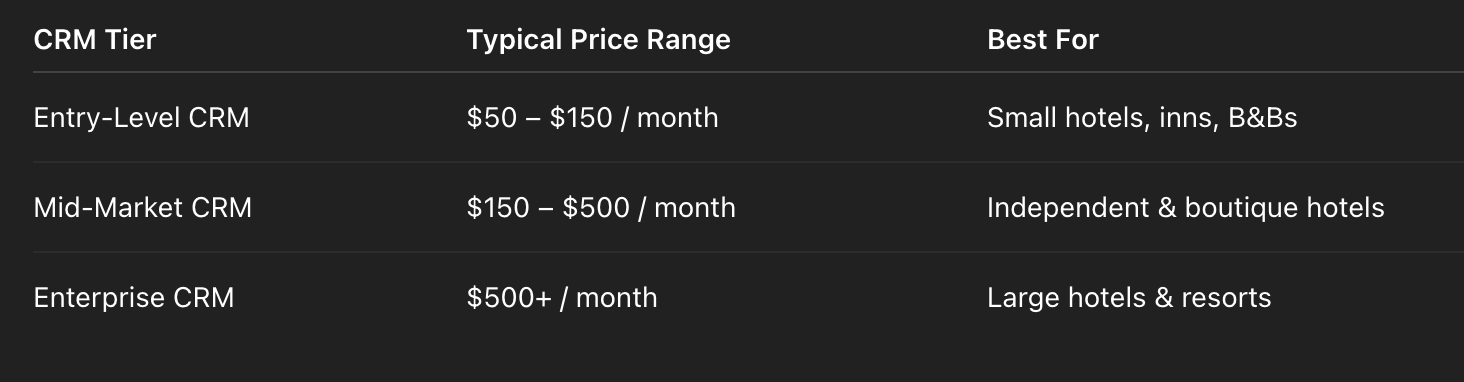
Hotel CRM Software Pricing: What to Expect
Hotel CRM pricing scales with how much guest data you manage and how actively you market to it. The right choice depends less on the lowest monthly fee and more on whether the platform fits your hotel’s size, marketing needs, and growth plans.
uccessful hotel CRM implementations start with clear expectations and strong alignment between the vendor and the hotel team. The best CRM providers clearly outline the full scope of the implementation during the kickoff call and ensure that key stakeholders—typically marketing, revenue, and operations—understand their role in the process.
Because a CRM sits downstream of core systems like the PMS and booking engine, implementation is less about configuring rooms and rates and more about data ingestion, automation setup, and campaign readiness. Vendors that can efficiently ingest historical guest and reservation data, map fields correctly, and validate data quality will significantly shorten onboarding time and improve early results.
Smaller hotels with simple needs can typically expect a 2–3 week implementation, while larger hotels or resorts with multiple integrations, larger databases, and more complex automation should plan for 4–6+ weeks, depending on data volume and internal responsiveness.
The Future of Hotel CRM Software
Hotel CRMs are becoming more powerful execution tools—adding automation, messaging channels, upselling integrations, and revenue attribution. What they are not becoming is full data infrastructure platforms.
Despite marketing claims, most CRMs still rely on PMS-fed data models and are optimized for activating data, not cleansing or governing it. This distinction is becoming clearer as hotels push CRMs harder and expose their data limits.
Hotel CDPs are increasingly framed as foundational data layers, focused on ingesting, deduplicating, and unifying guest data across systems. Their value is upstream—creating clean, persistent guest profiles that downstream tools like CRMs, RMS, and BI platforms can trust.
Importantly, CDPs typically do not handle campaign execution, messaging, or automation. Hotels adopting CDPs are doing so to enable better tools—not replace them.
CRMs and CDPs are not converging—they are specializing. CRMs are becoming better at marketing automation and guest engagement, while CDPs are solidifying their role as data infrastructure.
Hotels that understand this distinction are better equipped to build flexible, future-proof tech stacks—using CRMs to activate guest relationships and CDPs to ensure the data behind those relationships is accurate and scalable.
Most independent and boutique hotels do not have the data complexity—or internal resources—to justify a standalone CDP. As a result, the market is trending toward CRM-first stacks, where the CRM handles both basic data management and guest engagement.
For these hotels, simplicity and speed to value matter more than perfect data architecture.
Larger hotels and resorts with multiple systems, outlets, and data sources are increasingly separating data unification (CDP) from guest activation (CRM). This allows them to scale personalization without locking themselves into a single vendor’s ecosystem.
This trend is driven by data governance needs, analytics requirements, and long-term flexibility.
Hoteliers Also Ask
Email Marketing & customer relationship management software enables hotels to manage guest relationships at scale through profiling and marketing automation. At the core of any good Hotel CRM lies guest profiles that are created from data in property management systems, reputation management software and other third party data sources like social media. These profiles are then used to personalize marketing communications at scale. Hotel industry marketers use email marketing software to send personalized campaigns that drive material revenue for their properties without spamming their entire guest lists with generic offers. CRM software is mostly associated with email communications but increasingly is powering multi-channel communication like SMS, Facebook Messenger and more.
A CRM system is only as powerful as the data within it. CRM software relies on guest history to pull from a database of guest profiles, create guest segments, send personalized messaging, and measure the engagement level and revenue impact of marketing campaigns. Guest history contains important data like stay dates, reservation source, and total spend.
If a hotel wants to build and maintain a lasting relationship with its guests, then a CRM system is a necessary component of a hotel’s tech stack. A CRM system enables hoteliers to send automated, personalized messages, track engagement, promote special offers, maximize revenue, and gain insight into booking behavior.
It’s in a hotel’s best interest to have CRM software. Without it, a hotel will struggle to manage and track relationships with guests. With a CRM software and strategy in place, a hotel can develop guest loyalty, measure success of marketing campaigns, and better understand booking behavior - plus grow revenue and direct bookings.
According to HotelTechReport’s rating system, which is based on real user reviews and software specs, the top hotel CRM systems are Profitroom, Revinate (the 2021 HotelTechAward winner), dailypoint, Experience Hotel, and For-Sight Guest Engagement. Other popular systems include Cendyn's eInsight and Travelclick GMS (Amadeus).
Hotels use CRM software to initiate, maintain, and measure relationships with guests. A hotel’s CRM system should integrate with the property management system (PMS) to pull guest profile information and reservation history. Hotels that have a strong CRM strategy can increase direct bookings, guest loyalty, and incremental revenue.
Does your software have functionality for multi-property groups and portfolios? No matter how good your segmentation and A/B testing gets, you’ll always need to be constantly trying new things and iterating. Without an easy to use DIY editor you’d need to spend an enormous amount of time developing campaigns. How easy is it to customize my own email templates? Use the sales process to gather intelligence! Make sure that vendors add value before you sign up with them. Get comps and benchmarks from local competitors and then compare them to your own results to ensure that the provider is worth the switch. - What are the average CTRs and conversions for campaigns run by customers like us? In an age where privacy and cyber security are at the forefront of consumers and regulators alike, it’s important to work with providers who are thought leaders and on the cutting edge of new regulations. Your software provider should both have the functionality to support compliance and the capability to educate you in real time. - What processes do you have in place to ensure compliance with privacy laws like GDPR? In order to understand the ROI of investment in new software it’s important to have a clear picture of where you are today and where you should be. Great email and hotel CRM providers will have enough experience to know where your property should be performing and will help guide you to success if you’re not there already.
- Hotel marketers are time strapped so thankfully their CRM software can automate campaigns based on certain rules to save time and improve results. - While GDPR went into effect a few years ago, guest privacy is still very much in focus with several high profile hacks at major hotel groups. - Marketers should be thinking holistically about campaigns to reduce acquisition costs. Great email marketing should be supported by paid advertising to maximize impact. - For the first time in history, oil was trumped for the most valuable resource on the planet. Can you guess what took the top spot?…data! With the amount of systems, integrations and data sources on the rise, identifying ways to cleanse, standardize and access data is the key to unlocking its value. - Google now allows travelers to search for hotels, find reviews, and book through its own travel portal. Given Google’s dominance on internet search, this may represent a major change for OTAs and the importance of a hotel’s internal data and ability to segment and target guests is becoming increasingly important to compete. - GDPR has been followed by the CCPA (California Consumer Protection Act) and other similar regulations are in the works elsewhere. Hoteliers will need to comply or risk facing fines.
LAST UPDATED
APPS TESTED
CONTRIBUTING EXPERTS
Get Your Custom Hotel CRM & Email Marketing Analyst Report
- Ranked recommendations for your property
- Real operator reviews & pricing data
- Tailored to your size, market & integrations
Trusted by thousands of hoteliers worldwide
Takes 2 min · No credit card needed
Get Your Free AI Analyst Report
Custom recommendations tailored to your property


Let´s lookup your hotel information
Still weighing your hotel crm & email marketing options?
A few popular systems from our hotel crm & email marketing guide — or let our AI score each one against your specific property in about two minutes.


