

Sorry, this functionality is only available for verified hoteliers
The project dashboard is a free tool that is only available to verified hoteliers to make adopting new technology easier by streamlining their research and simplifying their communication workflow.

10 Best Upselling Software for Hotels 2026

By Jordan Hollander
Last updated on March 5, 2026

Jordan Hollander
CEO @ Hotel Tech Report
Jordan is the co-founder of HotelTechReport, the hotel industry's app store where millions of professionals discover tech tools to transform their businesses. He was previously on the Global Partnerships team at Starwood Hotels & Resorts. Prior to his work with SPG, Jordan was Director of Business Development at MWT Hospitality and an equity analyst at Wells Capital Management. Jordan received his MBA from Northwestern’s Kellogg School of Management where he was a Zell Global Entrepreneurship Scholar and a Pritzker Group Venture Fellow.
-
517
articles contributed
Our reviewers evaluate software independently. Learn how we stay transparent, read our review methodology, and tell us about any tools we missed.
This list is based on research we’ve conducted since 2017, analyzing dozens of Upselling Software using verified hotelier reviews, product deep dives, and our proprietary HTScore.
Hotel Upselling Software Shortlist
Here are 10 of the top Hotel Upselling Software platforms that are covered in this in-depth guide:
- 1.
- 2.
- 3.
- 4.
- 5.
- 6.
- 7.
- 8.
- 9.
- 10.
Over 2M+ Leading Hotel Professionals Trust Our Advice




Get Your Custom Upselling Software Analyst Report
- Ranked recommendations for your property
- Real operator reviews & pricing data
- Tailored to your size, market & integrations
Trusted by thousands of hoteliers worldwide
Takes 2 min · No credit card needed
LAST UPDATED
APPS TESTED



CONTRIBUTING EXPERTS


How to Choose the Right Hotel Upselling Software Provider
This list is already personalized based on your hotel’s size, type, and location. Because upselling strategies vary widely between resorts, boutiques, and limited-service properties, we prioritize platforms that align with your operational model.
Want to go deeper? Use the filters to refine your shortlist by country, region, integration compatibility, and revenue focus to see which upselling systems are the best fit for your specific ancillary revenue strategy.
Best Hotel Upselling Software by Property Type
These rankings are powered by data — not vendor claims. By analyzing 80,000+ verified reviews, real-world performance signals, and segment-specific usage patterns across 130 countries, we’re able to identify the upselling platforms that consistently drive measurable ancillary revenue growth.
Because upselling success varies by property type, our rankings are segmented by hotel operating model — from large resorts with multi-outlet revenue strategies to small independents focused on simple upgrade automation.
The result: smarter, segment-aware recommendations based on what’s actually working for hotels most similar to yours — not just who has the flashiest demo.
Q3 2026 Upselling Software Survey Rankings
Based on HTR's Q3 2026 quarterly Upselling Software survey insights, these are the products that are currently most recommended by each size of hotel.
Q3 2026 Upselling Software Survey Rankings
Based on HTR's Q3 2026 quarterly Upselling Software survey insights, these are the products that are currently most recommended by each size of hotel.
| Best for | Hoteliers | Recommended | |
|---|---|---|---|
Best Upselling Software for Small Hotels (up to 49 rooms)
Small
up to 49 rooms
|
394 Hoteliers |
3 products recommended
|
|
|
|
|||
Best Upselling Software for Mid-sized Hotels (50-99 rooms)
Mid-sized
50-99 rooms
|
556 Hoteliers |
4 products recommended
Canary Technologies
, Duve
, SiteMinder
and 1 others
|
|
|
|
|||
Best Upselling Software for Large Hotels (100-499 rooms)
Large
100-499 rooms
|
1.3k Hoteliers |
4 products recommended
Canary Technologies
, Duve
, Frontline Performance Group
and 1 others
|
|
|
|
|||
Best Upselling Software for Enterprise Hotels (500+ rooms)
Enterprise
500+ rooms
|
241 Hoteliers |
3 products recommended
|
|
|
|
|||
Best Upselling Software for Small Hotels (up to 49 rooms)
Best Upselling Software for Mid-sized Hotels (50-99 rooms)
Best Upselling Software for Large Hotels (100-499 rooms)
Best Upselling Software for Enterprise Hotels (500+ rooms)
Create Free Account
Join 1.5M+ hoteliers making data-driven decisions



By proceeding you agree to our Terms of Service and Privacy Policy
What you'll get




Best Upselling Software Reviews
Hotel Upselling Software Features & Comparison


 100 HT Score
98 HT Score
89 HT Score
84 HT Score
89 HT Score
100 HT Score
98 HT Score
89 HT Score
84 HT Score
89 HT Score
How We Evaluate Hotel Upselling Software
Did you know that effective upselling can increase ancillary revenue by 10–20% per guest? Hotel upselling software helps automate and personalize these opportunities—before check-in, at the front desk, and even during the stay. But just like any tool, the impact depends on the solution you choose. That’s why I demoed the top upselling platforms and surveyed 2724 hoteliers in 94+ countries to bring you this comprehensive guide.
Upselling software has evolved from simple pre-arrival email offers into sophisticated, AI-powered revenue engines. Today’s platforms integrate deeply with your PMS, CRM, and guest messaging tools to dynamically price upgrades, personalize offers, and automate the entire ancillary revenue lifecycle.
The right solution won’t just increase revenue — it will improve guest satisfaction, reduce front desk workload, and deliver measurable ROI. Here’s how we break it down.
There isn't a single definition or flavor of Upselling Software — different providers take different POVs when building their tools with varying different delivery mechanisms designed to monetize different moments in the guest journey.
While all upselling platforms aim to generate incremental revenue through upgrades and add-ons, they vary significantly in how they deliver offers and when those offers appear.
Understanding these two vectors — delivery channel and timing — is critical to choosing the right solution for your property.
Pre-Arrival Focused | Full Lifecycle Monetization | |
|---|---|---|
Simple / Operational Tools | Basic Upgrade Automation • Email-triggered upgrade offers • Static pricing • Limited reporting Best for small hotels monetizing room inventory | Messaging-Driven Add-Ons • Conversational upselling • In-stay service offers • Limited dynamic pricing Best for properties focused on engagement over yield optimization |
Advanced / Revenue-Optimized Platforms | Dynamic Pre-Arrival Revenue Engines • AI pricing logic • Inventory-aware upgrade rules • Conversion optimization Best for hotels maximizing room upgrade ADR | Hybrid Ancillary Revenue Platforms • Multi-channel delivery (email + messaging + check-in) • Cross-department monetization • Unified reporting & TRevPAR focus Best for large hotels and resorts optimizing total revenue |
Comparison of Types of Upselling Software
Upselling Type | Primary Delivery Mechanism | Primary Moment of Upsell | Revenue Focus | Strengths | Limitations | Best Fit Segment |
|---|---|---|---|---|---|---|
Dedicated Upselling Platforms | Email-triggered upgrade portal (standalone branded page) | Post-booking, pre-arrival | Room upgrades, early check-in, packages | Strong automation, dynamic pricing, branded UX, robust reporting | Primarily pre-arrival focused; less in-stay depth | Hotels prioritizing room upgrade yield optimization |
Guest Messaging-Based Upselling | SMS, WhatsApp, web chat, or in-app messaging | Pre-arrival and in-stay | Add-ons, services, experiences | High engagement rates, conversational feel, effective for micro-upsells | Less sophisticated pricing logic; reporting may be lighter | Hotels focused on real-time engagement and in-stay monetization |
Digital Check-In / Guest App Embedded Upselling | Mobile check-in flow or branded guest app | Arrival window (pre-check-in or day-of) | Upgrades, breakfast, late checkout | High-intent timing, seamless payment integration, frictionless UX | Limited to check-in touchpoint; shorter revenue window | Mobile-first and contactless-enabled properties |
Front Desk-Facing Upsell Tools | PMS-embedded prompts or staff dashboard | At physical check-in | Last-minute room upgrades | Supports human selling, structured prompts, strong for luxury | Dependent on staff consistency and training | High-touch, service-driven hotels |
Hybrid Ancillary Revenue Platforms | Multi-channel (email + messaging + app + check-in) | Pre-arrival + arrival + in-stay | Full ancillary revenue mix (rooms + outlets) | Maximizes TRevPAR, unified reporting, cross-department monetization | More complex implementation; higher cost | Large hotels and resorts with multi-outlet operations |
Pre-Arrival vs In-Stay Revenue Capture Matrix
Upselling Type | Early Post-Booking (7–14 Days Out) | Pre-Arrival (1–5 Days Out) | Arrival / Check-In | In-Stay | Primary Revenue Strength |
|---|---|---|---|---|---|
Dedicated Upselling Platforms | ★★★★☆ | ★★★★★ | ★★☆☆☆ | ★☆☆☆☆ | Room upgrades & premium inventory monetization |
Guest Messaging-Based Upselling | ★★☆☆☆ | ★★★☆☆ | ★★★☆☆ | ★★★★★ | Real-time add-ons & experiential sales |
Digital Check-In / Guest App Embedded | ★☆☆☆☆ | ★★★★☆ | ★★★★★ | ★★☆☆☆ | Contextual upgrades during check-in |
Front Desk-Facing Tools | ☆☆☆☆☆ | ★☆☆☆☆ | ★★★★★ | ★★☆☆☆ | Last-minute paid room upgrades |
Hybrid Ancillary Revenue Platforms | ★★★★★ | ★★★★★ | ★★★★☆ | ★★★★★ | Full lifecycle ancillary revenue optimization |
Key Takeaways from the Comparison Table Above
Early Post-Booking (7–14 Days Out): Best time to maximize room upgrade yield before inventory tightens.
Pre-Arrival (1–5 Days Out): Strong window for early check-in, breakfast, and add-on packaging.
Arrival / Check-In: High-intent moment where contextual upsells perform well.
In-Stay: Ideal for spa, dining, experiences, and micro-monetization.
If your goal is premium room yield 👉 prioritize platforms strong in early post-booking automation.
If your goal is experiential and outlet revenue 👉 prioritize messaging or hybrid platforms that perform during the stay.
If your operation is mobile-first, check-in embedded upselling may be your highest-leverage moment. And if you're running a complex resort, lifecycle monetization (hybrid) will almost always outperform single-channel tools.
At first glance, many upselling platforms appear very similar. Most vendors promise automated upgrade offers, incremental ancillary revenue, and seamless PMS integration. Product pages often showcase the same core capabilities—pre-arrival emails, upgrade offers, and basic reporting dashboards.
But once you move past the surface, the differences become much more meaningful. Some platforms are little more than automated email campaigns with static pricing. Others function as full ancillary revenue engines with dynamic pricing, real-time inventory awareness, and deep integrations across the hotel tech stack.
That’s why a deeper evaluation framework is necessary. The real question isn’t whether a vendor offers upselling features—it’s how well those features operate in a live hotel environment where inventory changes constantly, guests interact across multiple channels, and revenue teams need reliable data.
Our evaluation framework focuses on operational performance, integration depth, automation capabilities, and measurable revenue impact. The goal is simple: help hoteliers distinguish between platforms that truly drive incremental revenue and those that simply add another layer of software with limited operational value.
Capability | Importance | What to Ask Vendors | What Good Looks Like | Red Flags / Weak Implementations |
|---|---|---|---|---|
PMS Integration Depth | ★★★★★ | Does the system sync availability and room types in real time? Can accepted upgrades automatically update the reservation and folio? | Real-time bidirectional PMS integration that updates inventory and posts charges automatically. | Batch data syncs, manual room assignment, or upgrades that require front desk intervention. |
Upgrade & Ancillary Revenue Engine | ★★★★★ | Can pricing adjust dynamically based on occupancy or demand? Are multiple offer types supported beyond room upgrades? | Dynamic upgrade pricing, flexible offer rules, and support for multiple ancillary products (spa, dining, experiences). | Static upgrade pricing, limited offer customization, or manual campaign setup. |
Pre-Arrival Automation | ★★★★☆ | Can offers trigger automatically based on booking date or check-in window? Are campaigns customizable by segment or room type? | Automated offer sequences tied to booking lifecycle with customizable timing and segmentation. | One-time email blasts or manual campaign creation for each stay period. |
Guest Communication Channels | ★★★★☆ | Which channels deliver offers—email, SMS, guest messaging, mobile check-in? Are channels configurable? | Multi-channel delivery with consistent branding and centralized campaign management. | Email-only distribution or fragmented communication tools. |
Inventory Awareness & Protection | ★★★★☆ | How does the system prevent upgrades when inventory becomes constrained? | Real-time inventory awareness that suppresses offers automatically when availability tightens. | Overselling upgrades, inventory mismatches, or reliance on manual monitoring. |
Payments Processing Integration | ★★★★☆ | Can guests pay for upgrades immediately? How are charges posted to the PMS folio? | Secure payment processing with automatic posting to PMS folios and clear reconciliation. | Offline payment capture, manual charge posting, or delayed revenue reconciliation. |
Reporting & Revenue Analytics | ★★★★☆ | What metrics are available—conversion rates, revenue per guest, upgrade yield? Can reports be exported? | Clear dashboards showing conversion rates, incremental revenue, and performance by campaign or room type. | Limited reporting, spreadsheet exports only, or lack of revenue attribution. |
Guest Experience & Offer UX | ★★★☆☆ | Are offer pages mobile optimized? Can the interface be branded to match the hotel website? | Clean, branded upgrade experience optimized for mobile with simple one-click acceptance. | Generic landing pages, poor mobile usability, or confusing upgrade flows. |
Integration Ecosystem | ★★★☆☆ | Which systems integrate besides the PMS (CRM, messaging tools, digital check-in, RMS)? | Open APIs and certified integrations across major hotel tech systems. | Closed systems with limited integration options or middleware dependencies. |
Operational Management & Controls | ★★★☆☆ | Can revenue managers adjust offers and pricing rules without vendor support? | Self-service configuration tools that allow hotels to manage campaigns, offers, and pricing internally. | Vendor-managed configuration requiring support tickets for basic changes. |
Dealbreaker Questions
Before committing to detailed product demos, a few practical questions can quickly eliminate weak vendors.
Does the platform update reservations and post charges directly to the PMS in real time?
If upgrades require manual intervention or batch syncing, operational errors and revenue leakage become likely.
Are upsell campaigns automated based on booking and arrival timing?
Strong platforms trigger offers automatically at predefined moments in the guest journey, eliminating manual campaign management.
Does the system protect room inventory dynamically?
If upgrade availability isn’t tied to real-time inventory, hotels risk overselling premium rooms or creating front desk conflicts.
Can hotel staff manage offers and pricing rules internally?
Operational teams should be able to adjust upgrade pricing, offer types, and campaign timing without needing vendor support for every change.
Upselling software needs vary dramatically depending on your property type, guest profile, and revenue model. A luxury resort monetizing spa packages and suites has very different needs than a limited-service hotel focused on early check-in and parking add-ons.
Below is how we break down upselling software selection by hotel segment.
1. Large Hotels & Resorts
If you’re managing a large hotel or resort, upselling isn’t just about room upgrades — it’s a full ancillary revenue strategy. You likely operate multiple outlets (spa, golf, F&B, activities, events), and guest expectations for personalization are high.
Your upselling platform must integrate deeply across departments, support dynamic pricing logic, and scale across high booking volumes without creating operational friction.
Defining Characteristics:
Multi-department operations with separate revenue centers such as spa, golf, F&B, and events. High booking volume across diverse channels. Dedicated revenue management teams. Strong PMS, RMS, and CRM ecosystem. Heavy focus on maximizing Total RevPAR and ancillary revenue performance.
Common Needs & Preferences:
Enterprise-grade integrations across departments. Dynamic pricing for room upgrades. Advanced reporting and benchmarking. Portfolio-level scalability. Strong automation to reduce operational complexity.
Key Features and Needs:
Feature Title | Description | Why It’s Critical |
|---|---|---|
Dynamic Upgrade Pricing | Automated pricing based on availability and demand | Maximizes incremental revenue per stay |
Multi-Outlet Offer Management | Sell spa, dining, activities, and experiences | Resorts rely heavily on non-room revenue streams |
Enterprise PMS & RMS Integrations | Real-time inventory and pricing synchronization | Prevents overbooking and ensures pricing accuracy |
Advanced Analytics Dashboard | Track conversion rates, revenue per guest, and total ancillary impact | Enables data-driven optimization across departments |
Multi-Property Management | Centralized control across multiple locations | Essential for branded groups and chains |
2. Boutique & Independent Hotels
Boutique hotels focus on curated experiences and personalization. Upselling here is less about aggressive monetization and more about enhancing the stay — champagne on arrival, curated local experiences, premium room upgrades.
Presentation matters. Offers must feel branded, seamless, and aligned with the property’s aesthetic.
Defining Characteristics:
Experience-driven guest journeys. Strong focus on brand identity and design. Lean teams with limited revenue staff. Heavy reliance on direct bookings. High expectations for personalization.
Common Needs & Preferences:
Visually branded upsell flows. Automated pre-arrival offers. Guest-friendly mobile UX. Seamless payment experience. Automation without operational complexity.
Key Features and Needs
Feature Title | Description | Why It’s Critical |
|---|---|---|
Branded Offer Pages | Customizable design and messaging | Maintains brand identity and premium feel |
Pre-Arrival Automation | Scheduled upsell emails or SMS before check-in | Captures revenue early in the guest journey |
Guest Segmentation | Target offers by room type, rate, or stay length | Personalization increases conversion rates |
Mobile-Optimized UX | Seamless upgrade and payment experience | Most guest interactions occur on smartphones |
Guest Messaging Integration | Sync with CRM or communication tools | Keeps communication centralized and consistent |
3. Small Hotels & B&Bs Properties
For small hotels, upselling software should be simple, affordable, and automated. There may not be a revenue manager actively optimizing pricing daily — so the system should do most of the work.
The goal is incremental revenue without creating operational burden.
Defining Characteristics:
Owner-operated or lean teams. Limited tech support. Budget sensitivity. Focus on room revenue first. Minimal time for complex setup or management.
Common Needs & Preferences:
Simple automation. Quick onboarding. Clear ROI visibility. Easy PMS integration. Predictable pricing.
Key Features and Needs:
Feature Title | Description | Why It’s Critical |
|---|---|---|
Automated Upgrade Rules | Set pricing logic once and let the system run | Reduces manual oversight |
Early Check-In & Late Check-Out Offers | Monetize simple, high-demand add-ons | Quick revenue wins with strong conversion |
Basic PMS Integration | Sync availability and guest data | Prevents operational errors |
Conversion Tracking Dashboard | Simple reporting on revenue impact | Owners need visible ROI |
Transparent Pricing Model | Low monthly or commission-based pricing | Keeps costs predictable and manageable |
4. Budget Hotels, Motels & Limited-Service Properties
For economy properties, upselling must be frictionless and efficient. Guests are price-sensitive, and margins are thin. Offers should be simple — parking, early check-in, better room location — and easy to accept.
The technology should require minimal setup and staff involvement.
Defining Characteristics:
High turnover and short stays. Heavy OTA booking mix. Lean staffing or automated front desk operations. Strong focus on cost control. Low tolerance for complexity or downtime.
Common Needs & Preferences:
Simple, high-conversion offers. Automation with minimal configuration. OTA compatibility. Fast implementation. Low cost structure.
Key Features and Needs:
Feature Title | Description | Why It’s Critical |
|---|---|---|
OTA-Compatible Upselling | Trigger offers for OTA bookings | Enables monetization beyond direct bookings |
One-Click Upgrade Acceptance | Fast confirmation and payment flow | Reduces friction and abandonment |
Lightweight Automation | Pre-set workflows for common offers | Saves staff time in high-turnover environments |
Basic Performance Reporting | Track revenue uplift per stay | Ensures ROI visibility |
Performance-Based Pricing | Commission-based cost structure | Aligns vendor incentives with hotel revenue |
If you’ve ever tried comparing upselling platforms side-by-side and ended up thinking, “Aren’t they all just upgrade email tools?” — you’re not alone.
On the surface, most upselling software vendors promise the same thing: automated pre-arrival offers, room upgrade monetization, ancillary revenue growth, and seamless PMS integration.
But once you dig deeper, the differences become significant — and those differences directly impact your revenue potential.
Here’s why comparing upselling software is more complicated than it looks:
1. Upselling Platforms Are Built for Different Revenue Strategies
Some platforms are laser-focused on monetizing room upgrades with dynamic pricing logic. Others prioritize total ancillary revenue — spa, dining, experiences, parking, transfers, and more.
A limited-service hotel looking to monetize early check-in doesn’t need the same functionality as a resort managing 12 revenue outlets.
Comparing them without segment context is like comparing a minibar to a full-service cocktail bar — both generate revenue, but the operational complexity is entirely different.
2. “Automation” Means Different Things to Different Vendors
Every vendor claims automation. But automation can range from:
Basic scheduled pre-arrival emails
Rule-based upgrade pricing
AI-driven personalization based on guest behavior
Fully dynamic pricing tied to occupancy and demand
The feature may exist on the checklist — but how intelligently and flexibly it works varies dramatically.
Unless you evaluate how automation aligns with your internal resources and revenue strategy, you risk choosing a tool that either underperforms or requires more manual oversight than expected.
3. Pricing Models Are Structured in Very Different Ways
Upselling software pricing is far from standardized.
You’ll see:
Commission-only models (percentage of upsold revenue)
Flat monthly subscriptions
Hybrid structures
Volume-based tiers
Setup or integration fees
A commission-based model may sound attractive — until you calculate long-term cost at scale. A flat fee may look expensive — until you realize conversion volume makes it more economical.
Without revenue projections and context, pricing comparisons can be misleading.
4. Integration Depth Is Often Overlooked
Almost every vendor says they “integrate with your PMS.”
But does that mean:
Real-time room inventory updates?
Automated upgrade assignment?
Bidirectional guest data sync?
Or just a basic reservation import?
The depth of integration directly impacts operational smoothness, reporting accuracy, and front desk workload.
And yet, integration quality is rarely obvious in marketing materials or demos.
5. Guest Experience Quality Varies Widely
An upsell offer can either feel like a premium service enhancement — or a spammy add-on.
The UX, branding flexibility, mobile responsiveness, and payment flow all influence conversion rates.
Two platforms may technically offer the same feature set, but the presentation layer can significantly affect guest trust and acceptance.
In upselling, experience design directly impacts revenue.
6. Upselling Needs Are Hyper-Specific by Hotel Segment
This is the big one.
A luxury resort may prioritize:
Dynamic pricing
Multi-outlet monetization
Enterprise reporting
A boutique hotel may care most about:
Branded presentation
Curated experience add-ons
Seamless guest messaging
A budget hotel may simply want:
Easy early check-in monetization
Minimal setup
Low commission
Without filtering by operational DNA, every upselling platform starts to look “pretty similar” — until implementation reveals the mismatch.
The Bottom Line
Comparing upselling software is hard because the category spans multiple revenue philosophies, pricing structures, integration depths, and operational models.
Choosing a platform isn’t about picking the one with the most features — it’s about finding the one that aligns with:
Your property type
Your internal resources
Your revenue goals
Your guest expectations
That’s why we built our vendor selection framework around one core principle:
Revenue tools should reflect operational reality.
Not just star ratings or surface-level feature comparisons — but how your hotel actually generates, manages, and optimizes ancillary revenue.
Our methodology groups hotels into four core segments:
Large Hotels & Resorts
Boutique & Independent Hotels
Small Hotels & B&Bs
Budget Hotels & Limited-Service Properties
Each segment has different upselling priorities. By evaluating vendors within these operational contexts, we eliminate the noise of one-size-fits-all rankings.
This allows you to:
Identify which upselling features truly move the needle for your property type
Compare vendors based on similar operational use cases
Avoid platforms that look impressive in demos but don’t align with your workflow
Model ROI based on realistic revenue scenarios
You’re leveraging real-world operator insight.
In a category where most tools promise “easy ancillary revenue growth,” our framework helps you find the platform that’s actually built for how your hotel operates — and how your guests buy.
Everything You Need to Know About Hotel Upselling Software
Not sure where to start with hotel upselling platforms? This section is your crash course. We’ll walk you through what upselling software actually is, which revenue opportunities it unlocks (room upgrades, early check-in, spa packages, add-ons), how pricing models typically work (commission vs. subscription), and which integrations matter most (PMS, RMS, CRM, payments).
We’ll also break down the measurable revenue impact, common implementation pitfalls, and the trends shaping the future of ancillary revenue automation. Whether you’re looking to monetize premium inventory or build a full ancillary revenue strategy, this guide will help you understand what to look for — and what to avoid — based on real-world insights from {{reviews}}+ hoteliers across {{countries}}+ countries.
2026 Upsell Software Buyer's Guide


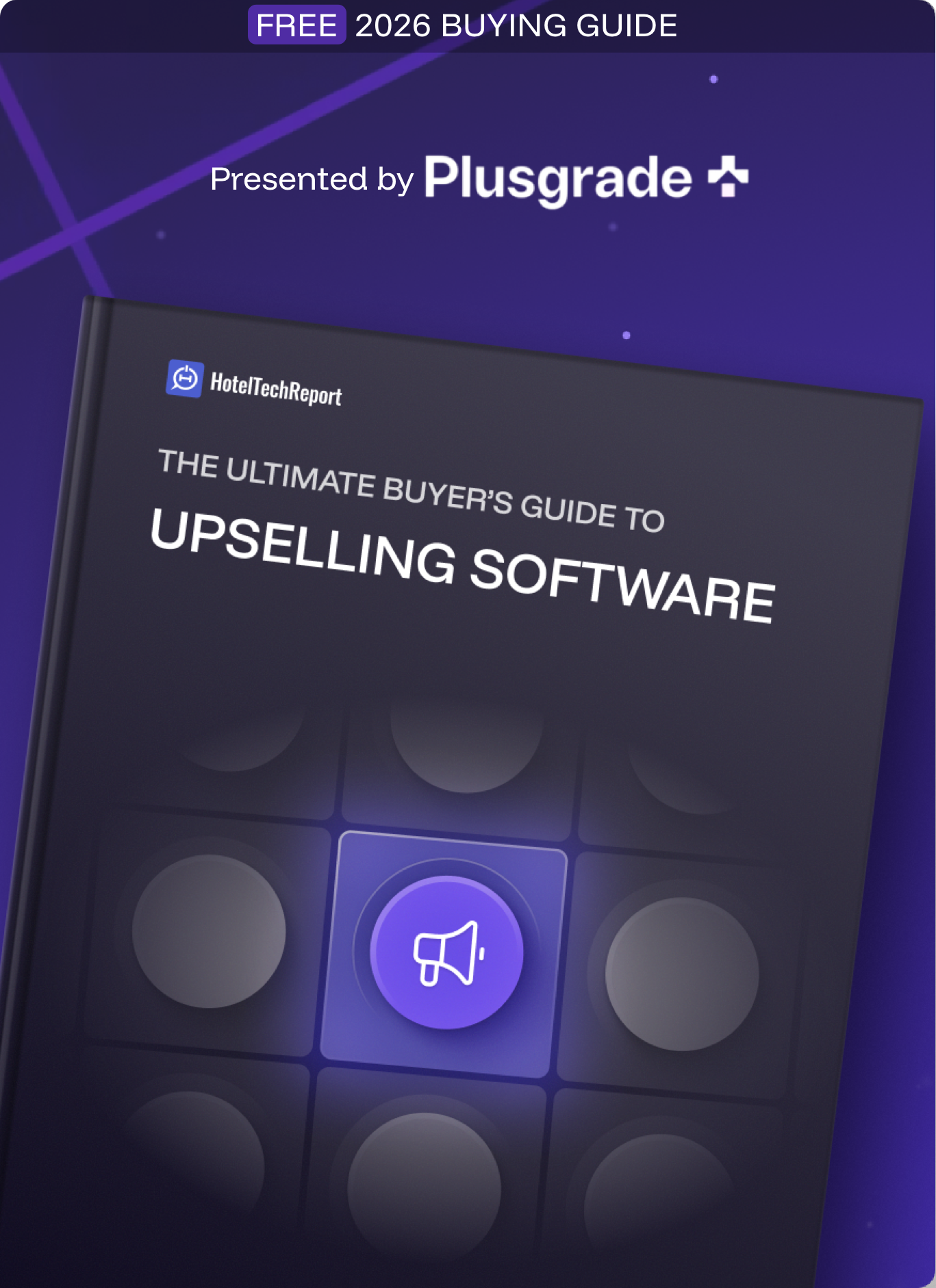
Download the Free Guide
Your guide was sent!
Your guide was successfully sent to .
This email may be incorrect
Our check detected that this address may have been entered incorrectly. Please confirm or correct it before we continue:
This looks like it may contain a typo.
Did you mean ?
What is Upselling Software?
What are the most important features of merchandising and upselling software?
Upselling software has evolved from simple pre-arrival upgrade emails into structured revenue platforms embedded throughout the guest journey. Early tools focused primarily on sending automated upgrade offers before arrival. Modern platforms go much further, connecting directly to the property management system (PMS) to manage upgrade inventory, trigger offers automatically, and capture payments without manual staff involvement.
These capabilities matter because upselling touches several operational workflows at once. Front desk teams must avoid inventory conflicts, revenue managers need visibility into upgrade performance, and guests expect a seamless experience when accepting paid upgrades or add-ons. If the platform is not deeply integrated with the hotel’s systems or automation rules, the operational burden can quickly outweigh the revenue benefit.
Today’s strongest platforms support automation across the guest lifecycle—triggering offers at the right moment, routing payments directly to the PMS folio, and providing clear reporting on conversion rates and ancillary revenue. For operators evaluating vendors, the key is understanding which capabilities truly drive revenue capture and operational efficiency versus those that simply replicate basic marketing campaigns.
Capability Area | Feature | Description |
|---|---|---|
Guest Experience / Guest Engagement | Pre-Arrival Upgrade Offers | Automatically presents room upgrades and add-ons to guests after booking. This creates a consistent opportunity to monetize premium inventory before arrival without requiring staff involvement. |
Branded Offer Pages | Customizable upgrade pages that match the hotel’s branding and booking experience. A well-designed interface improves guest trust and increases conversion rates. | |
Mobile-Optimized Offer Experience | Upgrade and add-on pages designed for mobile devices, where most guests engage with pre-arrival communications. This reduces friction when guests accept paid upgrades. | |
Guest Segmentation & Personalization | Allows hotels to target offers based on room type, length of stay, guest history, or booking channel. Personalization improves conversion and avoids irrelevant offers. | |
Operations & Workflow Management | Automated Offer Triggers | Campaigns automatically trigger based on booking confirmation, check-in date, or stay milestones. This removes the need for manual campaign management by hotel staff. |
Inventory-Aware Upgrade Logic | The system checks room availability before presenting upgrades to guests. This prevents overselling premium inventory and reduces front desk conflicts. | |
Upgrade Acceptance & Reservation Updates | When a guest accepts an upgrade, the system automatically updates the reservation and assigns the appropriate room type. This eliminates manual intervention during check-in. | |
Staff Configuration & Offer Management | Revenue or operations teams can adjust offers, pricing rules, and timing internally. This allows hotels to manage campaigns without relying on vendor support. | |
Revenue & Commercial Impact | Dynamic Upgrade Pricing | Upgrade pricing can adjust based on occupancy, availability, or demand. This helps hotels maximize revenue while protecting premium inventory. |
Ancillary Add-On Sales | Supports selling additional services such as breakfast, parking, spa appointments, or late checkout. Expanding beyond room upgrades increases total revenue per guest. | |
Conversion Tracking & Revenue Attribution | Dashboards track conversion rates, revenue generated, and performance by offer type. This visibility helps revenue teams refine pricing and campaign strategy. | |
Multi-Moment Upselling | Offers can appear at multiple points in the guest journey, such as after booking, before arrival, or during digital check-in. Capturing multiple opportunities increases overall ancillary revenue. | |
Integrations & Data | PMS Integration | Direct integration with the Property Management System enables real-time reservation data, inventory awareness, and automatic folio posting for upgrades and add-ons. |
Payment Processing Integration | Guests can pay for upgrades or add-ons instantly through secure payment processing. This ensures revenue is captured before arrival and simplifies reconciliation. | |
CRM & Guest Data Integration | Integration with CRM or guest profile systems allows upsell offers to be informed by guest history, preferences, and loyalty status. | |
Reporting & Data Export | Operational and revenue reporting can be exported or integrated into business intelligence systems. This provides visibility into ancillary revenue performance across properties. |
- Offer Orchestration (Booking → Pre-Arrival → Arrival → In-Stay → Post-Stay)
- Multi-Channel Delivery (Email, SMS, WhatsApp, Chat)
- Guest Segmentation & Targeting
- Digital Acceptance & Payment Capture
- Check-In & On-Property Upsell Support
- Post-Stay & Future Stay Offers
- Offer Orchestration (Booking → Pre-Arrival → Arrival → In-Stay → Post-Stay)
- Multi-Channel Delivery (Email, SMS, WhatsApp, Chat)
- Guest Segmentation & Targeting
- Digital Acceptance & Payment Capture
- Check-In & On-Property Upsell Support
- Post-Stay & Future Stay Offers
- Offer Templates Library
- Dynamic Upgrade Pricing
- Room Upgrade Merchandising
- Ancillary Product Merchandising
- Gift Vouchers & Prepaid Experiences
- Segmentation
- Offer Templates Library
- Dynamic Upgrade Pricing
- Room Upgrade Merchandising
- Ancillary Product Merchandising
- Gift Vouchers & Prepaid Experiences
- Segmentation
- Type 2 SOC 2 Certified (Data Security)
- Automated Fulfillment Task Routing
- Multi-Channel Delivery (Email, SMS, WhatsApp, Chat)
- Gift Vouchers & Prepaid Experiences
- Inventory & Eligibility Controls
- Reservation & Folio Update Workflow
- Staff & Department Fulfillment Visibility
- Exception, Refund & Override Handling
- Type 2 SOC 2 Certified (Data Security)
- Automated Fulfillment Task Routing
- Multi-Channel Delivery (Email, SMS, WhatsApp, Chat)
- Gift Vouchers & Prepaid Experiences
- Inventory & Eligibility Controls
- Reservation & Folio Update Workflow
- Staff & Department Fulfillment Visibility
- Exception, Refund & Override Handling
- Segmentation
- Type 2 SOC 2 Certified (Data Security)
- Offer Suppression & Approval Controls
- Performance Reporting & Offer Analytics
- Multi-Property/Chain Dashboard
- Offer Experimentation & A/B Testing
- Offer Performance Analytics
- Segmentation
- Type 2 SOC 2 Certified (Data Security)
- Offer Suppression & Approval Controls
- Performance Reporting & Offer Analytics
- Multi-Property/Chain Dashboard
- Offer Experimentation & A/B Testing
- Offer Performance Analytics
How can merchandising and upselling software improve profitability and efficiency?
- Increase incremental spend per guest: By offering segmented Upselling before arrival, hoteliers manage to provide true flexibility to their guests, enabling them to choose from personalized offers at a time that’s right for them. Upselling as part of the overall Revenue Management strategy, achieves two goals: Higher ADR, Less Free Upgrades.
- Save time and maximize outlets: Expectations are all set before the experience itself. By enabling guests to share their needs (and get inspired by what the hotel has to offer), Hotel Operations are able to anticipate special requests and save precious time in the communication with every single guest. 2
- Personalize the guest experience: Consumers of today are used to controlling their experience. Gone are the times of fixed packages and one size fits all. Modern travelers crave freedom and personalization.
Critical Integrations for Hotel Upselling Software
When you're evaluating Upselling Software, it’s easy to focus on flashy revenue dashboards and projected uplift percentages. But here’s the thing: upselling only works if it’s deeply connected to your core systems.
At a minimum, your upselling platform should include:
Real-Time PMS Integration for reservation data, room inventory, and guest profiles
Automated Upgrade Assignment Logic synced with availability
Secure Payment Processing for frictionless offer acceptance
Pre-Arrival Communication Triggers tied to booking and check-in timing
These shouldn’t rely on manual exports or delayed syncs. Real-time connectivity is what ensures upgrade availability is accurate, revenue is tracked correctly, and front desk teams aren’t left cleaning up discrepancies.
That said, not all integrations are created equal. Some vendors advertise “PMS integration,” but that may simply mean reservation imports via API without true bidirectional sync. Others rely on middleware or partial data pulls that limit automation capabilities.
If the integration isn’t deep and real-time, you may run into:
Upgrade inventory conflicts
Manual room reassignments
Reporting inconsistencies
Guest experience friction
Once you’ve confirmed strong PMS connectivity, here are the external integrations that truly matter — the ones that allow your upselling software to plug into your broader revenue, marketing, and guest experience ecosystem.
Pricing for upselling software is typically structured as a SaaS model, but the way vendors charge can vary significantly. Some platforms charge a fixed monthly subscription per property or per room, while others operate on a commission model based on the revenue generated through the platform. In some cases, vendors offer hybrid models that combine a subscription fee with a revenue-share component.
Hotels evaluating upselling software should look beyond the base subscription price and consider the total cost of ownership. Integration requirements—particularly with the Property Management System (PMS), payment processing, or CRM platforms—can influence both implementation time and cost. Operational complexity, such as managing campaigns across multiple properties or revenue outlets, may also require more advanced pricing tiers.
Scalability is another important factor. Platforms that work well for a single property may become more expensive as hotels expand across a portfolio or add additional revenue channels such as spa services, dining packages, or late checkout. Understanding how pricing scales with property size and usage is essential when comparing vendors.
Some firms such as Nor1 operate on a commission model. While this in many cases requires no up-front cost due to contribution based on performance it often results in higher fees that can be as high as 25% of incremental sales. A fixed fee model such as that employed by firms such as Oaky may seem riskier in the short run; however, in many cases end up being dramatically more cost effective - especially as hotels get better and better at upselling.
Common Pricing Models
Pricing Model | How It Works | Typical Cost Considerations |
|---|---|---|
Per-Room Monthly Subscription | Vendors charge a recurring monthly fee based on the number of rooms in the property. | Costs scale with property size, which can increase expenses for large hotels or portfolios. |
Per-Property Licensing | A flat monthly or annual fee covers the entire property regardless of room count. | Predictable pricing, but may be higher upfront for smaller hotels with fewer rooms. |
Commission / Revenue Share | The vendor takes a percentage of the revenue generated through upgrades and ancillary sales. | Low upfront cost, but total fees increase as upsell revenue grows. |
Hybrid Subscription + Commission | A base monthly subscription is combined with a smaller revenue-share percentage. | Balances predictable costs with performance-based pricing tied to revenue generation. |
Tiered Pricing Plans | Vendors offer different plan levels based on features such as automation tools, integrations, or reporting capabilities. | Advanced automation, dynamic pricing, and integrations may only be available in higher tiers. |
What Impacts Pricing the Most
Property size or room count – Many vendors price based on the number of rooms, which increases costs for larger hotels.
Integration complexity – Connecting the platform to PMS, payment processing, CRM, or messaging tools may require additional setup or higher-tier plans.
Feature depth and automation capabilities – Advanced functionality such as dynamic pricing, segmentation, and multi-channel delivery is often priced at premium tiers.
Multi-property deployments – Hotel groups deploying the platform across several properties may receive portfolio pricing, but total cost increases with scale.
Evaluating ROI
When evaluating upselling software, hotels should focus on revenue impact and operational efficiency rather than subscription price alone. The strongest platforms generate incremental revenue through room upgrades and ancillary sales while automating offer delivery and reducing manual workload. When implemented effectively, upselling software can increase total revenue per guest while simplifying operational workflows across the guest journey.
A hotelier should expect to be live with any good upselling software provider within 7-30 days. Providers should make the implementation as simple as possible, and provide training accordingly. The connection to the PMS is usually the factor that cause this variance (depending on PMS providers, connection is immediate or takes longer).
The Future of Hotel Upselling Software
Early upselling tools relied on fixed pricing and generic email campaigns. Today’s platforms increasingly use real-time data to optimize pricing, timing, and personalization.
By connecting to Property Management Systems, Revenue Management Systems, and CRM platforms, upselling tools can dynamically adjust upgrade pricing based on occupancy forecasts, room availability, and demand curves.
Here’s what this could mean for your hotel:
Dynamic upgrade pricing based on sell-out risk. Instead of offering flat-rate upgrades, hotels can automatically increase or decrease upgrade pricing depending on occupancy and forecasted demand.
Smarter inventory protection. Systems can suppress upgrade offers when availability becomes tight, preventing revenue dilution or operational conflicts.
Continuous conversion optimization. Built-in analytics and A/B testing help revenue teams refine offer timing, pricing thresholds, and presentation to maximize acceptance rates.
Upselling is becoming a true extension of revenue management — not just a marketing add-on.
The next generation of upselling platforms leverages AI to analyze guest data and predict which offers are most likely to convert.
By integrating with CRM, guest messaging, and behavioral data systems, upselling software can tailor offers based on loyalty status, booking history, length of stay, and even on-property behavior.
Here’s what this could mean for your hotel:
Personalized pre-arrival offers. Returning guests may receive premium room upgrade suggestions, while price-sensitive segments may see value-driven add-ons.
In-stay micro-upsells. Real-time triggers allow hotels to offer spa appointments, late checkout, or dining credits at optimal moments during the stay.
Automated segmentation without manual rules. AI reduces the need for constant manual campaign management by identifying patterns and optimizing targeting autonomously.
This shift transforms upselling from one-size-fits-all campaigns into intelligent, guest-specific revenue moments.
Upselling is no longer limited to pre-arrival emails. It is increasingly embedded directly into digital check-in, mobile apps, guest messaging platforms, and even contactless kiosks.
As guest journeys become more mobile-first, upsell offers are integrated seamlessly into natural interaction points.
Here’s what this could mean for your hotel:
Upgrade offers within digital check-in flows. Guests can accept room upgrades, add breakfast, or purchase early check-in while completing online check-in.
One-click acceptance via messaging apps. SMS and WhatsApp integrations enable frictionless in-stay purchases without requiring phone calls or front desk visits.
Unified ancillary revenue tracking. Embedded upselling ensures all incremental revenue is captured, reconciled, and reported accurately across departments.
The future of upselling isn’t separate from operations — it’s embedded within the entire digital guest experience.
Hoteliers Also Ask
A good upsell provider is data-driven and laser focused to drive conversion. They also love to talk data, so ask away! What can I expect? How do other similar hotels perform? What are the best-selling deals today?
As with most software purchases, start by thinking about your business’ strategic goals. If you are looking to increase tRevPaR (Total Revenue Per Available Room), upsell software can help by increasing the average spend of your existing guests ancillary sales such as F&B/experiential purchases. If you are looking to increase ADR, upsell software can decrease the amount of free upgrades and let your guests actually pay more to get to a higher category room. Upsell software can even increase occupancy by making sure that your highly demanded entry-level rooms are available for last minute purchases within a relatively short booking window. This way, no need to overbooking your standard rooms or give upgrades for free. Your standard rooms become available - again, even right before the checkin, allowing for last minute bookings to come in nicely.
LAST UPDATED
APPS TESTED
CONTRIBUTING EXPERTS
Get Your Custom Upselling Software Analyst Report
- Ranked recommendations for your property
- Real operator reviews & pricing data
- Tailored to your size, market & integrations
Trusted by thousands of hoteliers worldwide
Takes 2 min · No credit card needed
Get Your Free AI Analyst Report
Custom recommendations tailored to your property


Let´s lookup your hotel information
Still weighing your upselling software options?
A few popular systems from our upselling software guide — or let our AI score each one against your specific property in about two minutes.


